▶ Клик по таймкоду или по карточке — перемотать плеер сюда. Под каждой правкой: кадр, «как есть → как надо», подробности.
Разбор готового экспорта v2 (9:57, 4K). Проверены все 59 уникальных экранов с графикой — посекундный свип гарантирует, что ни один не пропущен. Каждый экран прочитан по кадру 1920px вместе с речью врача в этот момент и с тем, что было задумано в плане экранов. Правки — в хронологическом порядке; у каждой свой кадр, «как есть → как надо» и кнопка копирования. Экранный текст английский — поля «как надо» можно копировать прямо в титр.
18ВСЕГО ПРАВОК
18🔴 ИСПРАВИТЬ
0🟡 ПОДУМАТЬ
44🟢 ЭКРАНОВ БЕЗ ПРАВОК
🎯 Правки заказчика — пришли от Романа 07.08.2026, приоритет №1
#1✂️🔴 ИсправитьВырезать вступительную фразу — начать сразу с РСот Романа
✏️ Что сделать
- Режем 3.0 секунды. Озвучку не трогаем — она записана, это чистый монтажный вырез вместе с картинкой под ним.
- Экран с тремя вопросами (сейчас 0:04–0:17) сдвигается на новое начало вместе со всем блоком.
- Обратный отсчёт в углу остаётся (Роман его одобрил) — перетаймить под новую длину, чтобы досчитывал до нуля.
✂️ Вырезать (0:00 – 0:03) — 3.0 секунды
In this video, we'll answer some questions.
▶ Что идёт дальше — ролик начнётся отсюда
0:03What are the most characteristic manifestations of multiple sclerosis? ← новое начало
0:07How does a relapse present? I have this symptom.
0:11Is it related to multiple sclerosis or not?
0:15In Greek, manifestation means symptom. That's why we always say a symptom of
0:21multiple sclerosis. We have symptoms that are characteristic of MS,
Дальше по тексту резать нельзя: следующая точка входа — только 0:15.2 «In Greek, manifestation means symptom», это откроет ролик этимологией, а не про РС.
#2🎬🔴 ИсправитьПервые секунды — сделать понятным, о чём видео. Врач остаётсяот Романа
✏️ Что сделать
- Что сейчас. Первые 17 секунд — только врач и чёрная панель с тремя вопросами. По кадру непонятно, о чём ролик.
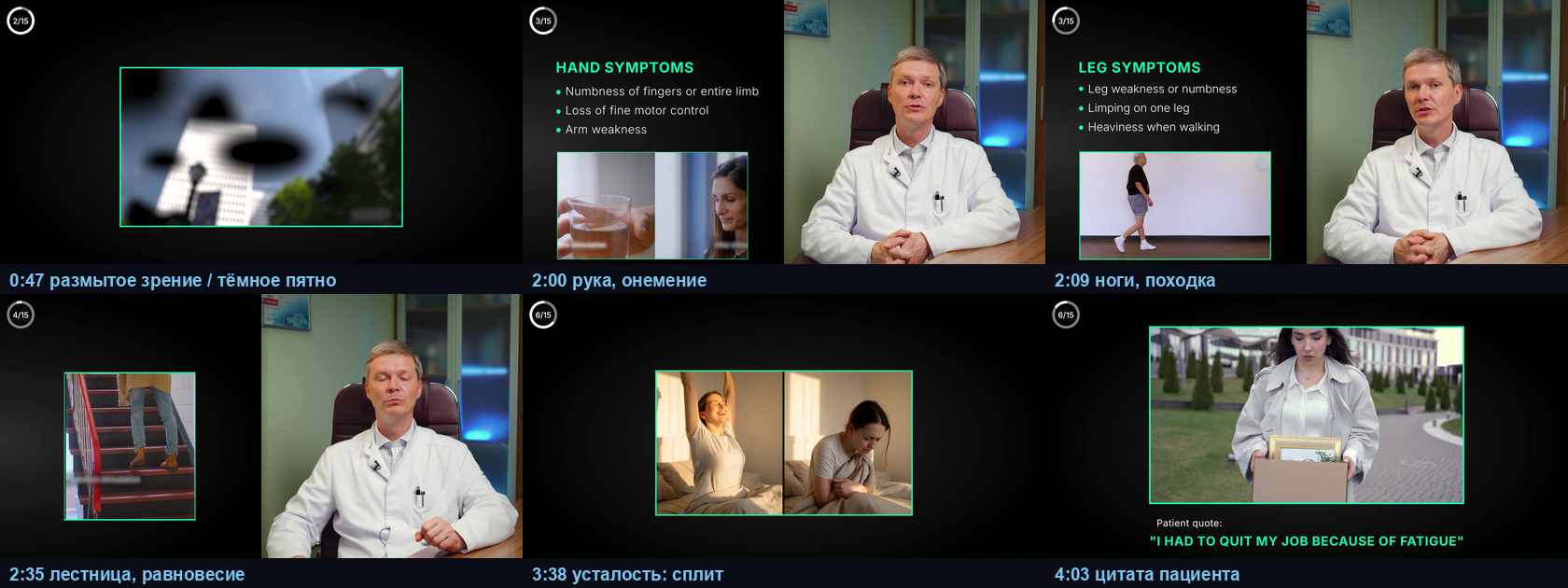
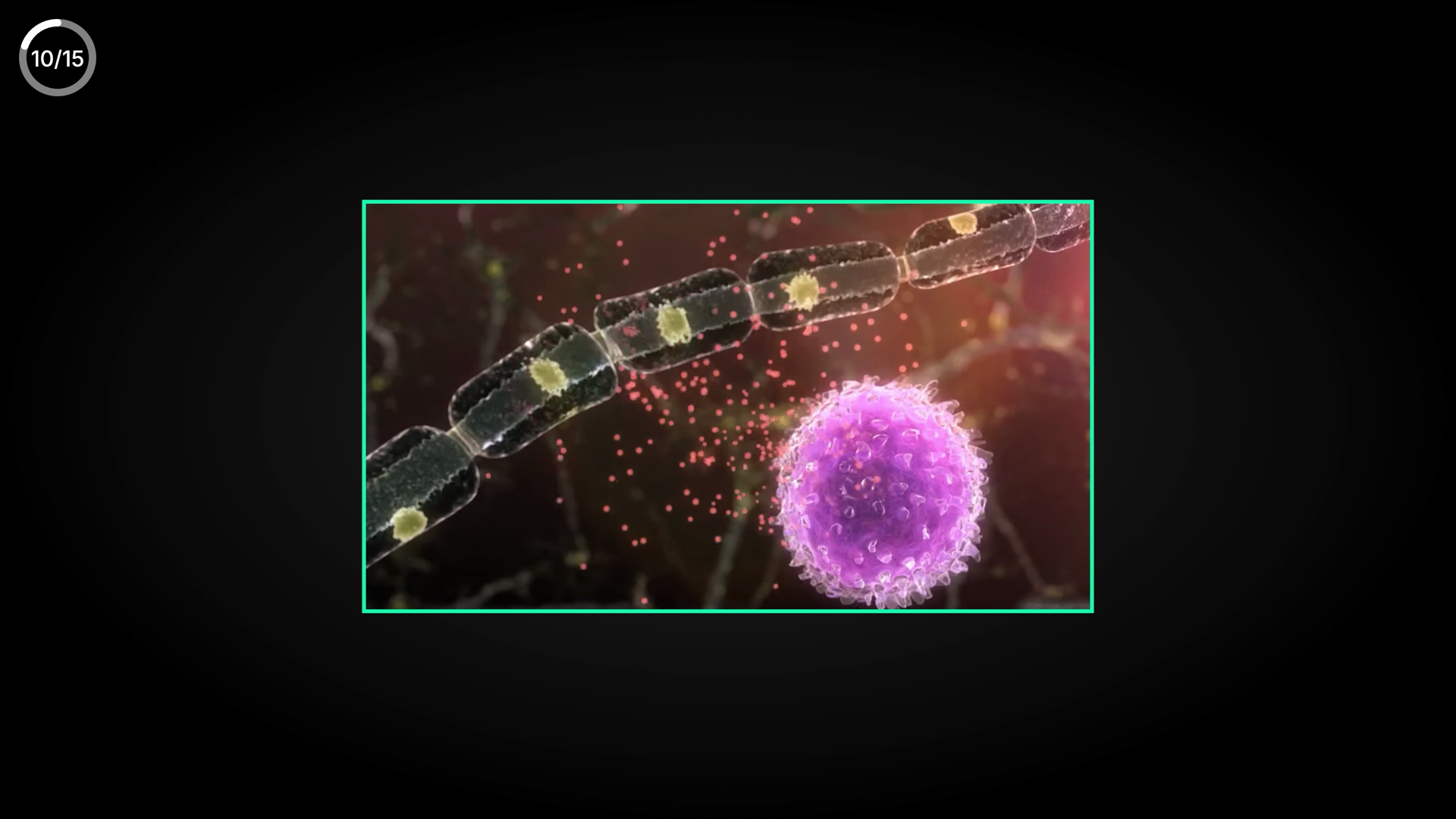
- Что должно получиться. Врач остаётся основой — он никуда не уходит. Между его планами подкладываем короткие врезки, чтобы за первые секунды считывалось: это видео про рассеянный склероз и про то, как он проявляется.
- Раскладка по вопросам (врезки в той же мятной рамке и том же PiP-формате, что дальше по ролику; врач в кадре между ними):
вопрос 1 · «What are the typical MS symptoms?»→ врезка 0:47: размытая улица с тёмным пятном в поле зрениявопрос 2 · «What does a relapse look like?»→ врезка 2:09: походка, прихрамывание · и 3:38: усталость, сплит «как должен просыпаться / как просыпается»вопрос 3 · «Is MY symptom related to MS?»→ врезка 6:51: иммунная клетка атакует миелин — тот самый кадр, что прислал Роман. Даёт ответ «а вот что за этим стоит» и сразу задаёт медицинский масштаб.- Хронометраж врезок — по 1.5–2 с, чтобы не растянуть интро. Общая длина блока не меняется.
Все четыре кадра уже в проекте — задача чисто монтажная, новых ассетов не требуется. Клеточная анимация с 6:51 идёт в начало (на 7:11 её добавлять не нужно).
⚙️ Общие правки — не привязаны к таймкоду
#3⚠🔴 ИсправитьДисклеймер — обязателен, текст готов
✏️ Что сделать
- Что сейчас. Посекундная проверка всех 597 секунд: дисклеймера в ролике нет нигде. В плане экранов (глава №01) он был обязательным пунктом.
- Зачем. Канал англоязычный и медицинский. Дисклеймер снимает риск претензий регулятора к медицинскому контенту и входит в требования к статусу health-source на health.youtube, к которому канал идёт.
- Где ставить. Полнокадровая карточка сразу после интро-блока с вопросами — на новом монтаже это 0:12–0:17, держать 5 секунд. Оформление — как титры глав: чёрный фон, белый текст, мятный #21FFB6 акцент на заголовке. Озвучки нет, карточка молчаливая.
- Ниже — готовый текст. Первый блок идёт на экран, второй Роман кладёт в описание ролика на YouTube.
📺 Текст НА ЭКРАН — карточка 5 секунд
Три строки. Первая — мятным капсом, остальные белым. Кегль подобрать так, чтобы третья строка не переносилась больше чем на две строки.
MEDICAL DISCLAIMER

This video is for general education only. It is not medical advice.

Always consult a qualified neurologist about your own symptoms,
diagnosis and treatment.
📄 Полный текст — в ОПИСАНИЕ ролика на YouTube
Ставить первым блоком описания, до ссылок. Английский — канал англоязычный.
⚠️ MEDICAL DISCLAIMER

The information in this video is provided for general educational purposes only and reflects the clinical experience of the presenting physician. It is not medical advice, and watching this video does not create a doctor–patient relationship.

This video cannot replace an in-person consultation, physical examination, MRI or laboratory testing. Multiple sclerosis is diagnosed and treated only by a qualified neurologist, on the basis of an individual assessment.

Never start, stop or change any medication — including corticosteroids and disease-modifying therapies (DMTs) — on the basis of this video.

If you develop new neurological symptoms, contact a neurologist. If your symptoms are severe or rapidly worsening, seek emergency medical care immediately.

Presented by Dr. Sergey Petrov, MD, PhD — neurologist, Chief Physician of the Moscow Multiple Sclerosis Center (stopsclerosis.ru).
Без этой карточки ролик лучше не выпускать — это единственный пункт ТЗ, который блокирует публикацию.
🕐 По таймкоду — все экраны в хронологическом порядке
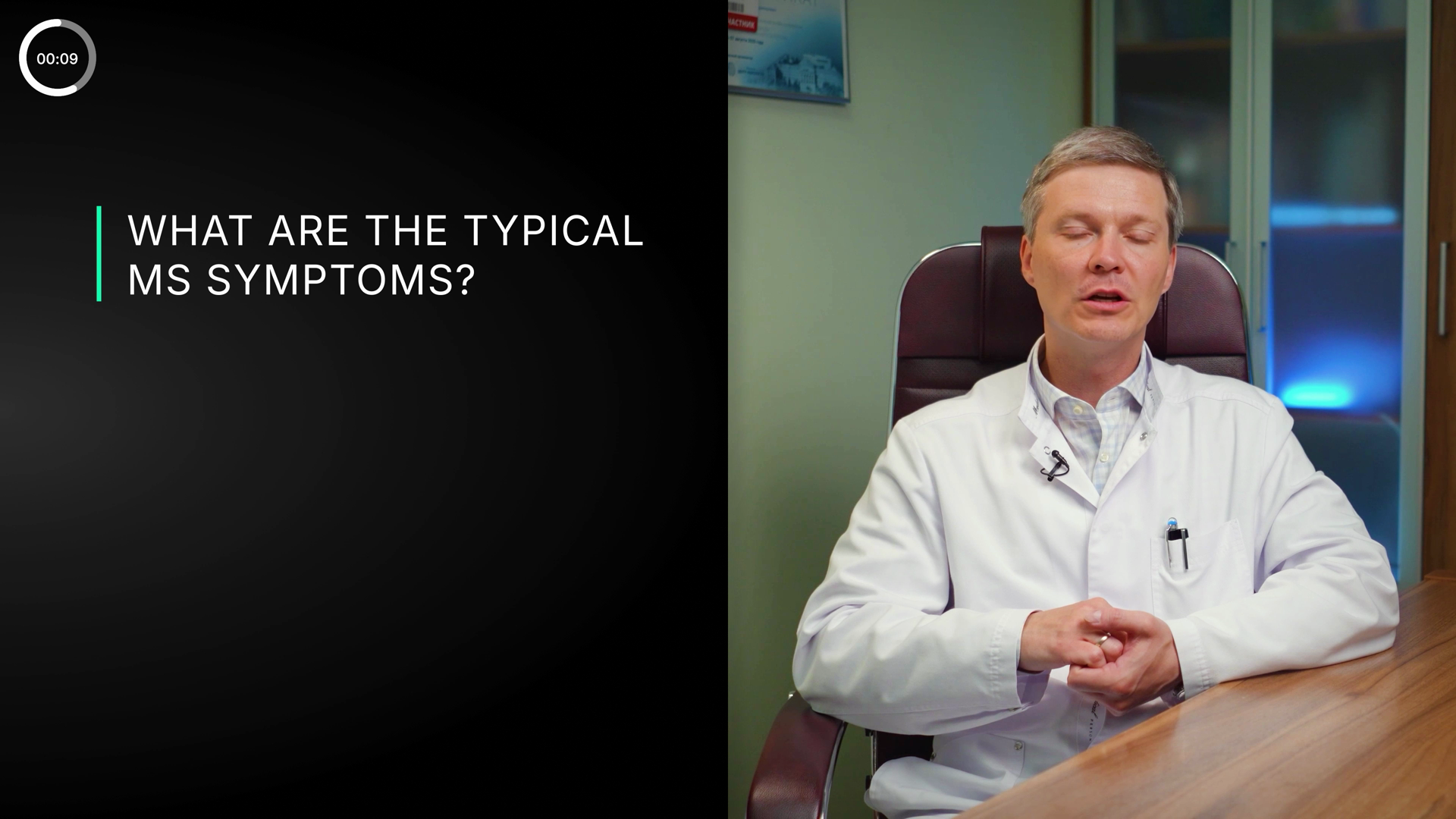
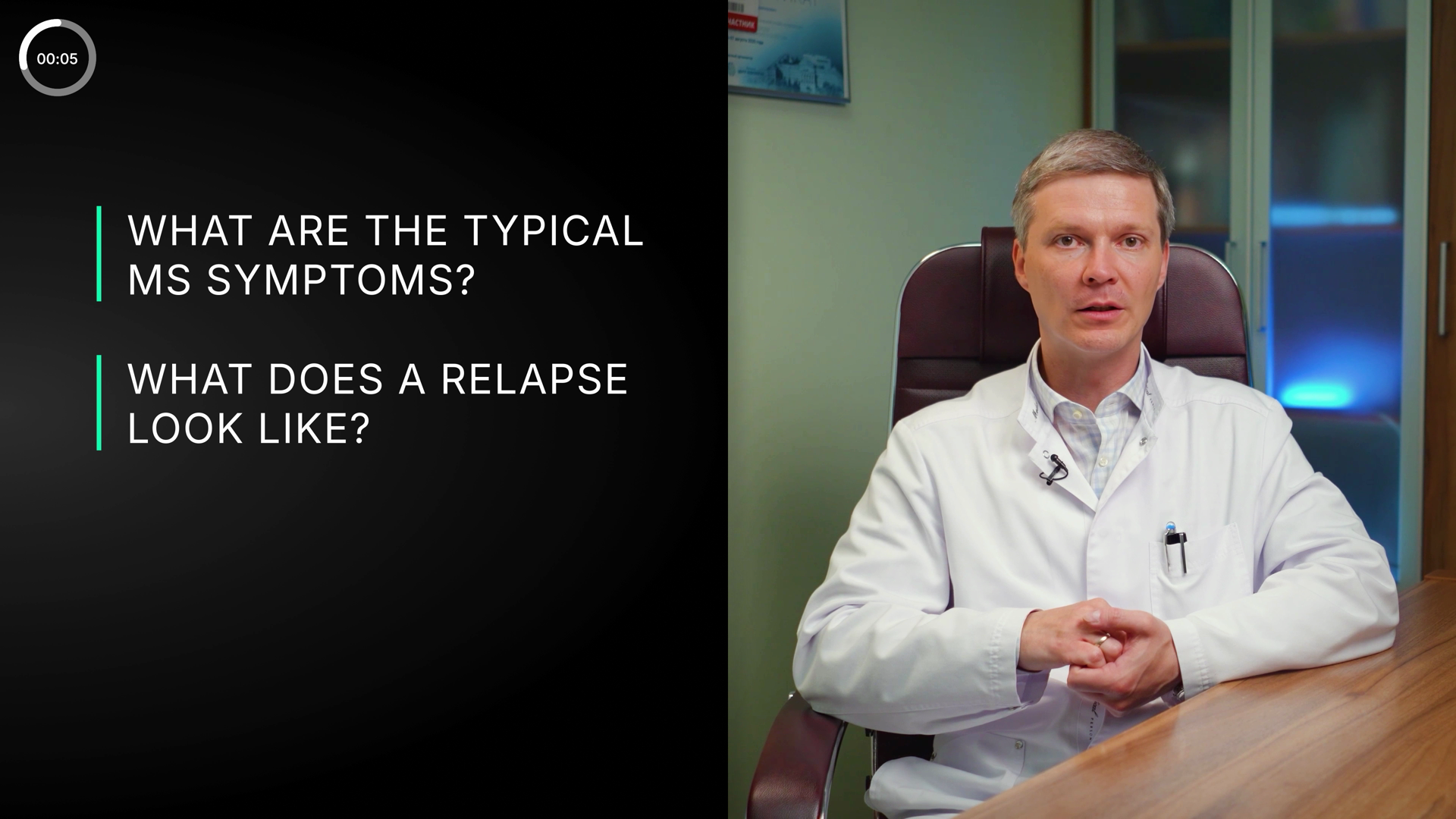
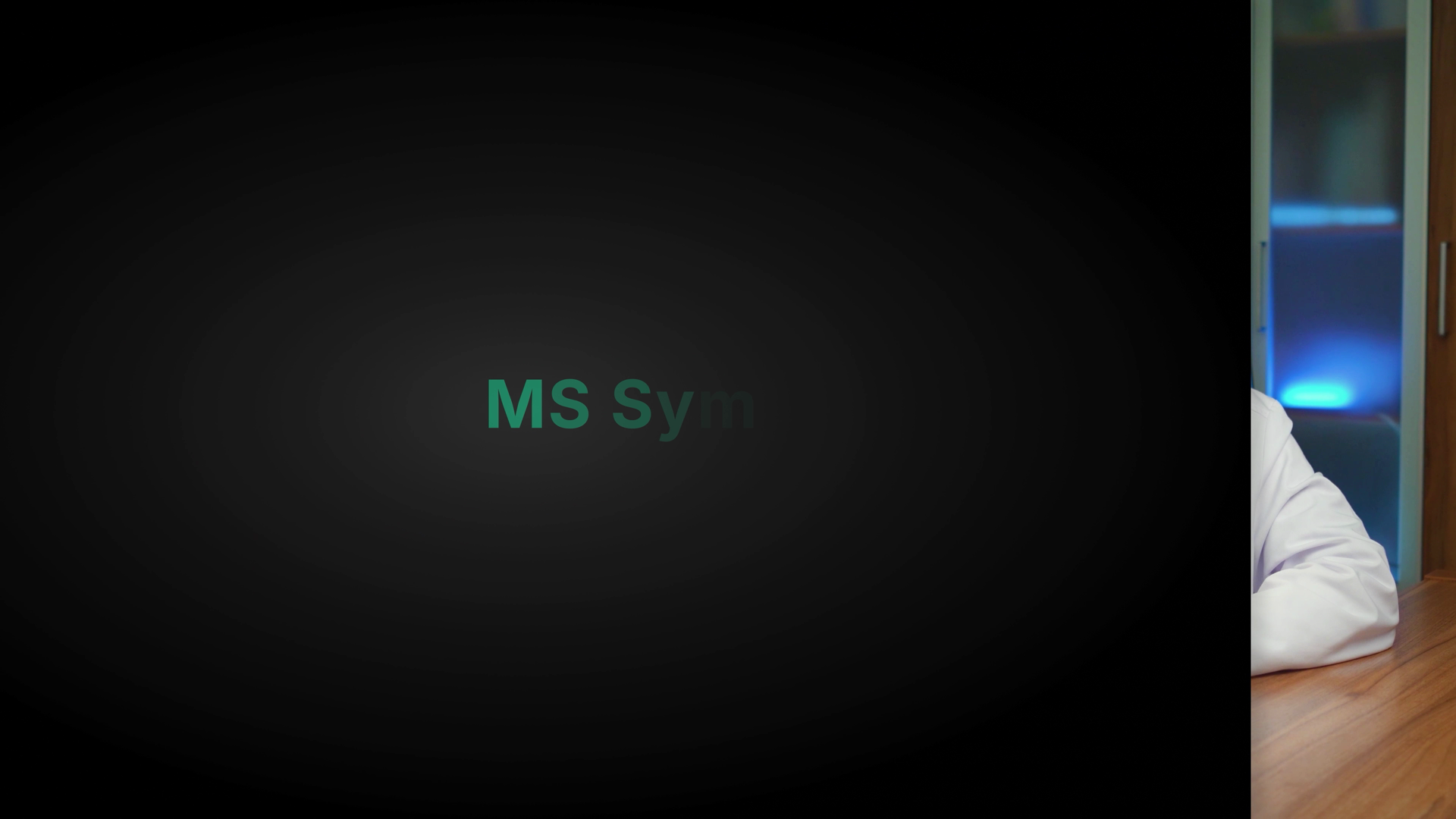
🖼🟢 ОкТри вопроса-интро + плашка главы00:09 (на 0:06) / 00:05 (на 0:10) — это обратный отсчёт 00:15→00:00, а не «N/15»; на плашке главы 0:15–0:17 счётчика нет вовсе
📺 На экране
00:13 | WHAT ARE THE TYPICAL MS SYMPTOMS? | WHAT DOES A RELAPSE LOOK LIKE? | IS MY SYMPTOM RELATED TO MS? | MS Symptoms
🟢 Правок нет — экран чистый.
подробнее: речь + разбор по пунктам
💬 Что говорит врач в этот момент“What are the most characteristic manifestations of multiple sclerosis? How does a relapse present? I have this symptom. Is it related to multiple sclerosis or not? In Greek, manifestation means symptom. That's why we always say a symptom of”
📺 Весь текст экрана00:13 | WHAT ARE THE TYPICAL MS SYMPTOMS? | WHAT DOES A RELAPSE LOOK LIKE? | IS MY SYMPTOM RELATED TO MS? | MS Symptoms
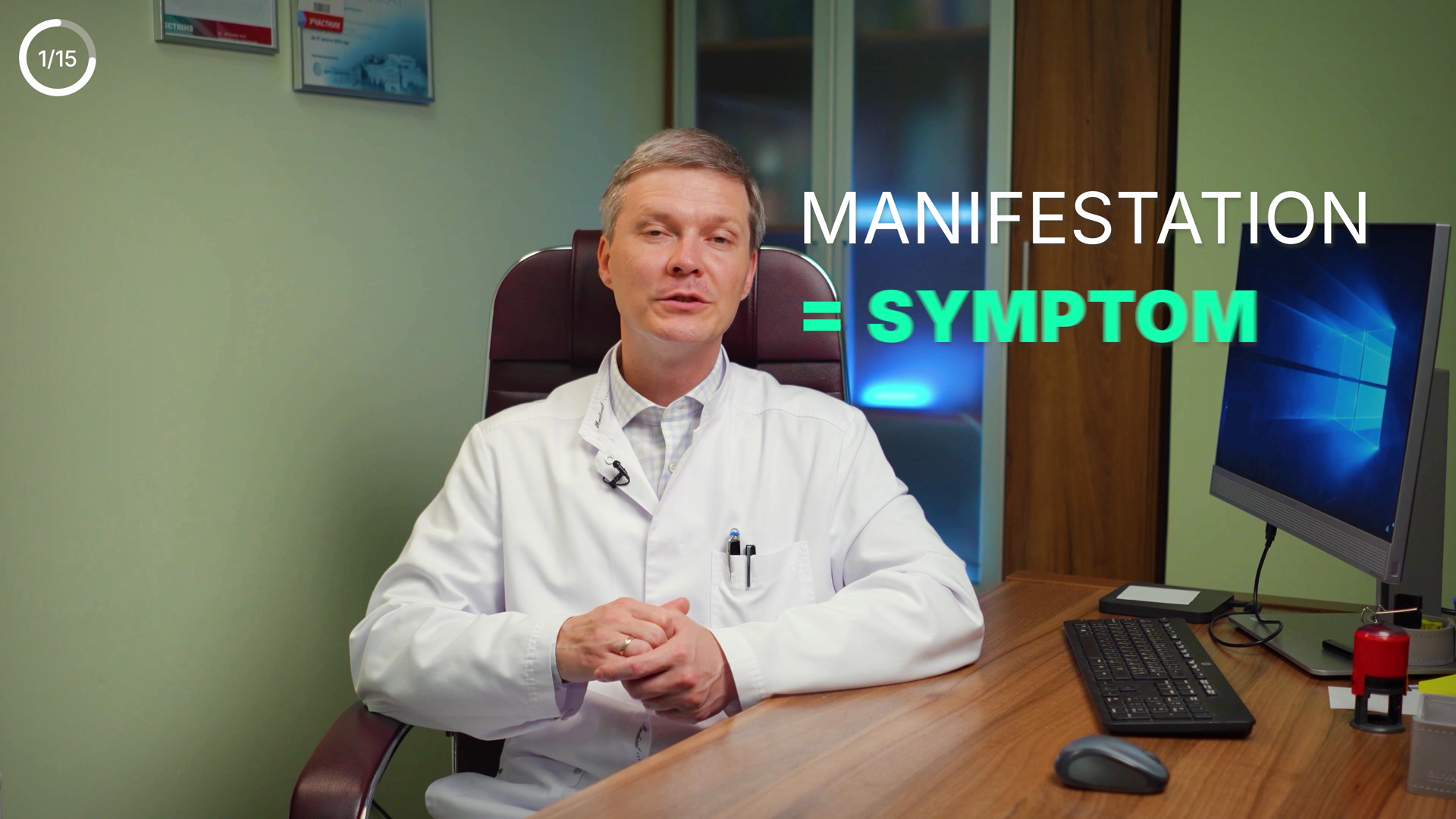
🖼🟢 ОкКарточка-определение «Manifestation = Symptom»1/15
📺 На экране
1/15 | MANIFESTATION | = SYMPTOM
🟢 Правок нет — экран чистый.
подробнее: речь + разбор по пунктам
💬 Что говорит врач в этот момент“In Greek, manifestation means symptom. That's why we always say a symptom of multiple sclerosis. We have symptoms that are characteristic of MS,”
📺 Весь текст экрана1/15 | MANIFESTATION | = SYMPTOM
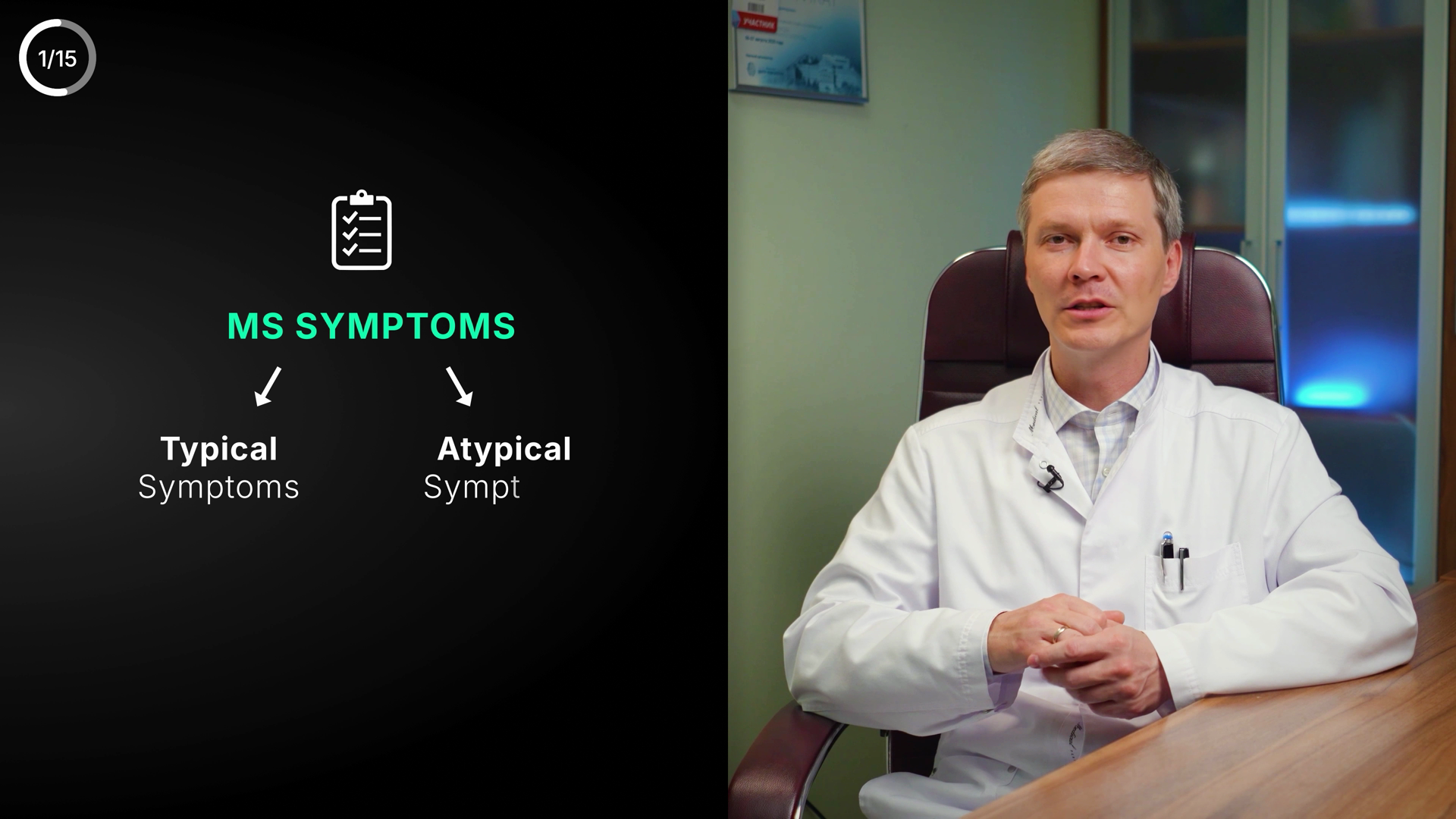
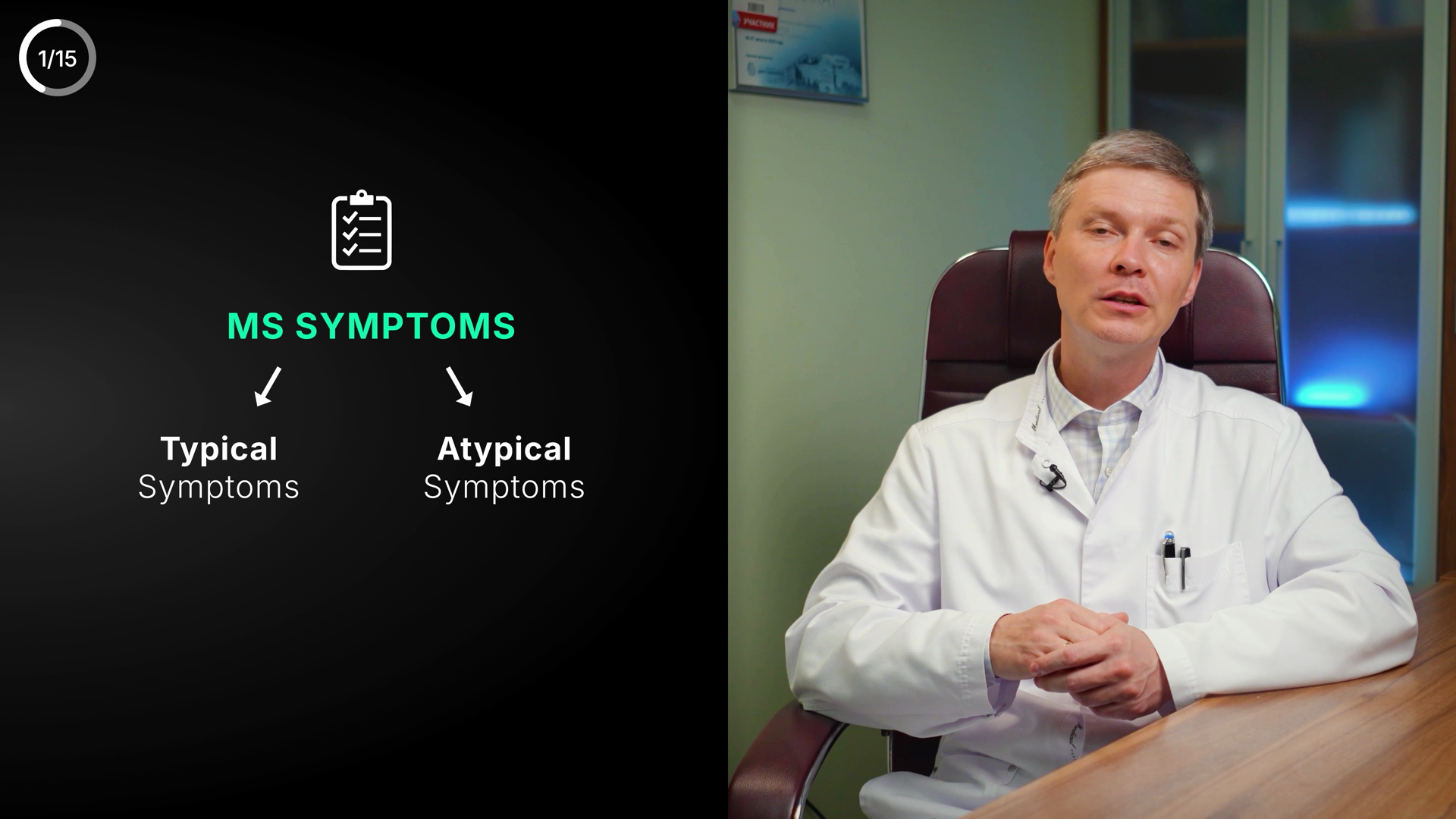
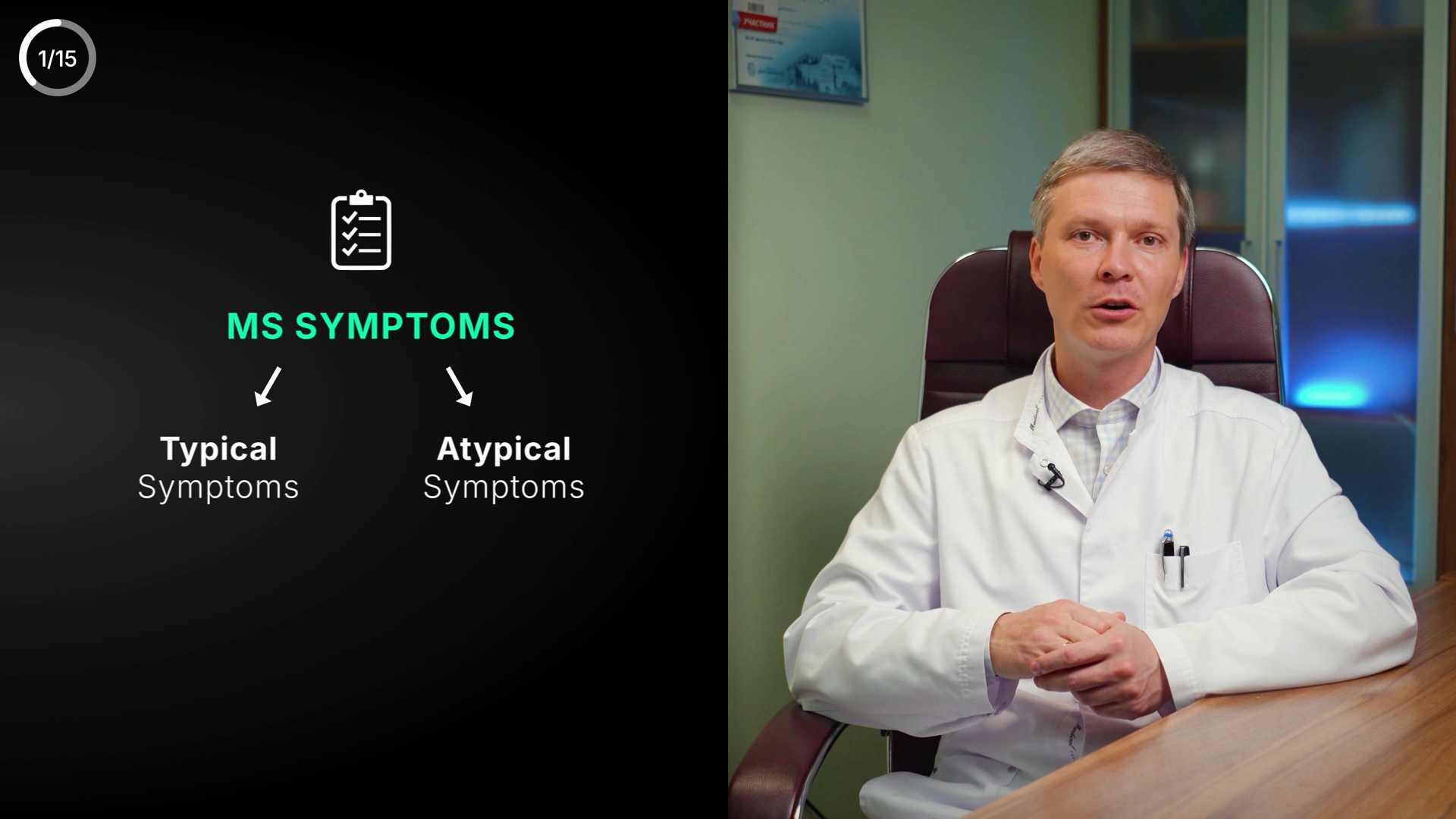
🖼🟢 ОкСхема: типичные и нетипичные симптомы1/15
📺 На экране
1/15 | MS SYMPTOMS | Typical Symptoms | Atypical Symptoms
🟢 Правок нет — экран чистый.
подробнее: речь + разбор по пунктам
💬 Что говорит врач в этот момент“multiple sclerosis. We have symptoms that are characteristic of MS, and there are symptoms that aren't typical initially. When a characteristic symptom appears, we immediately think,”
📺 Весь текст экрана1/15 | MS SYMPTOMS | Typical Symptoms | Atypical Symptoms
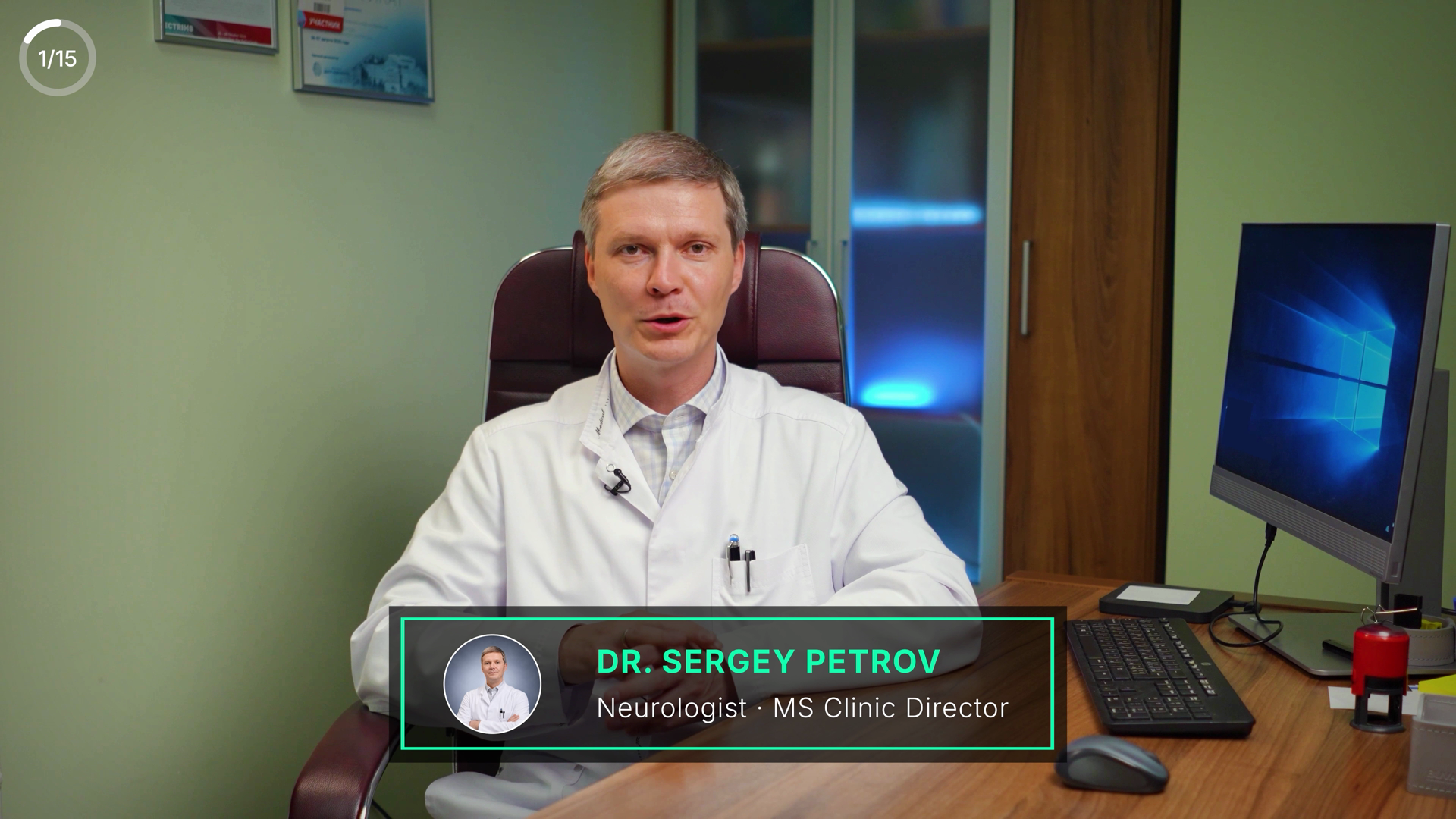
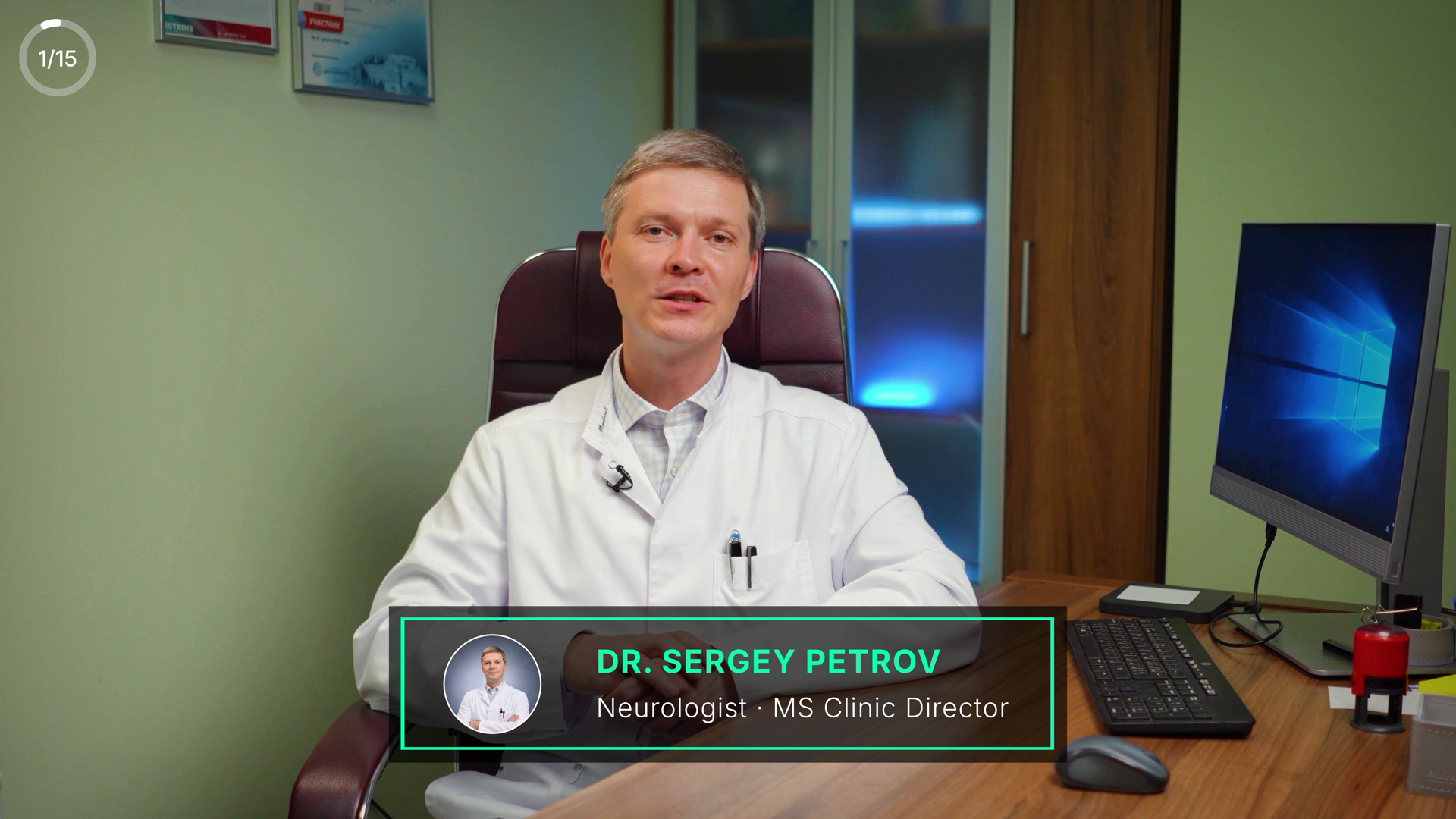
🖼🟢 ОкПлашка врача (lower third)1/15
📺 На экране
DR. SERGEY PETROV | Neurologist · MS Clinic Director
🟢 Правок нет — экран чистый.
подробнее: речь + разбор по пунктам
💬 Что говорит врач в этот момент“When a characteristic symptom appears, we immediately think, could this person have MS? So what's typical for MS? First is decreased vision in one eye.”
📺 Весь текст экранаDR. SERGEY PETROV | Neurologist · MS Clinic Director
🖼🟢 ОкТитр главы «Симптом №1»
📺 На экране
SYMPTOM #1: VISION PROBLEMS
🟢 Правок нет — экран чистый.
подробнее: речь + разбор по пунктам
💬 Что говорит врач в этот момент“First is decreased vision in one eye. This vision loss can present in completely different ways.”
📺 Весь текст экранаSYMPTOM #1: VISION PROBLEMS
🖼🟢 ОкB-roll: имитация нарушения зрения2/15
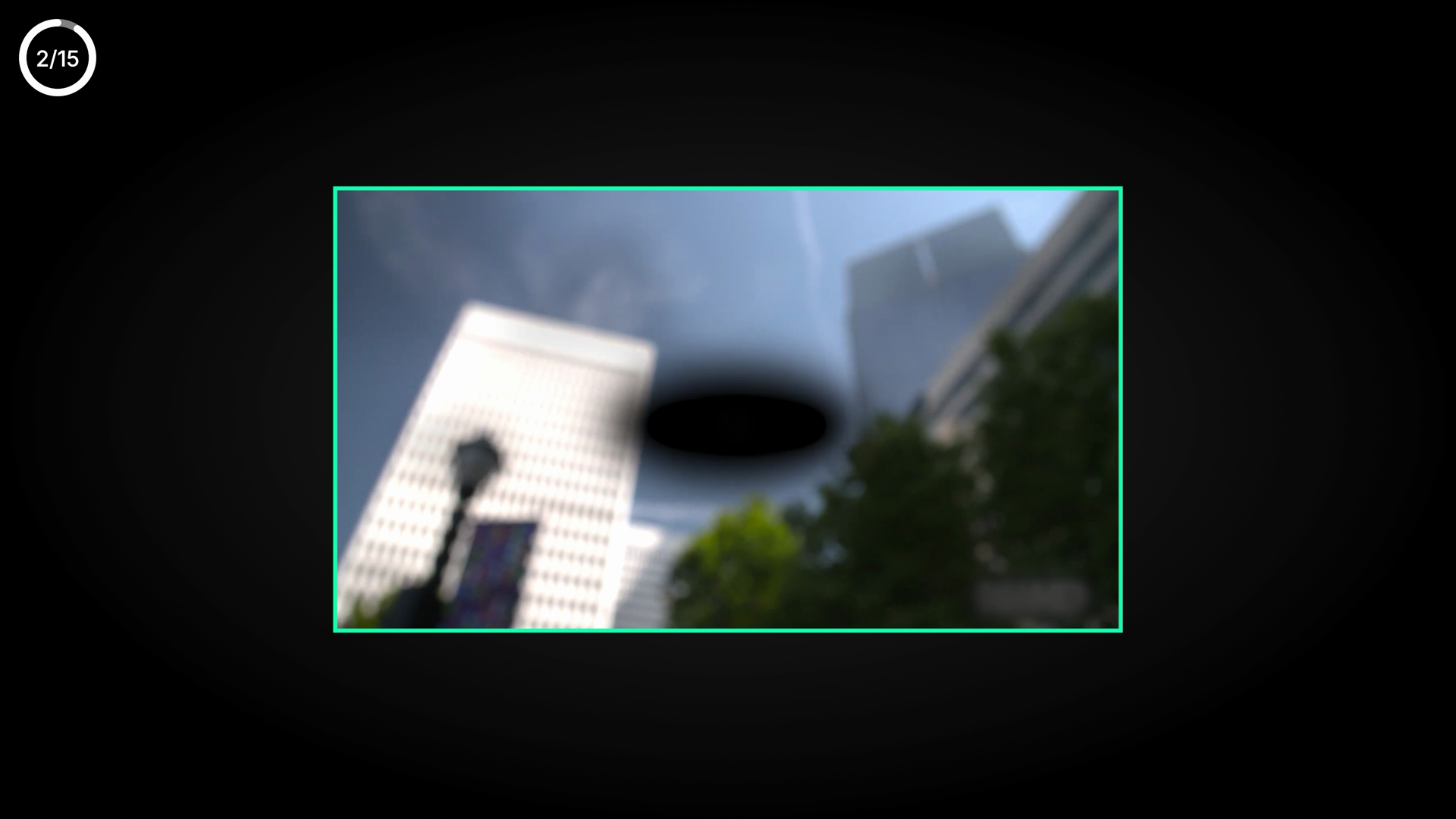
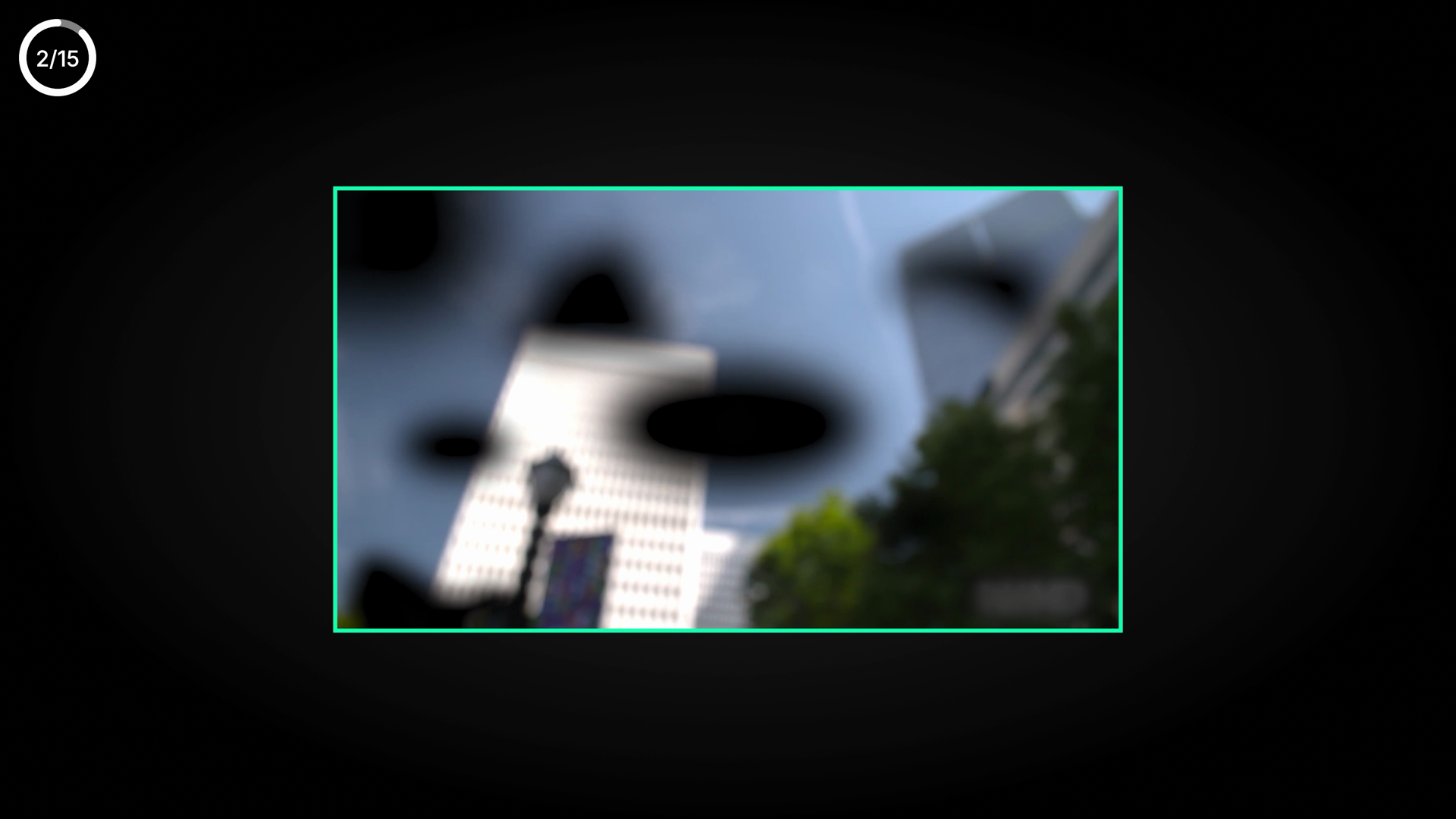

🟢 Правок нет — экран чистый.
подробнее: речь + разбор по пунктам
💬 Что говорит врач в этот момент“For example, a dark spot may appear in your visual field, in the center or off to the side. The eye might feel like it's covered by a curtain or gray film,”
🖼🟢 ОкСписок симптомов зрения (Decreased vision)2/15
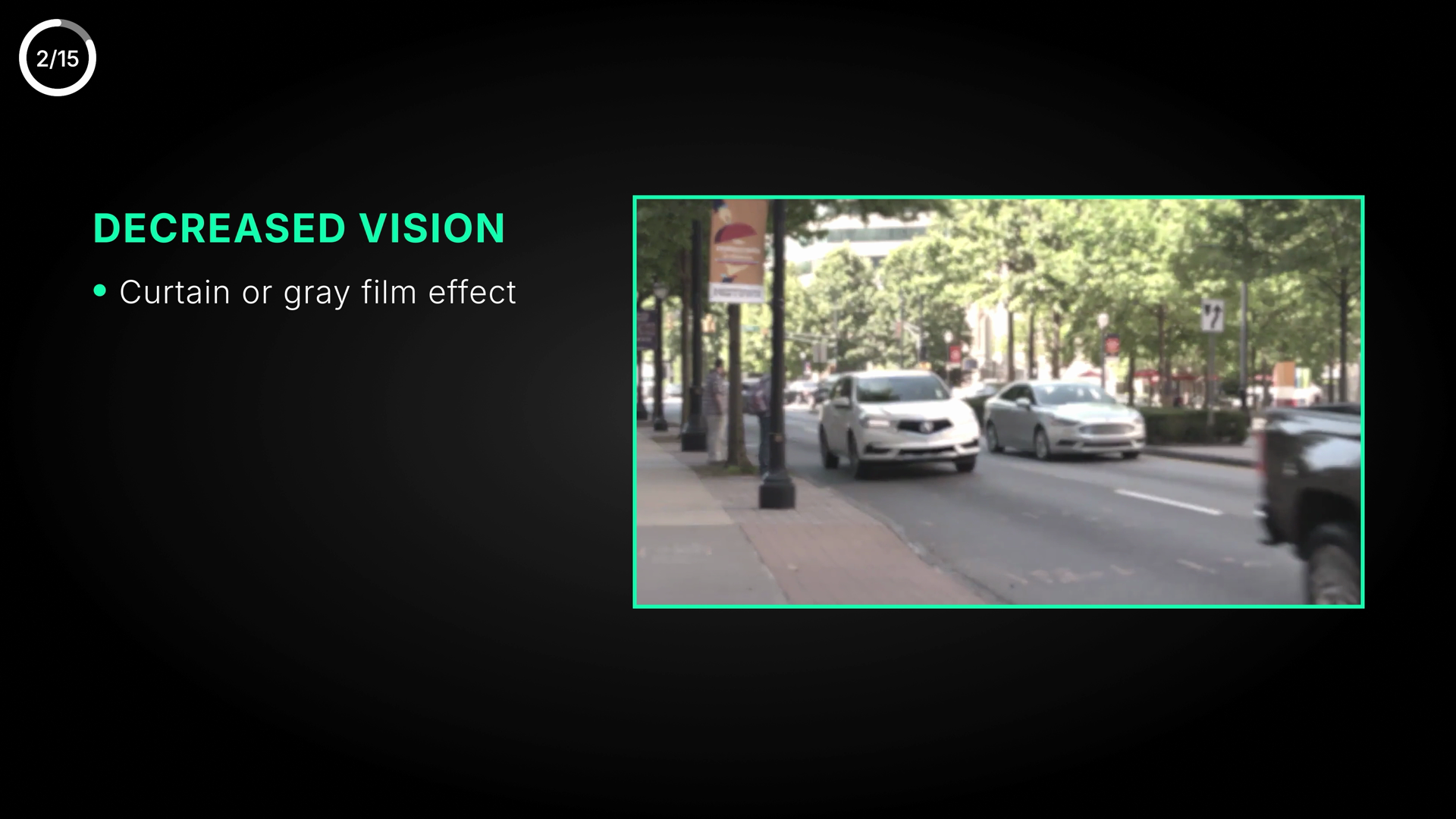
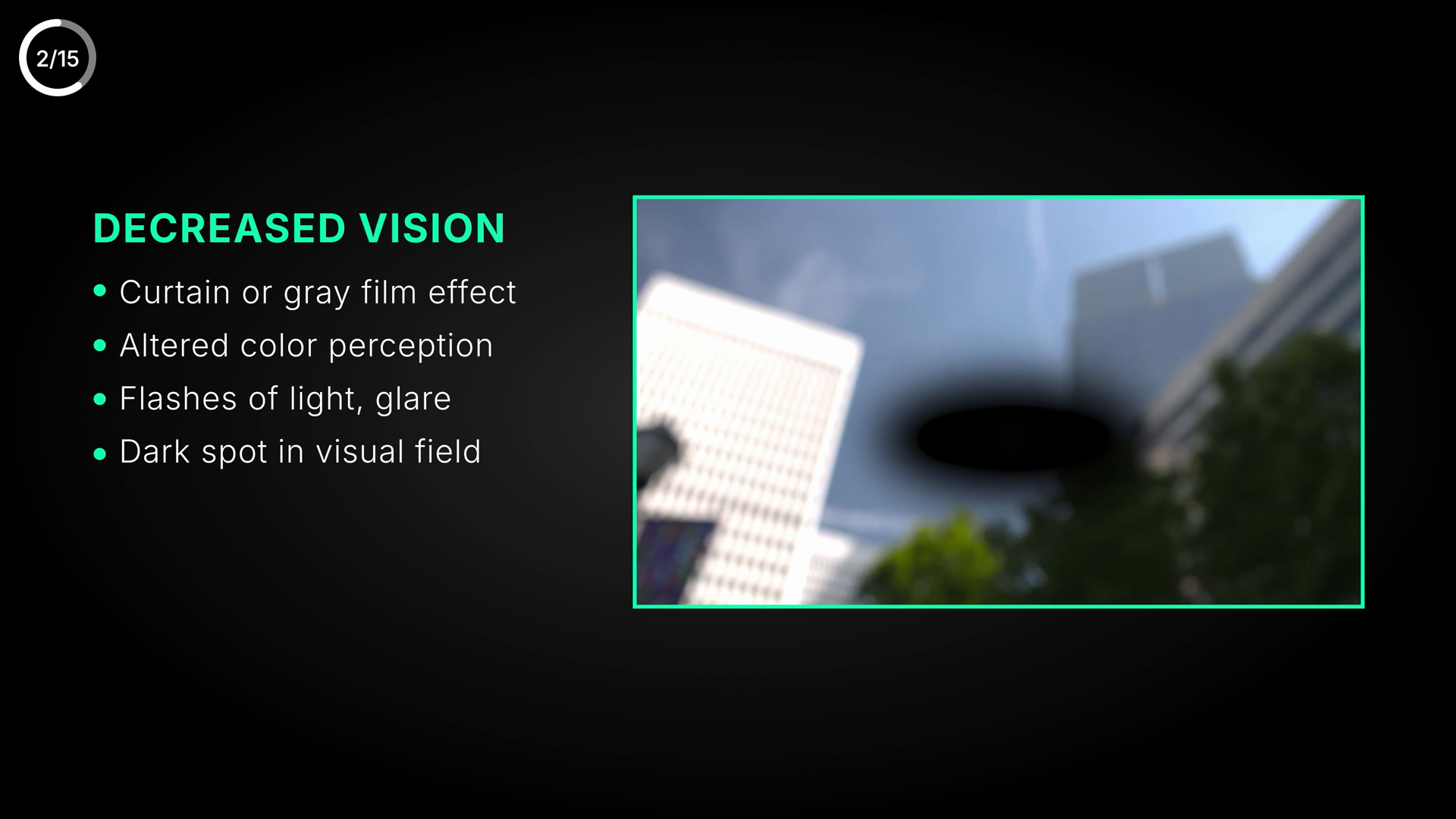
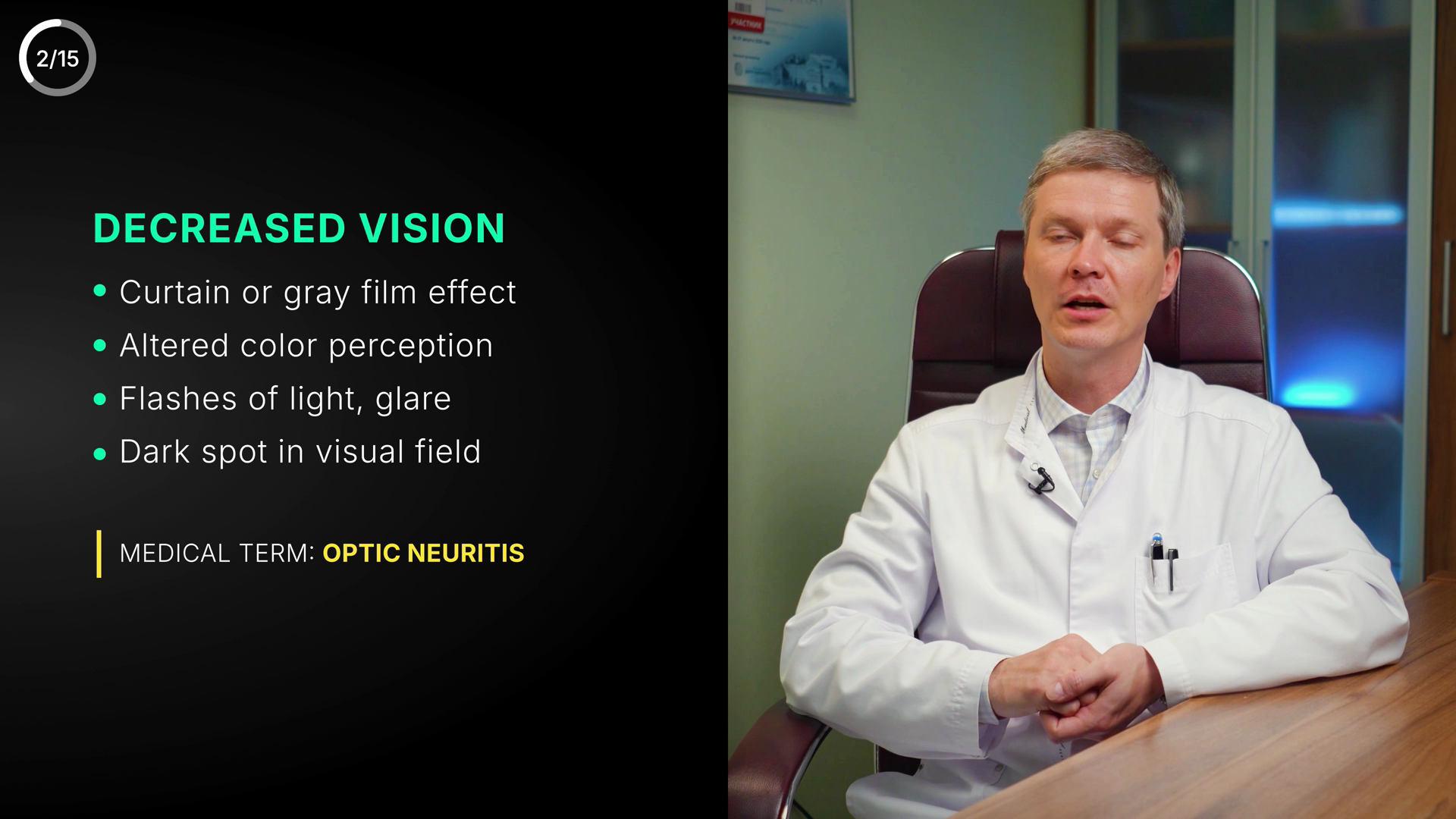
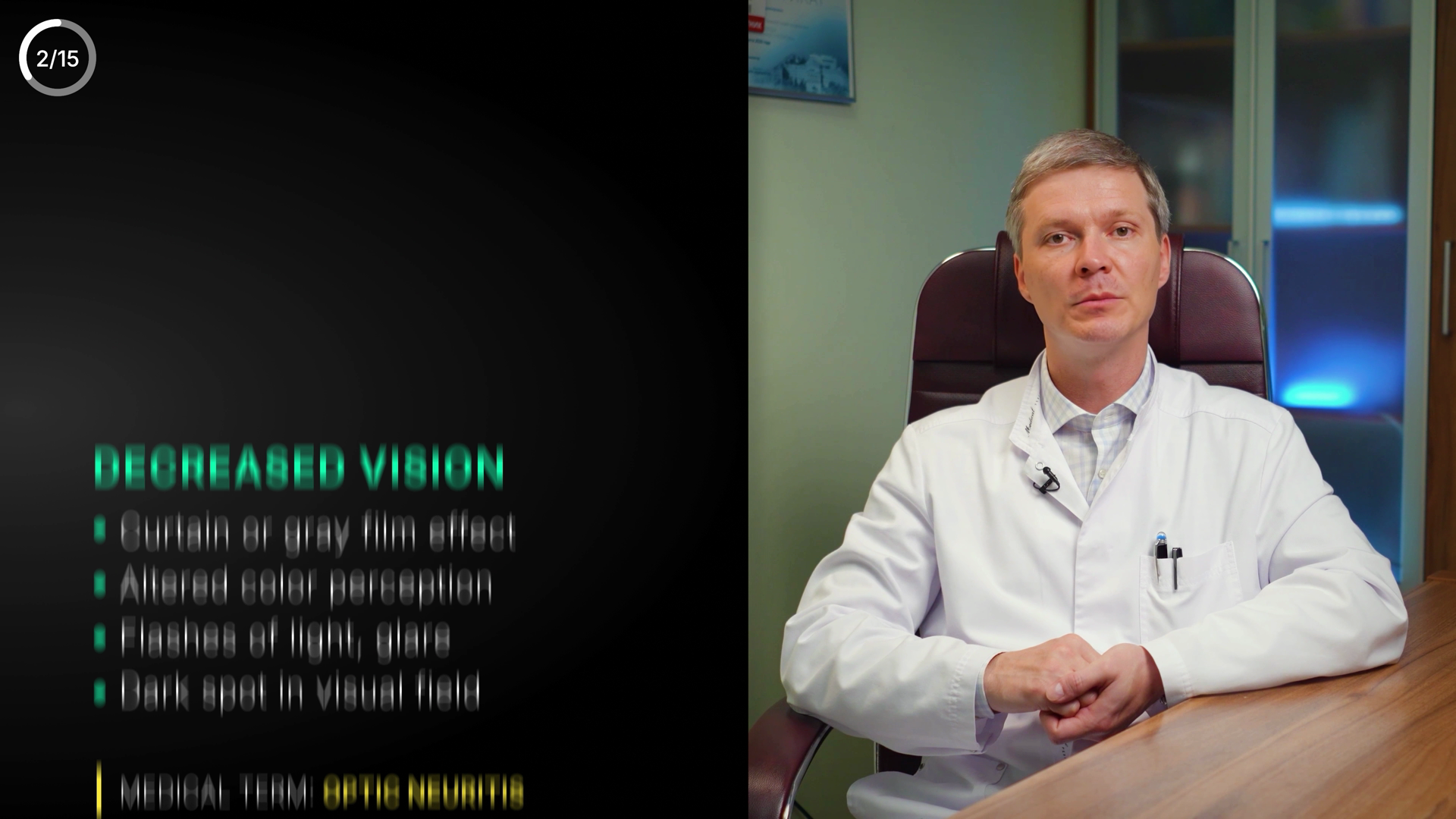
📺 На экране
DECREASED VISION | Curtain or gray film effect | Altered color perception | Flashes of light, glare | Dark spot in visual field | MEDICAL TERM: OPTIC NEURITIS
🟢 Правок нет — экран чистый.
подробнее: речь + разбор по пунктам
💬 Что говорит врач в этот момент“The eye might feel like it's covered by a curtain or gray film, and one eye will have decreased perception. And the image you perceive when looking at your environment may show altered color perception flashes of light or overlapping glare these are the kinds of symptoms we see but most often it's decreased vision like a curtain or dark spot in the visual field and importantly in just one eye this is a characteristic symptom that may indicate the onset of multiple sclerosis most often this is a manifestation of what we call optic neuritis The next characteristic symptom is double vision.”
📺 Весь текст экранаDECREASED VISION | Curtain or gray film effect | Altered color perception | Flashes of light, glare | Dark spot in visual field | MEDICAL TERM: OPTIC NEURITIS
🖼🟢 ОкДвоение (Double vision) — сравнение зрения2/15
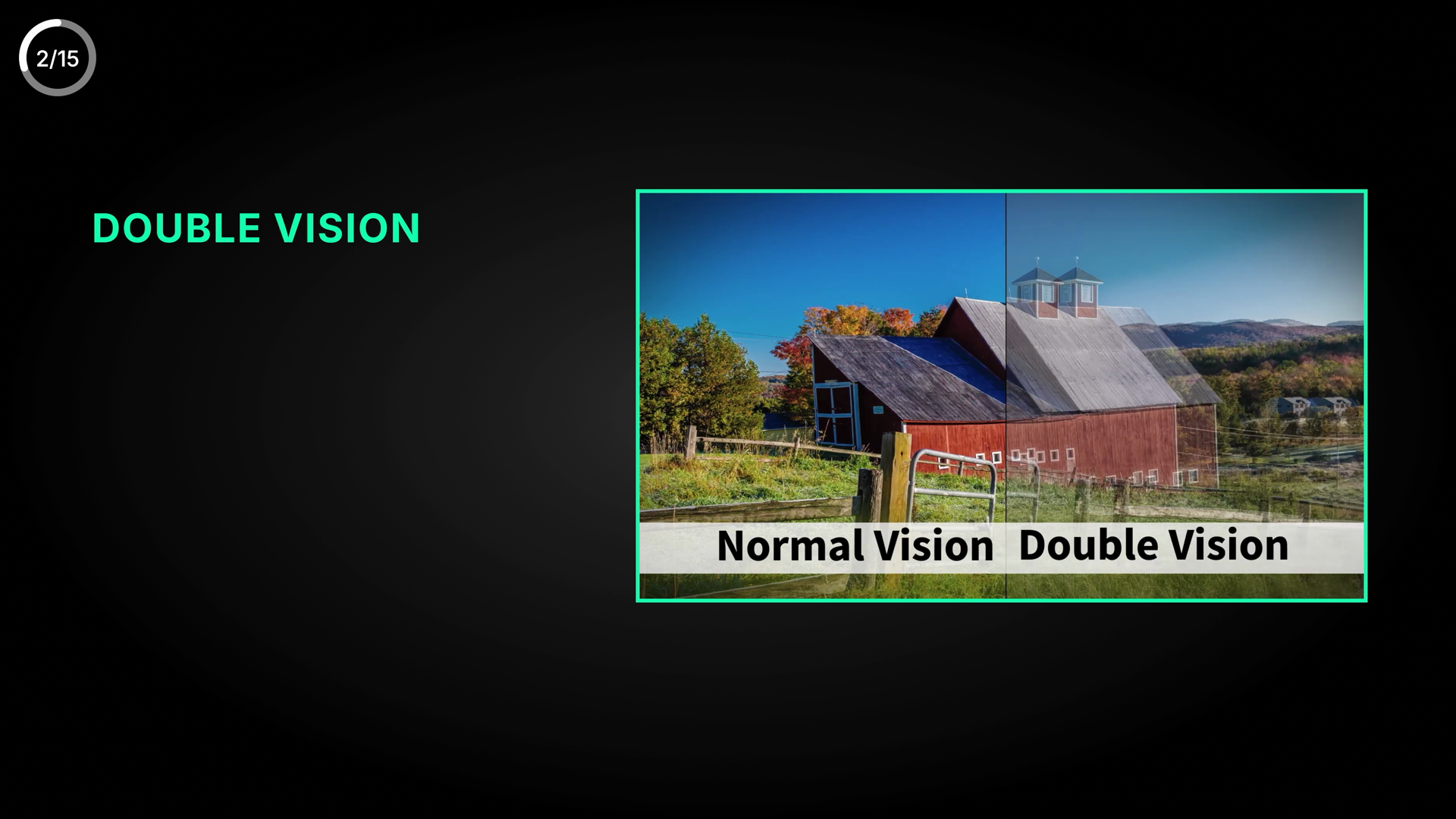
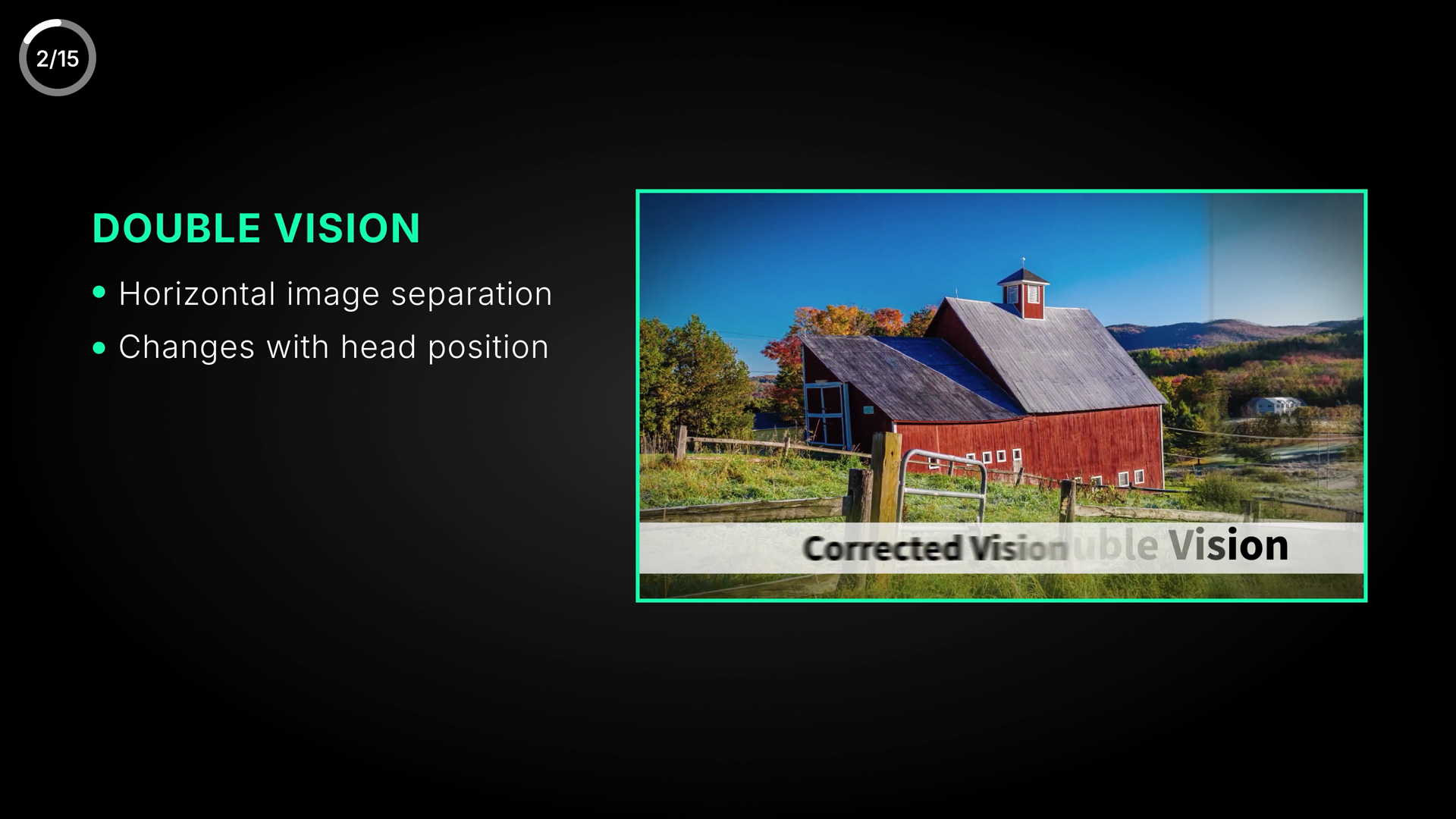
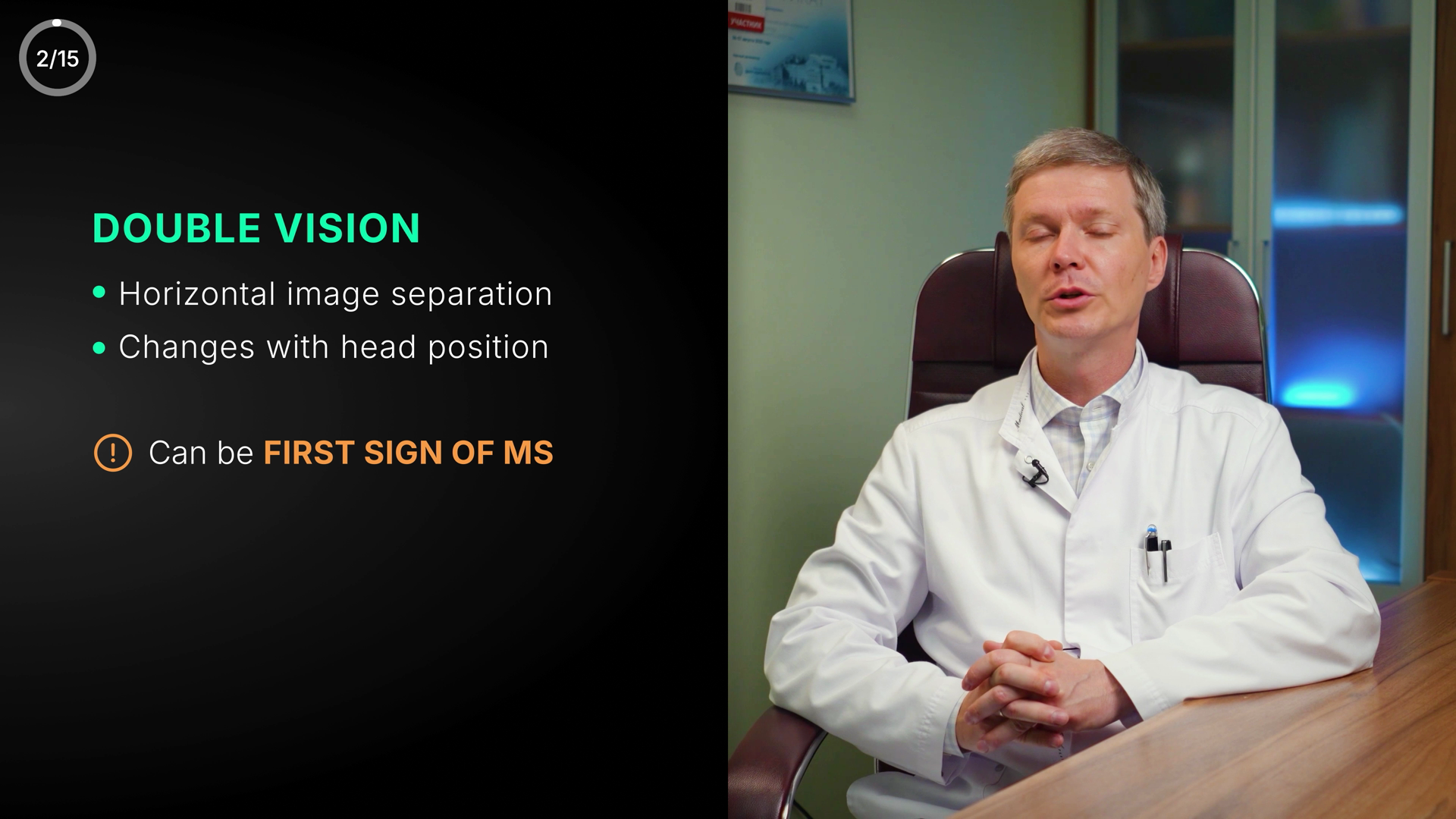
📺 На экране
DOUBLE VISION | Horizontal image separation | Changes with head position | Can be FIRST SIGN OF MS | [выжжено в самом клипе:] Normal Vision | Double Vision | Corrected Vision
🟢 Правок нет — экран чистый.
подробнее: речь + разбор по пунктам
💬 Что говорит врач в этот момент“For instance, out of nowhere you start seeing horizontal image separation, or as patients describe it, focusing problems. You look at an object and it keeps doubling. When you turn your head right or left, the doubling goes away, but when you turn the other way, it gets worse. This type of double vision can quite often be be the first sign of multiple sclerosis. Numbness in an arm or leg, fingers or the entire limb,”
📺 Весь текст экранаDOUBLE VISION | Horizontal image separation | Changes with head position | Can be FIRST SIGN OF MS | [выжжено в самом клипе:] Normal Vision | Double Vision | Corrected Vision
🖼🟢 ОкТитр-разделитель «Симптом №2»

📺 На экране
SYMPTOM #2: NUMBNESS & WEAKNESS
🟢 Правок нет — экран чистый.
подробнее: речь + разбор по пунктам
💬 Что говорит врач в этот момент“sclerosis. Numbness in an arm or leg, fingers or the entire limb,”
📺 Весь текст экранаSYMPTOM #2: NUMBNESS & WEAKNESS
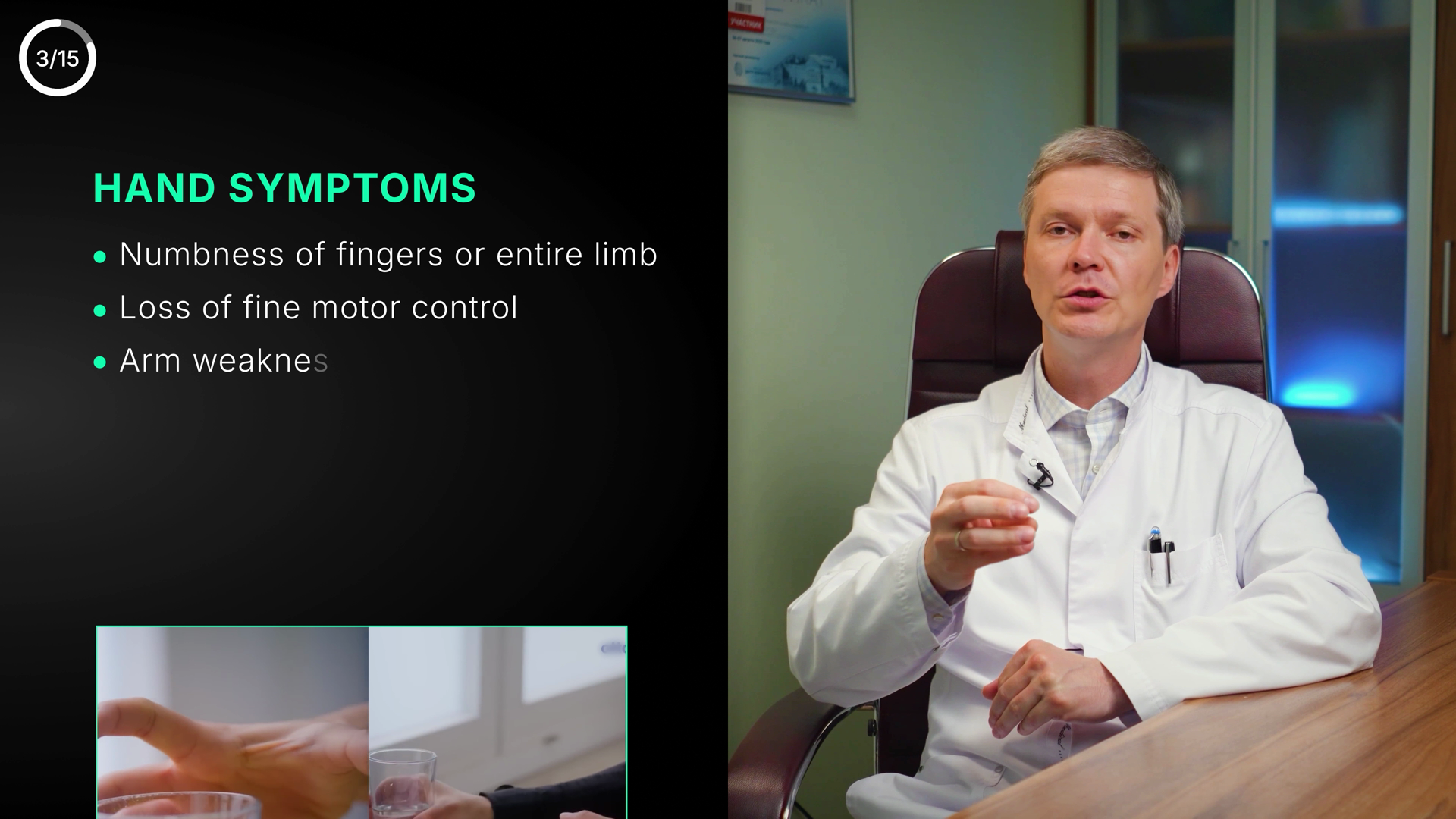
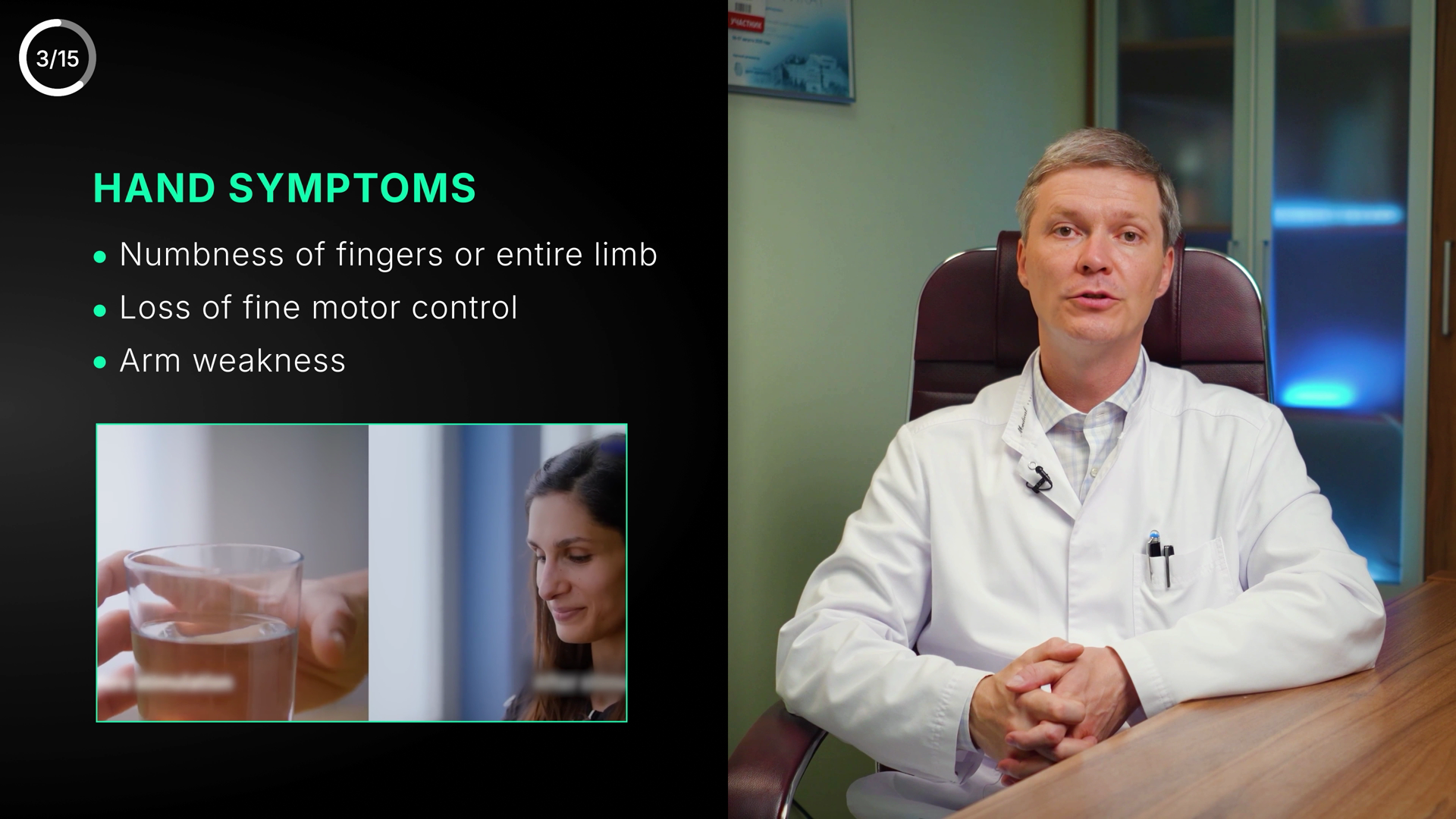
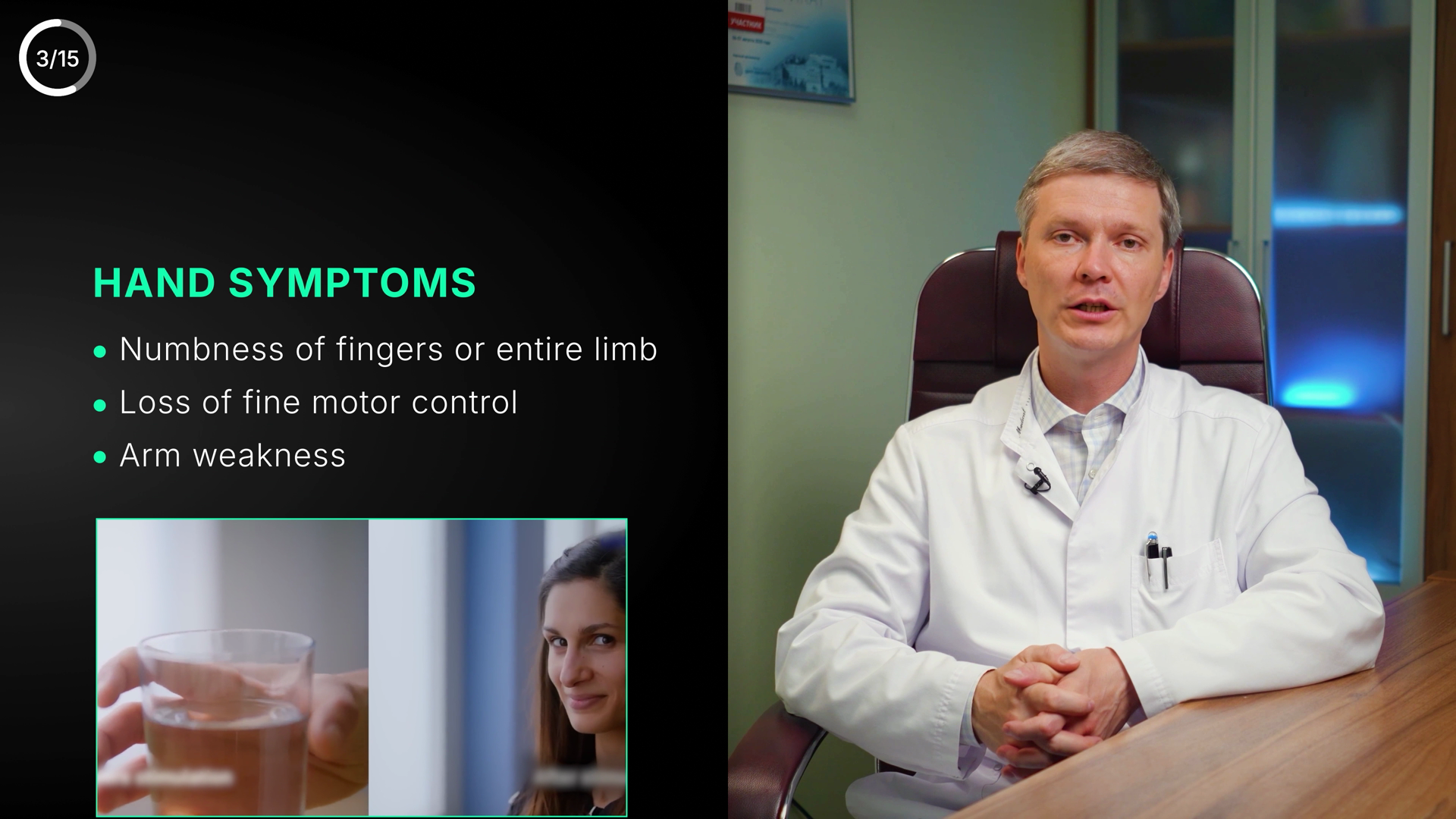
🖼🟢 ОкСписок симптомов рук (HAND SYMPTOMS) + вставка B-roll3/15
📺 На экране
3/15 | HAND SYMPTOMS | Numbness of fingers or entire limb | Loss of fine motor control | Arm weakness
🟢 Правок нет — экран чистый.
подробнее: речь + разбор по пунктам
💬 Что говорит врач в этот момент“clumsiness when performing movements. You used to perform fine motor movements quite well, but now there's some awkwardness. And of course, limb weakness. Often it's leg weakness or numbness that comes on suddenly.”
📺 Весь текст экрана3/15 | HAND SYMPTOMS | Numbness of fingers or entire limb | Loss of fine motor control | Arm weakness
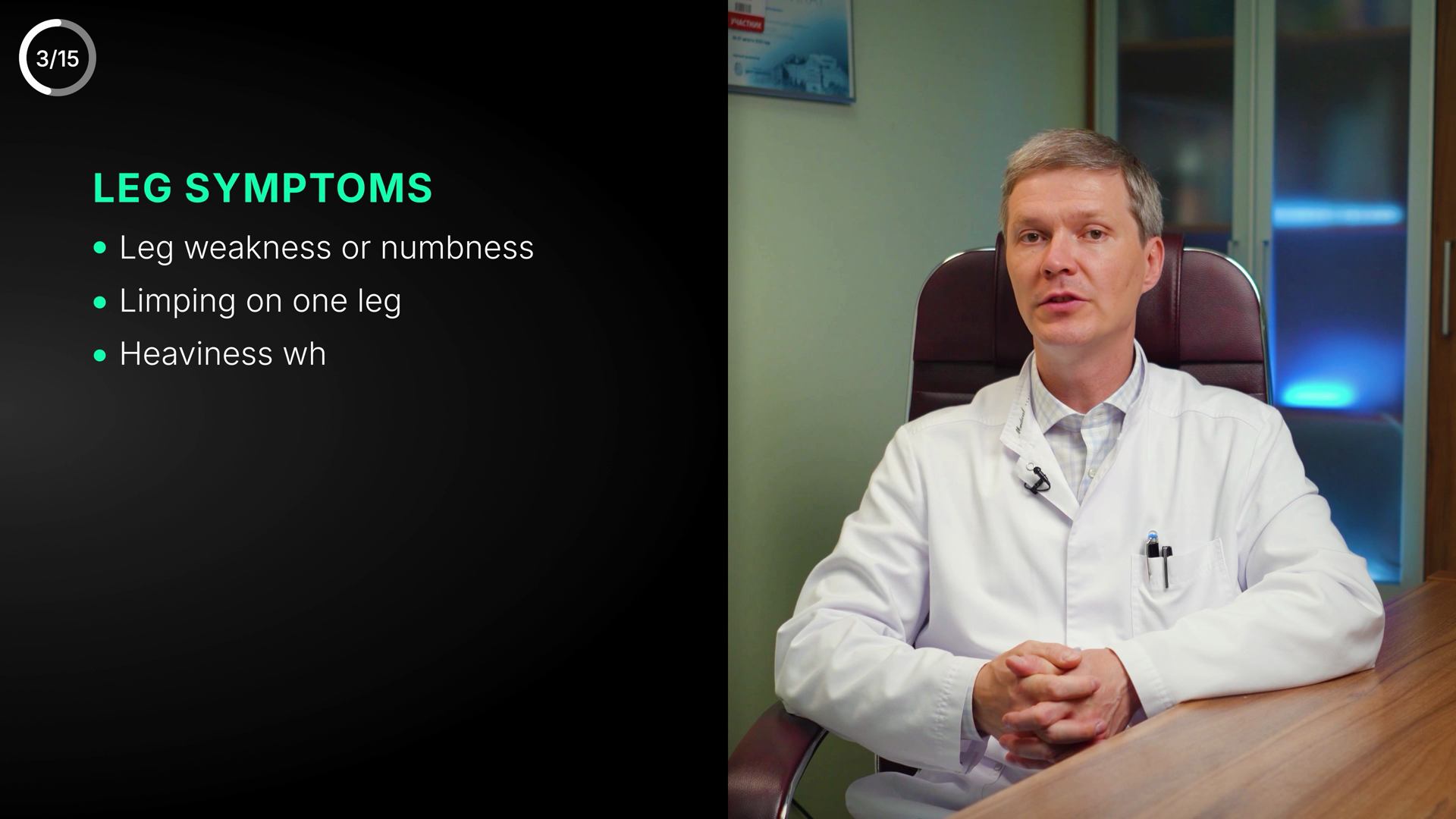
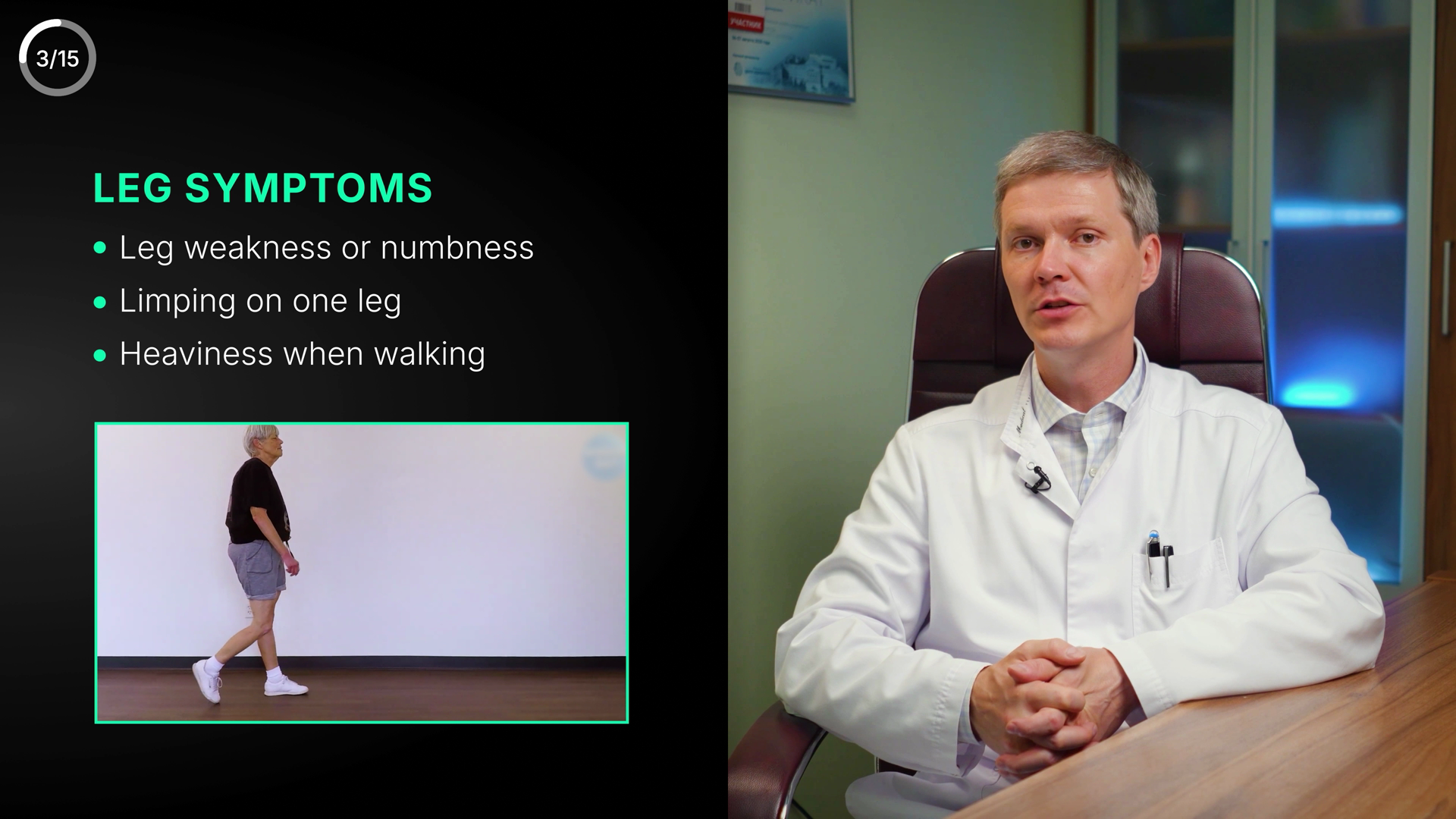
🖼🟢 ОкСписок симптомов ног (LEG SYMPTOMS) + вставка с ходьбой3/15
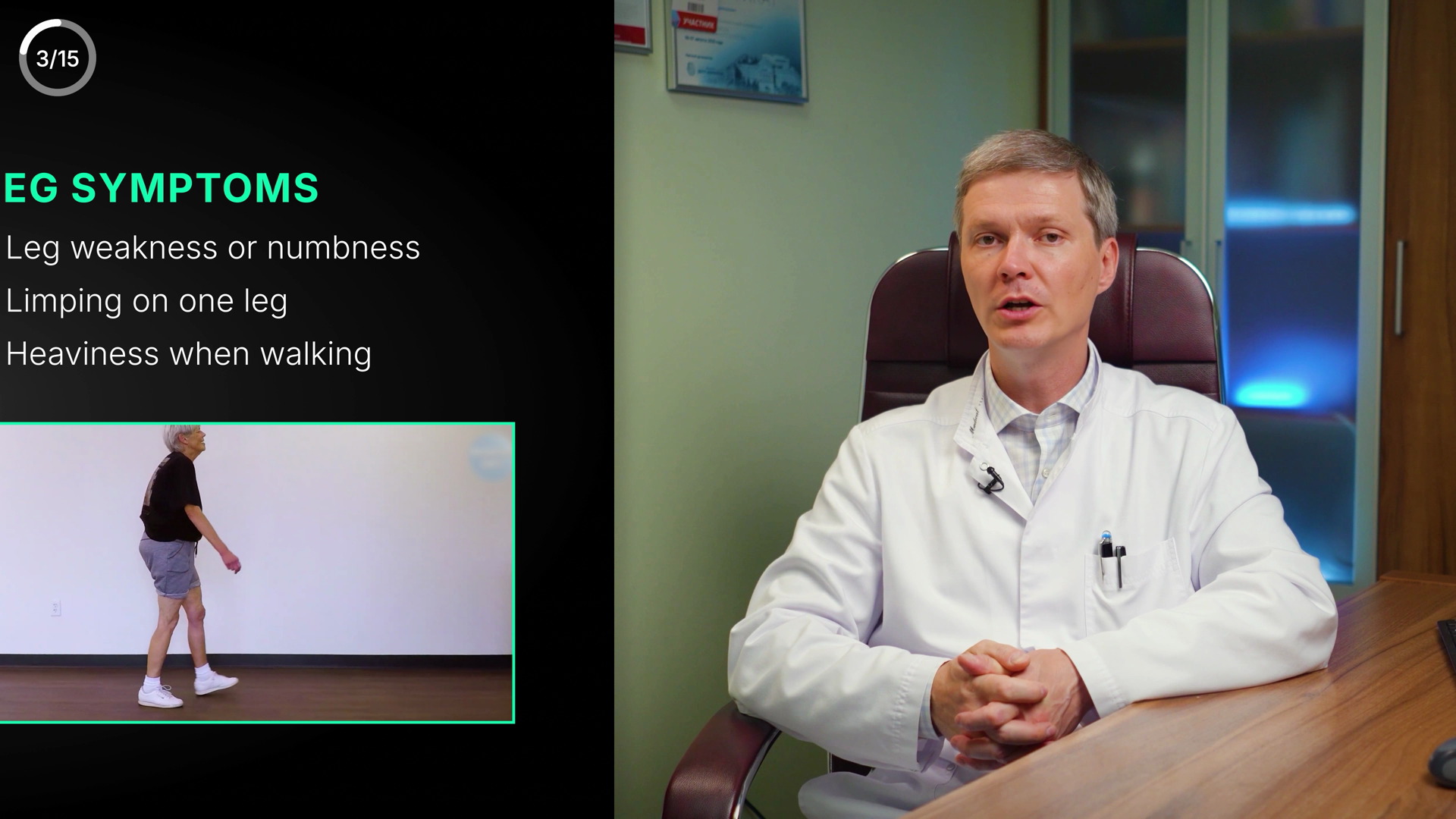
📺 На экране
3/15 | LEG SYMPTOMS | Leg weakness or numbness | Limping on one leg | Heaviness when walking
🟢 Правок нет — экран чистый.
подробнее: речь + разбор по пунктам
💬 Что говорит врач в этот момент“Often it's leg weakness or numbness that comes on suddenly. You might notice you're limping on one leg, or a feeling of heaviness in the legs when walking. These are the main manifestations, symptoms that are quite characteristic of”
📺 Весь текст экрана3/15 | LEG SYMPTOMS | Leg weakness or numbness | Limping on one leg | Heaviness when walking
🖼🟢 ОкТитр-заставка «Симптом №3: равновесие и координация»

📺 На экране
SYMPTOM #3: BALANCE & COORDINATION
🟢 Правок нет — экран чистый.
подробнее: речь + разбор по пунктам
💬 Что говорит врач в этот момент“multiple sclerosis there are rarer symptoms not as typical for ms these symptoms”
📺 Весь текст экранаSYMPTOM #3: BALANCE & COORDINATION
🖼🟢 ОкB-roll: ходьба по лестнице (баланс и координация)4/15
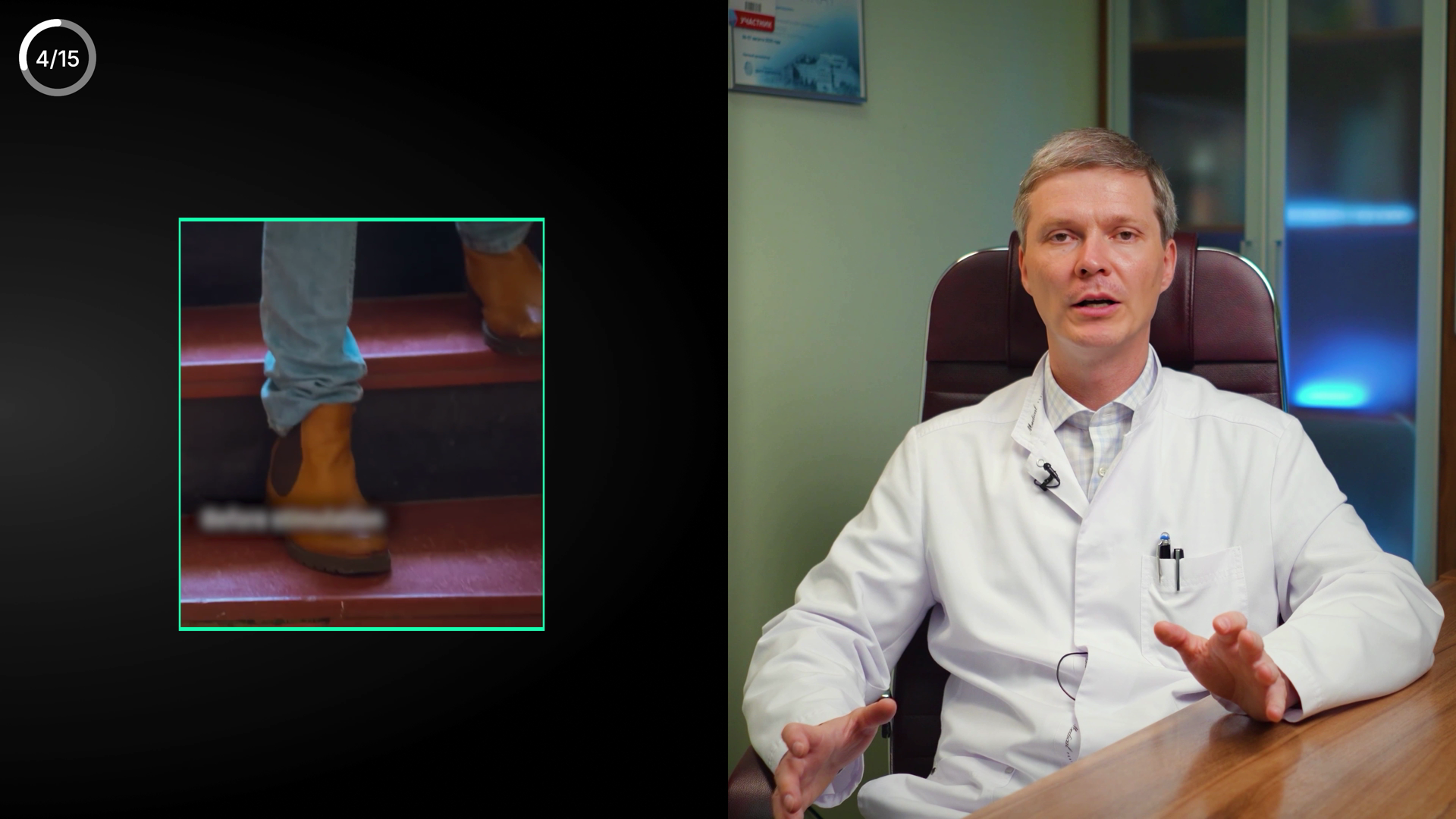
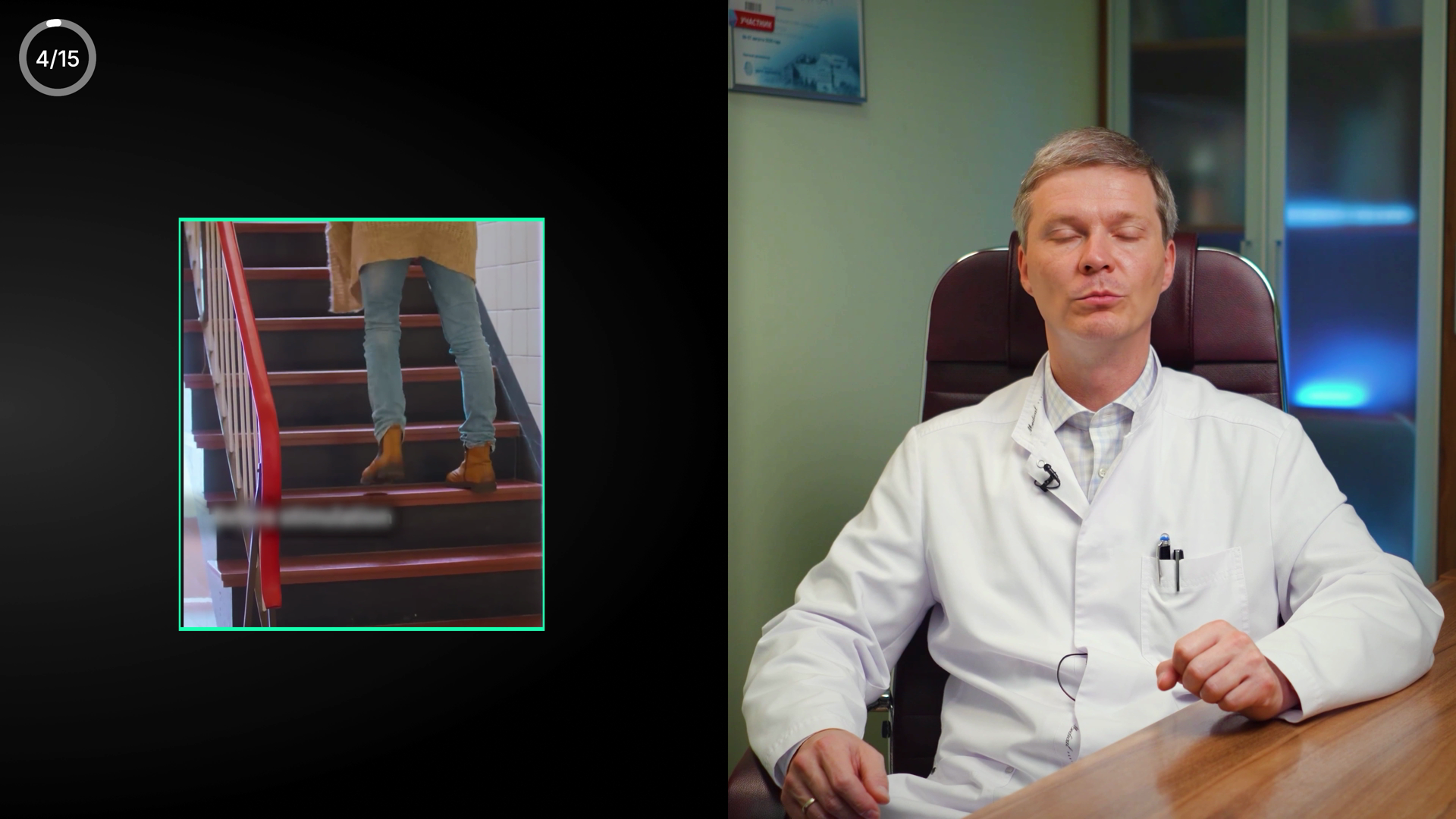

🟢 Правок нет — экран чистый.
подробнее: речь + разбор по пунктам
💬 Что говорит врач в этот момент“problems there's imprecision when performing fine movements or walking balance becomes impaired a person walks and starts veering to one side right then left another less common initial manifestation of ms is urinary dysfunction.”
🖼🟢 ОкТитр-карточка «Симптом №4: нарушения мочеиспускания»5/15

📺 На экране
SYMPTOM #4: URINARY DYSFUNCTION
🟢 Правок нет — экран чистый.
подробнее: речь + разбор по пунктам
💬 Что говорит врач в этот момент“another less common initial manifestation of ms is urinary dysfunction.”
📺 Весь текст экранаSYMPTOM #4: URINARY DYSFUNCTION
🖼🟢 ОкПанель: нарушения мочеиспускания при РС5/15
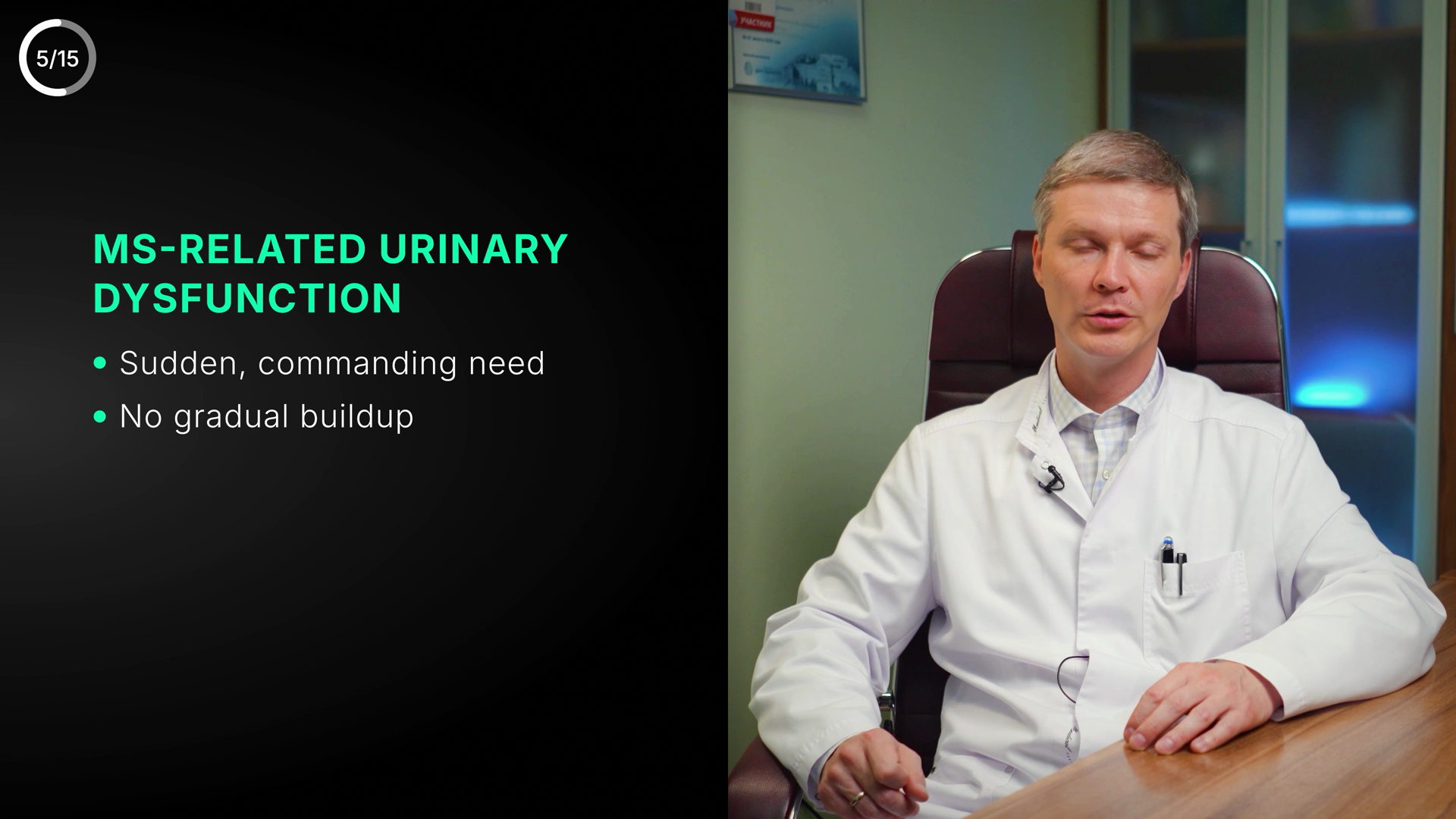
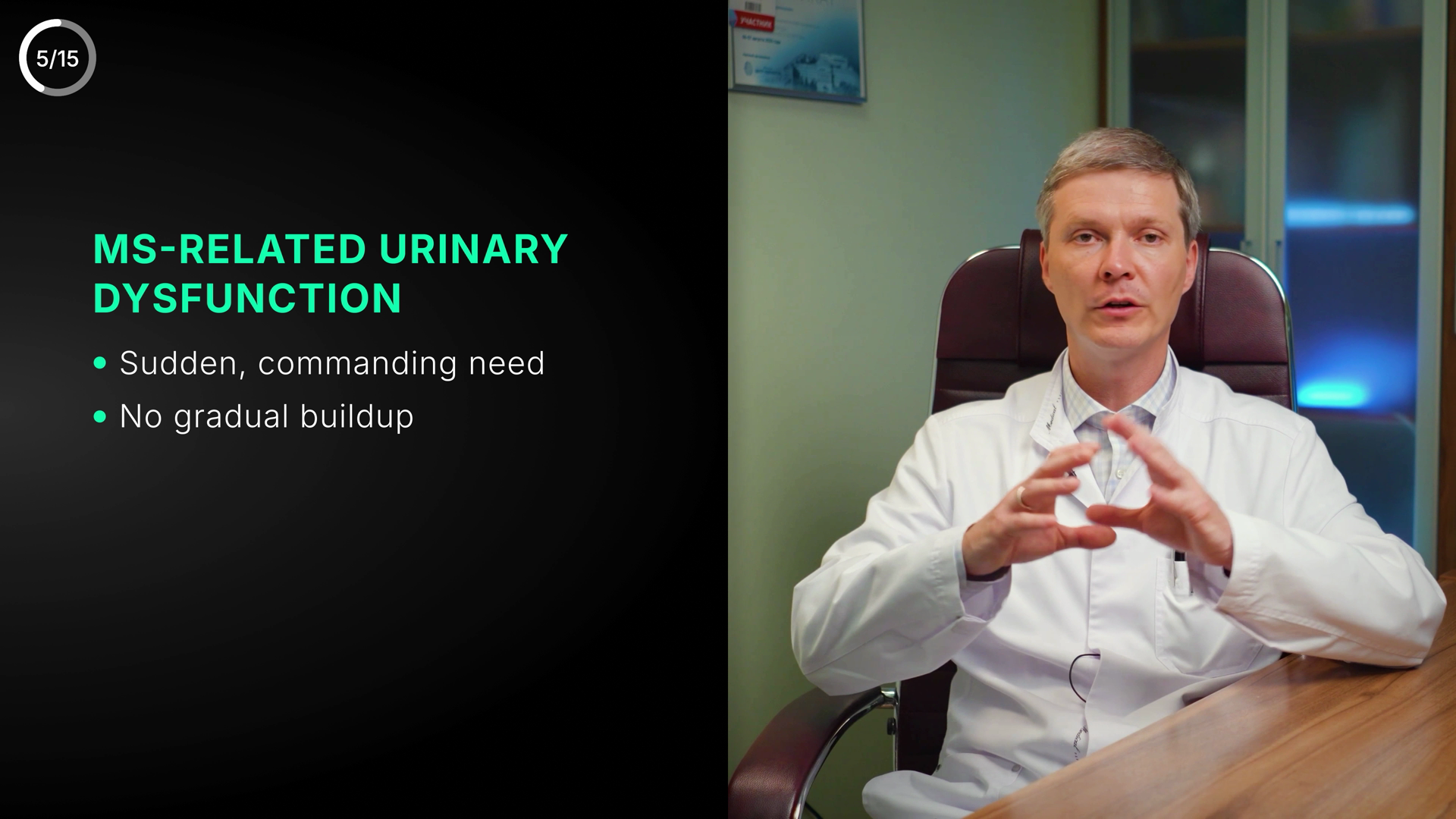
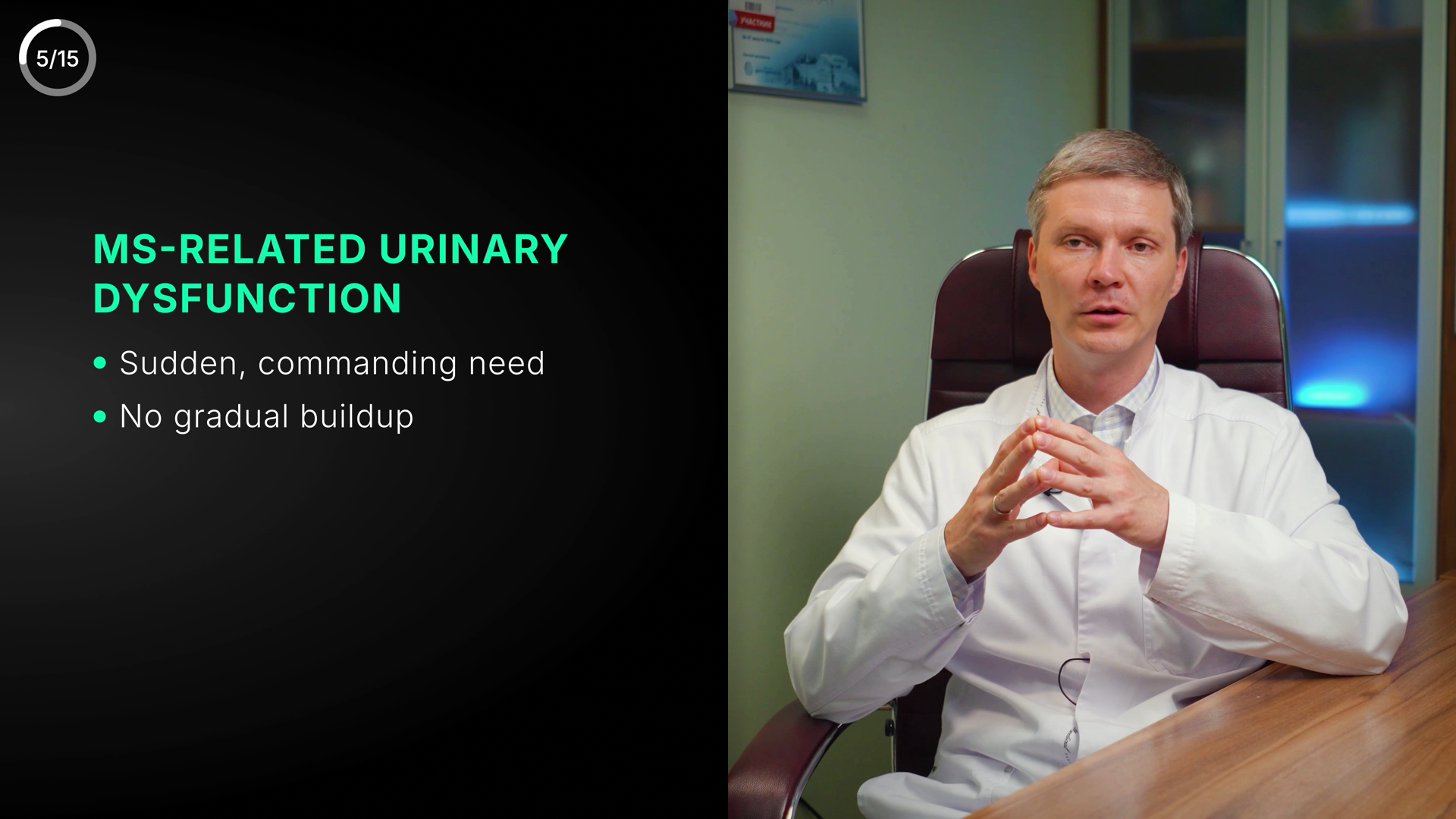
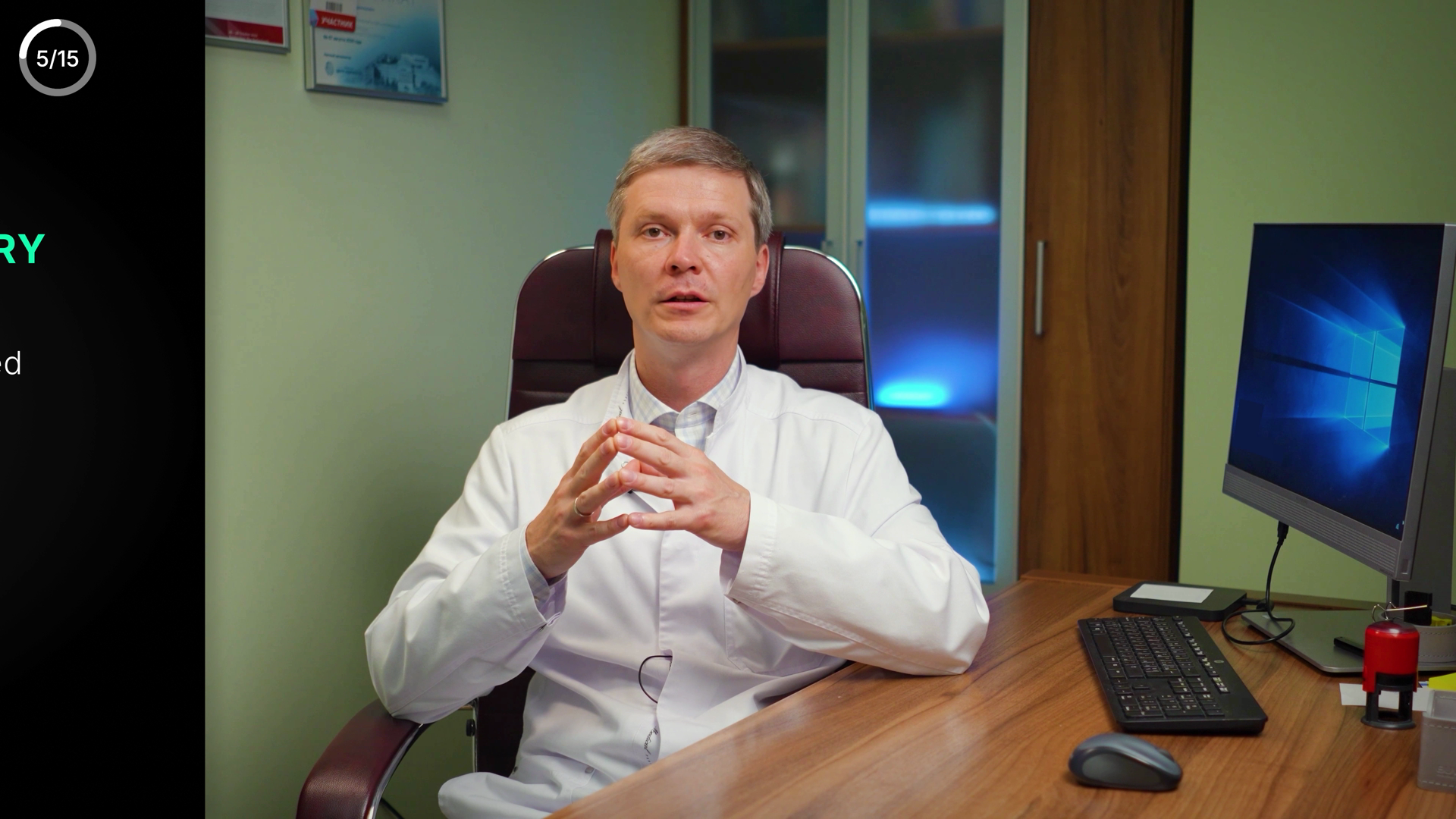
📺 На экране
MS-RELATED URINARY DYSFUNCTION | • Sudden, commanding need | • No gradual buildup
🟢 Правок нет — экран чистый.
подробнее: речь + разбор по пунктам
💬 Что говорит врач в этот момент“These can vary, but with MS, so -called urgency is more characteristic. Meaning the person doesn't feel the need to go at that moment. Then suddenly there's an urgent, commanding need to go, and they literally have to run. That's how strong this urge is.”
📺 Весь текст экранаMS-RELATED URINARY DYSFUNCTION | • Sudden, commanding need | • No gradual buildup
🖼🟢 ОкТитр «SYMPTOM #5: FATIGUE» (уход в белую вспышку)6/15

📺 На экране
SYMPTOM #5: FATIGUE
🟢 Правок нет — экран чистый.
подробнее: речь + разбор по пунктам
💬 Что говорит врач в этот момент“Another fairly characteristic sign,”
📺 Весь текст экранаSYMPTOM #5: FATIGUE
🖼🟢 ОкСплит «как должен просыпаться / как просыпается»6/15
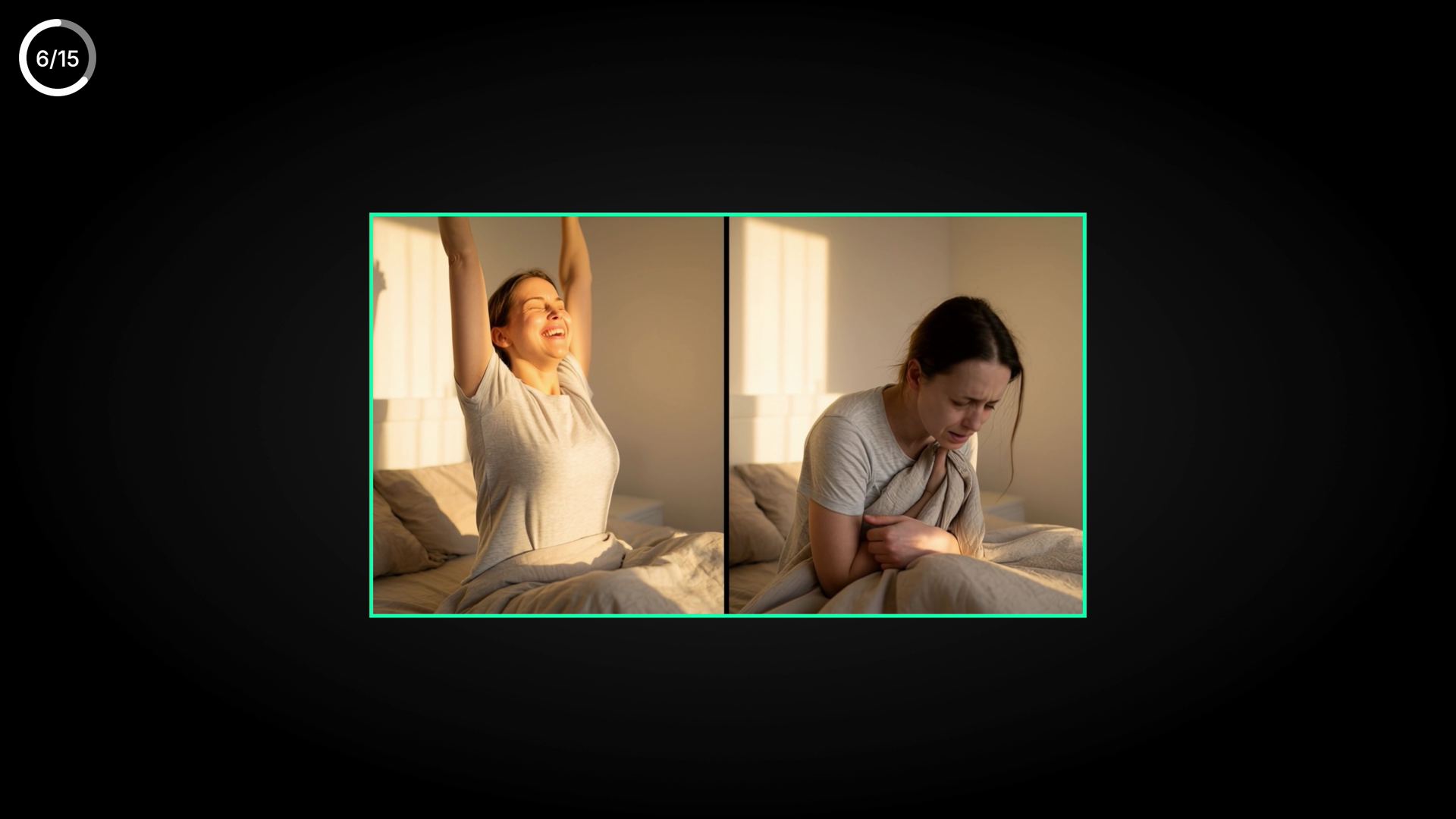
🟢 Правок нет — экран чистый.
подробнее: речь + разбор по пунктам
💬 Что говорит врач в этот момент“Sometimes this fatigue appears in the morning, after sleep. You should wake up rested, but instead you wake up exhausted, exhausted,”
🖼🟢 ОкЦитата пациента «I had to quit my job because of fatigue»6/15
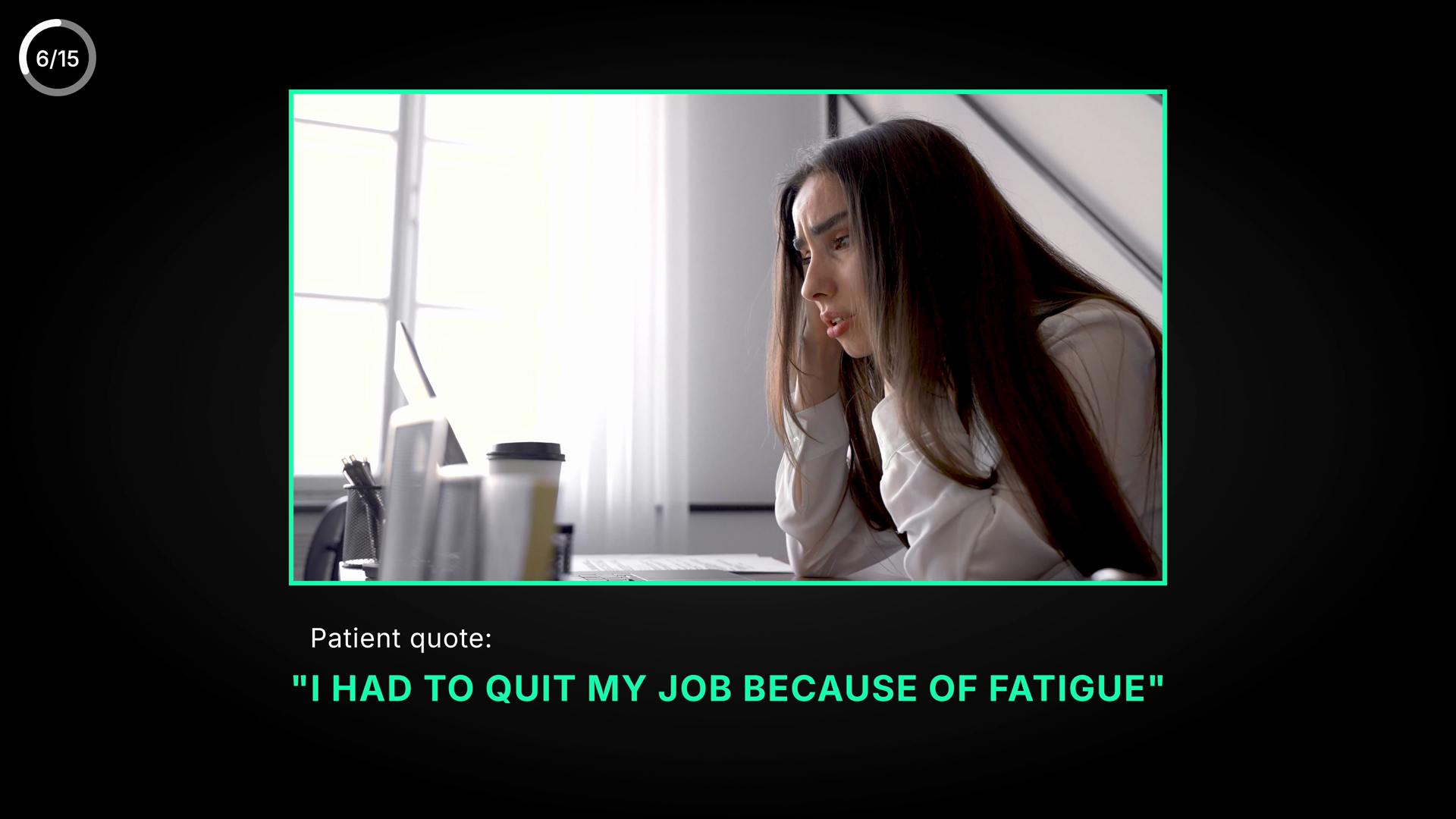
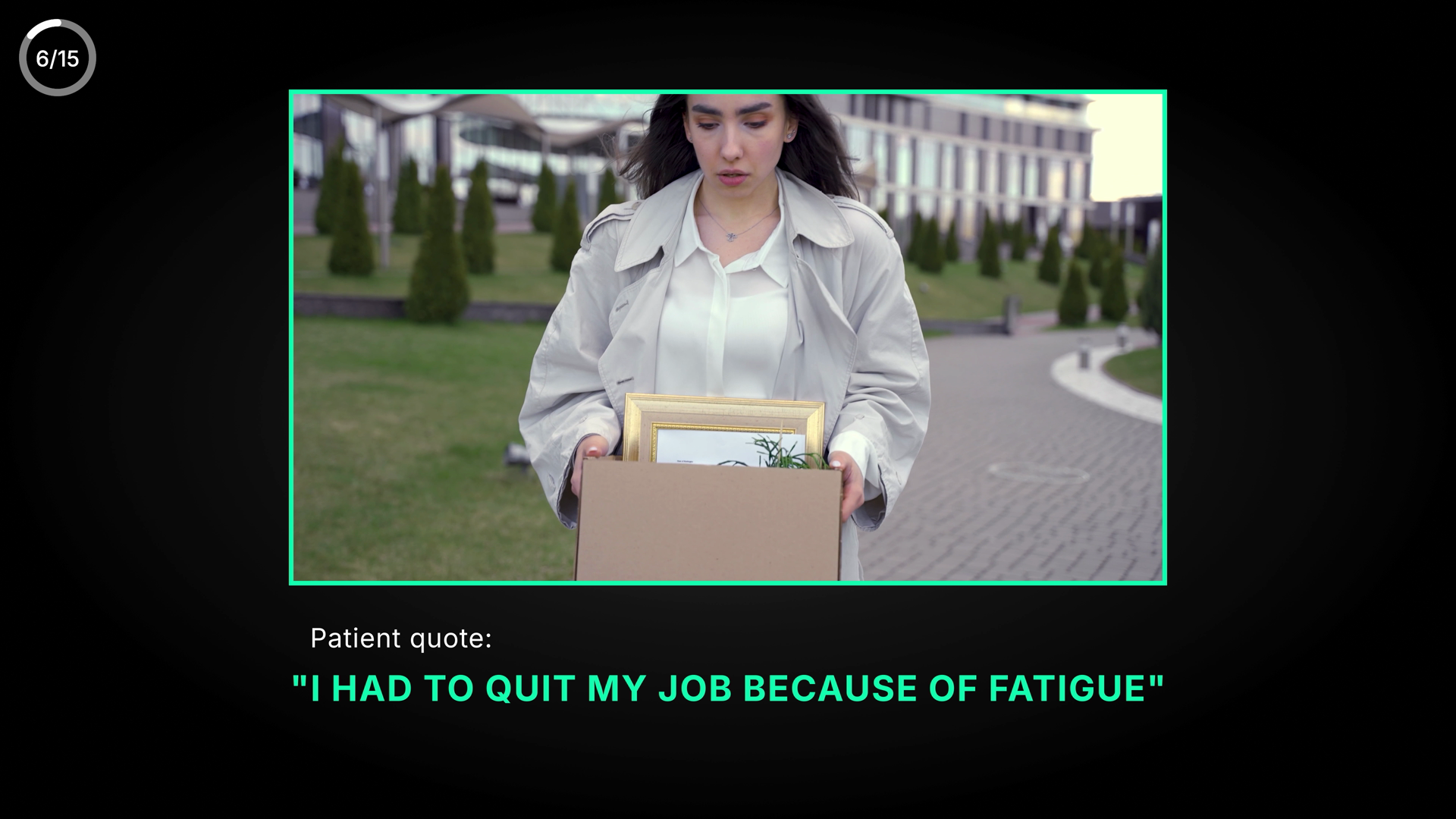
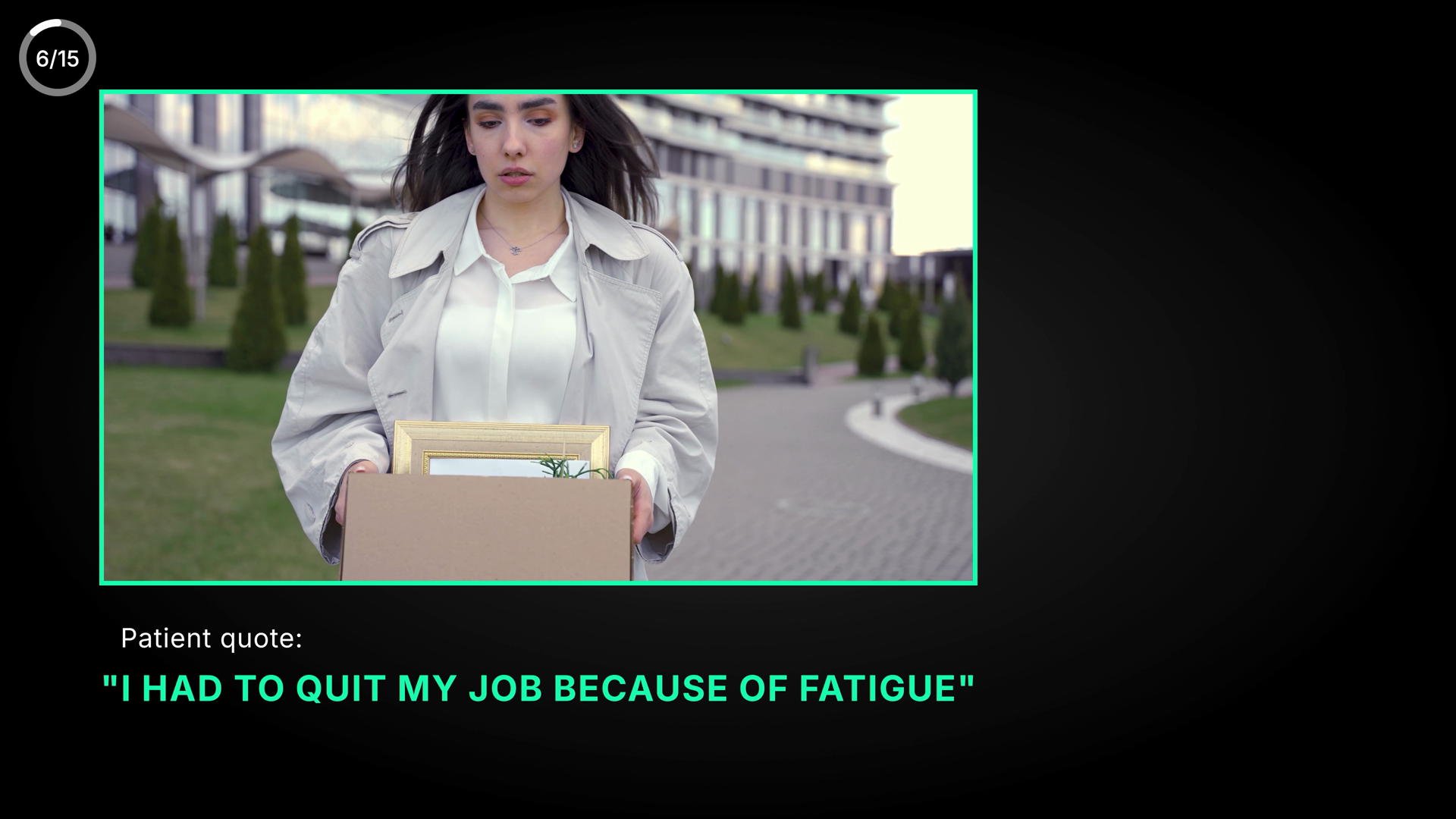
📺 На экране
Patient quote: | "I HAD TO QUIT MY JOB BECAUSE OF FATIGUE"
🟢 Правок нет — экран чистый.
подробнее: речь + разбор по пунктам
💬 Что говорит врач в этот момент“Often people say, yes, I remember I didn't have any other symptoms before, but I remember I started getting tired at work. I even had to quit my job. I switched to something easier because the fatigue was always with me. This is also a characteristic sign. If it occurs in a young person,”
📺 Весь текст экранаPatient quote: | "I HAD TO QUIT MY JOB BECAUSE OF FATIGUE"
#4🧠🔴 ИсправитьВозрастная шкала + формула «молодой + усталость»6/15
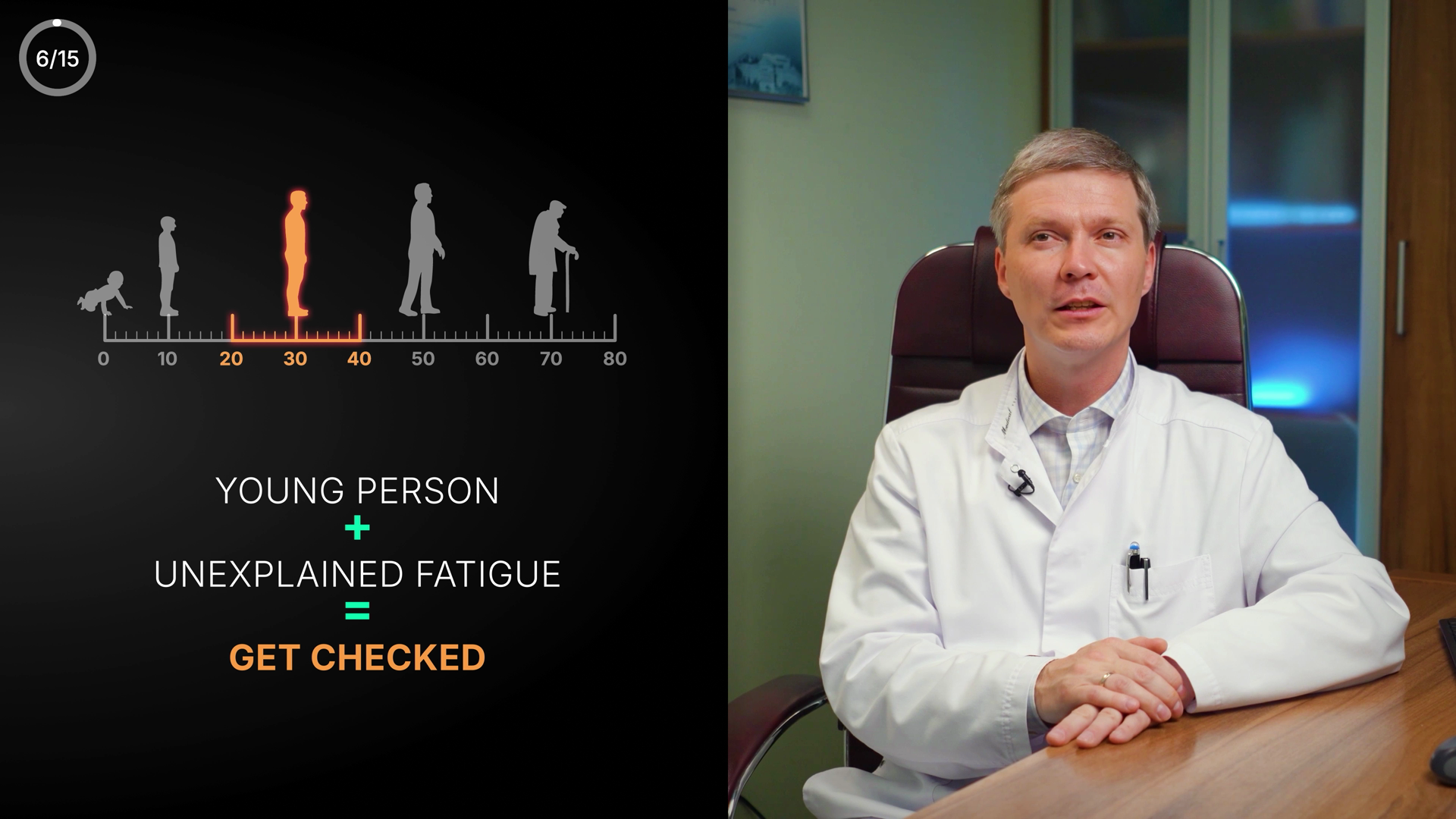
как естьAge axis "0 10 20 30 40 50 60 70 80" with the 20–40 band highlighted in orange — no caption, no unit label
как надоTYPICAL MS ONSET: AGE 20–40 · PEAK 20–30
TYPICAL MS ONSET: AGE 20–40 · PEAK 20–30
Добавить подпись под возрастной осью, разводящую дебют и пик.
подробнее: речь + разбор по пунктам
💬 Что говорит врач в этот момент“This is also a characteristic sign. If it occurs in a young person, it needs to be investigated. Although there are also atypical presentations.”
📺 Весь текст экрана0 10 20 30 40 50 60 70 80 | YOUNG PERSON | + | UNEXPLAINED FATIGUE | = | GET CHECKED
- СмыслДобавить подпись под возрастной осью, разводящую дебют и пик.
🖼🟢 ОкКарточка главы «Atypical Presentations»

📺 На экране
Atypical Presentations
🟢 Правок нет — экран чистый.
подробнее: речь + разбор по пунктам
💬 Что говорит врач в этот момент“it needs to be investigated. Although there are also atypical presentations. For example,”
📺 Весь текст экранаAtypical Presentations
#5🧪🔴 ИсправитьРедкие дебюты, возраст риска и «идите к неврологу»7/15
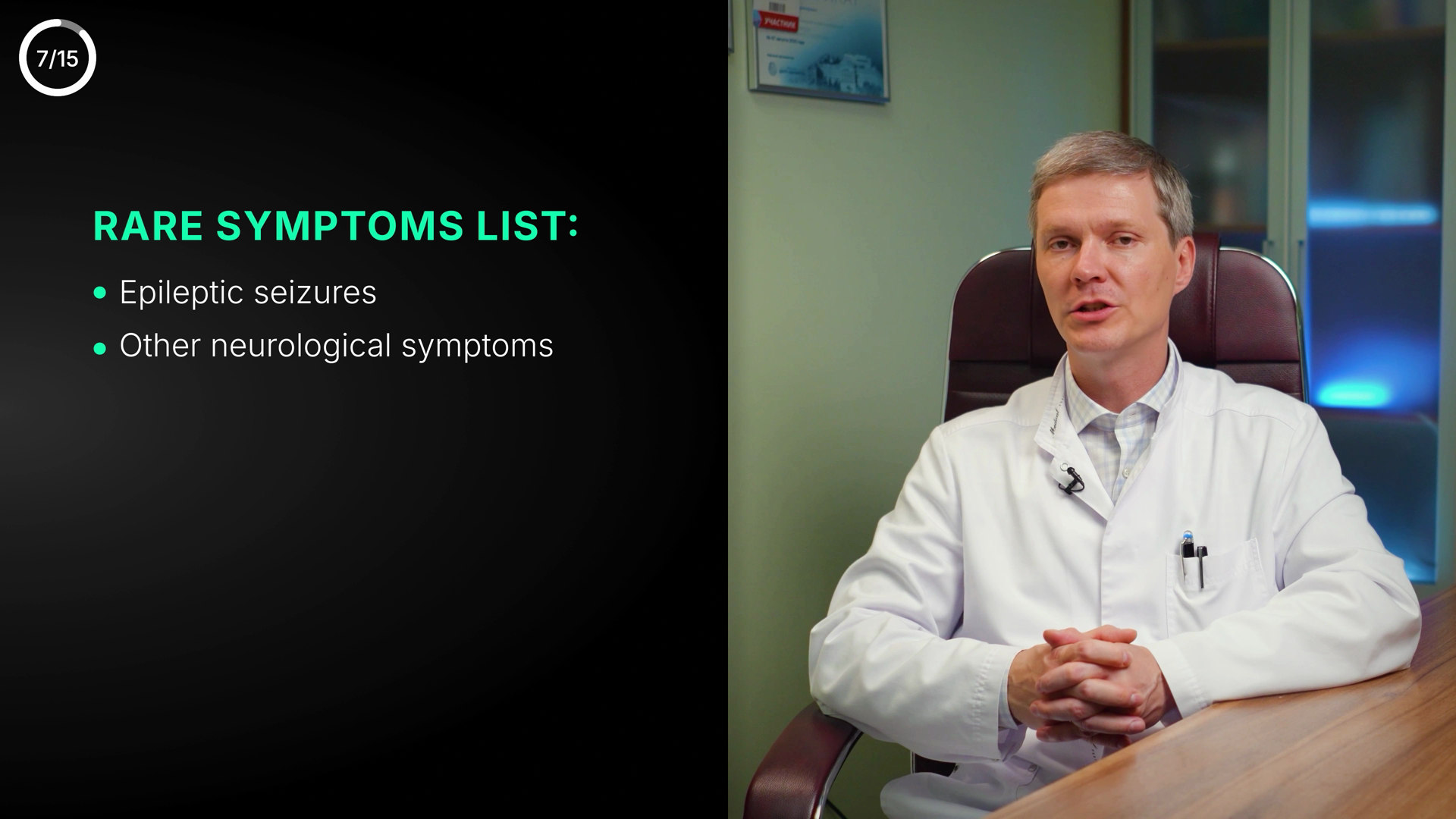
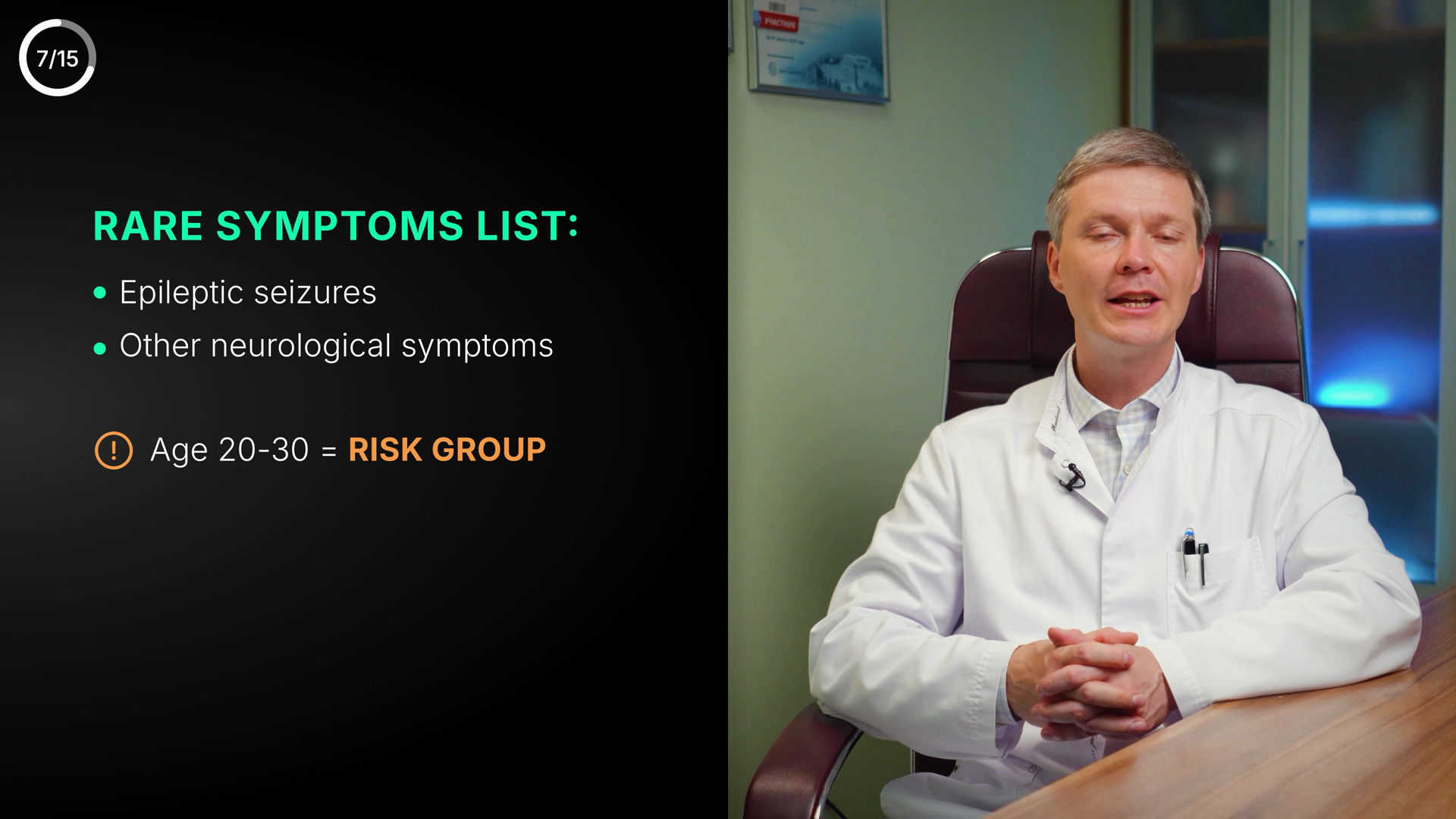
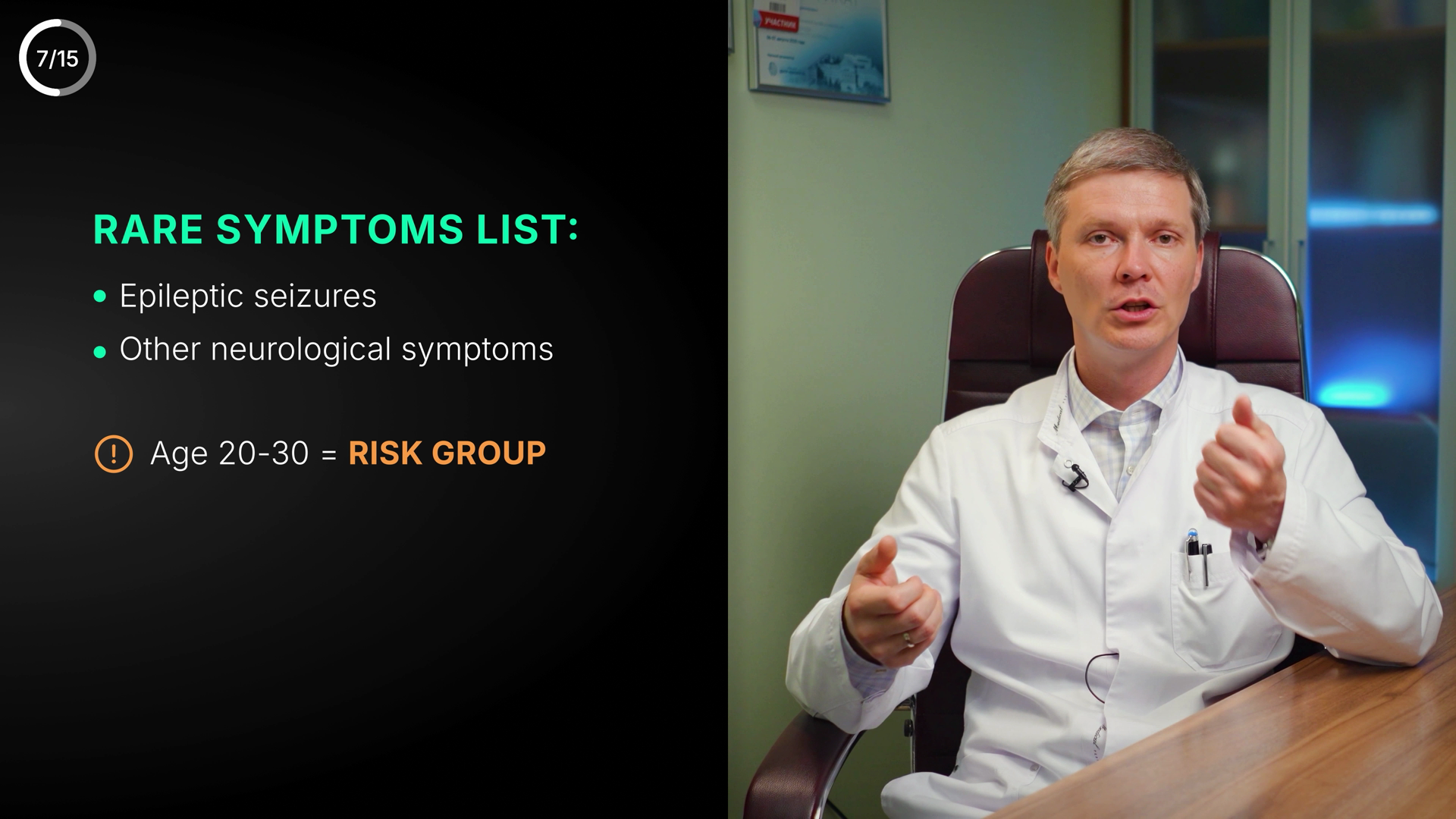
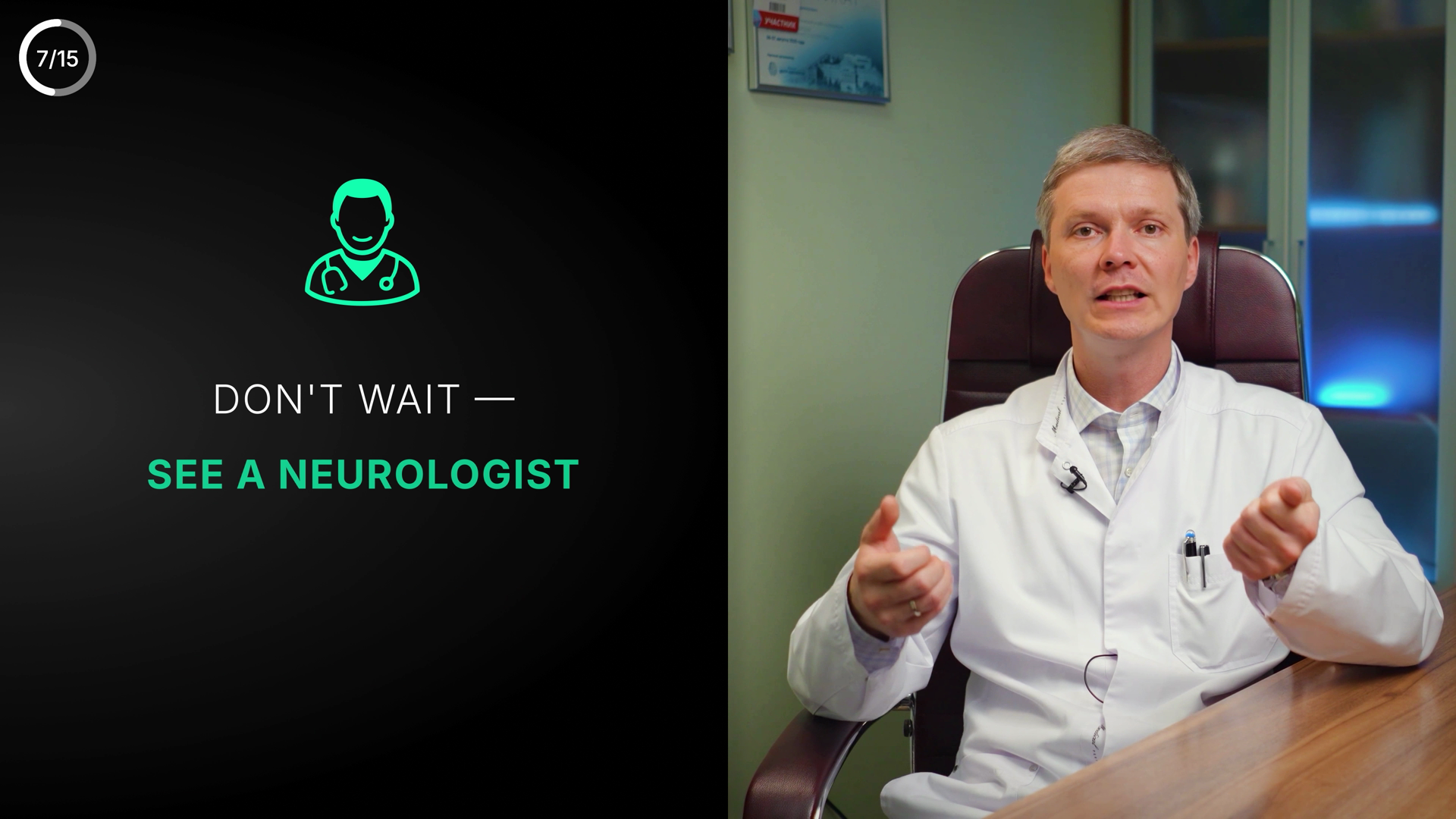
как есть(!) Age 20-30 = RISK GROUP
как надоAge 20-30 = PEAK RISK GROUP
Age 20-30 = PEAK RISK GROUP
Добавить слово PEAK в строку на 4:39 — диапазон не трогать (озвучка говорит «20 and 30»).
подробнее: речь + разбор по пунктам
💬 Что говорит врач в этот момент“MS can even debut with an epileptic seizure or with rarer neurological symptoms. In any case, I'll put it this way. If a young person between 20 and 30 starts experiencing dysfunction in any part of their body when performing certain tasks, sensory disturbances or movement problems, we immediately start thinking, could this be MS? mess? You need to see at least a neurologist and not wait for it to go away.”
📺 Весь текст экранаRARE SYMPTOMS LIST: | • Epileptic seizures | • Other neurological symptoms | (!) Age 20-30 = RISK GROUP | DON'T WAIT — | SEE A NEUROLOGIST
- ФактыДобавить слово PEAK в строку на 4:39 — диапазон не трогать (озвучка говорит «20 and 30»).
🖼🟢 ОкКарточка «Не жди — иди к неврологу»7/15
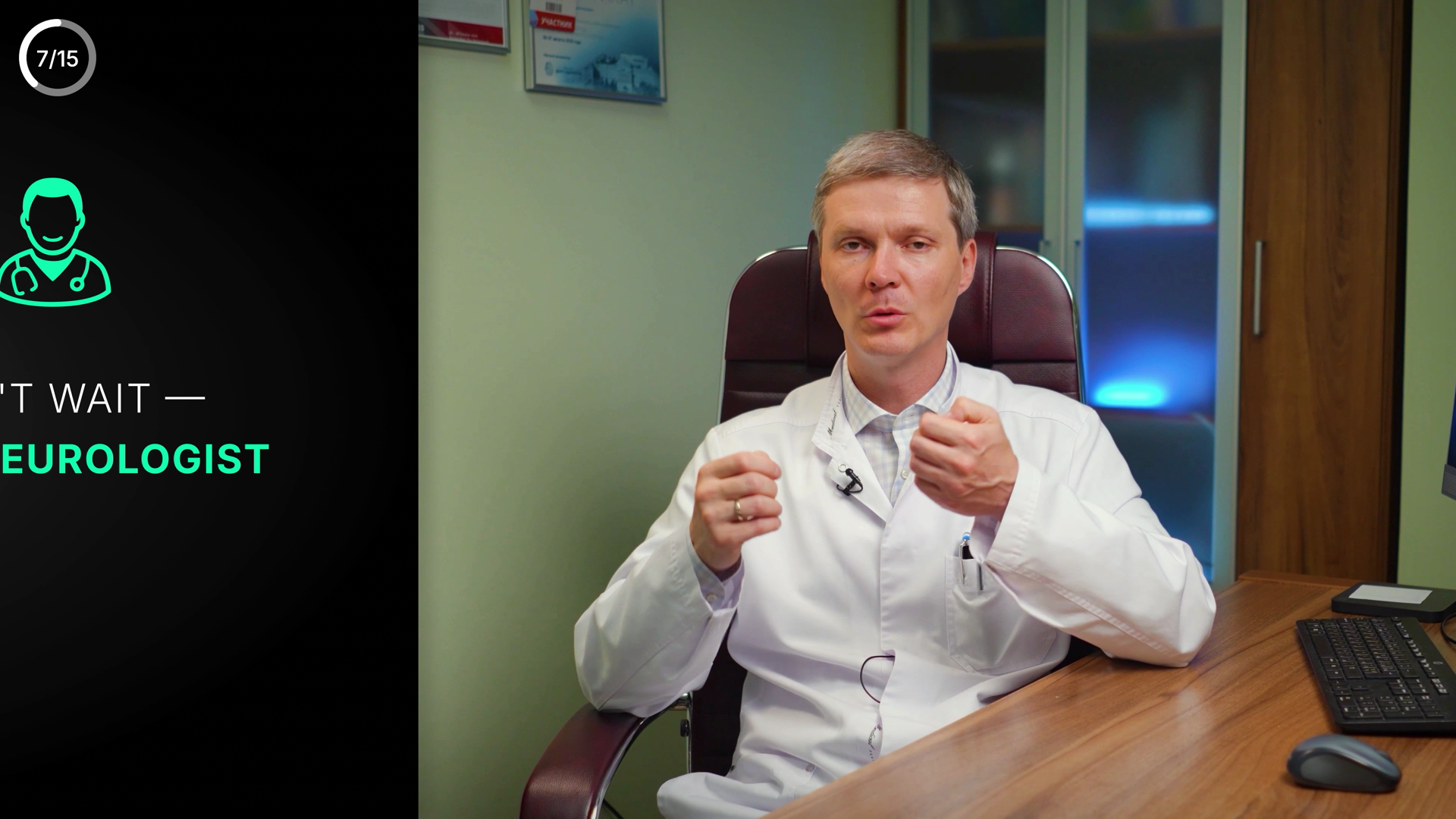
📺 На экране
DON'T WAIT — | SEE A NEUROLOGIST
🟢 Правок нет — экран чистый.
подробнее: речь + разбор по пунктам
💬 Что говорит врач в этот момент“You need to see at least a neurologist and not wait for it to go away. And I have a strong request. If a neurologist examined you and said it's”
📺 Весь текст экранаDON'T WAIT — | SEE A NEUROLOGIST
🖼🟢 ОкКарточка «Получите второе мнение»7/15
📺 На экране
GET A SECOND OPINION
🟢 Правок нет — экран чистый.
подробнее: речь + разбор по пунктам
💬 Что говорит врач в этот момент“degenerative disc disease, please get a second opinion to make sure this arm numbness is actually related to a spinal problem and not a manifestation of something more serious. Feel free to share in the comments the symptoms that are characteristic for you.”
📺 Весь текст экранаGET A SECOND OPINION
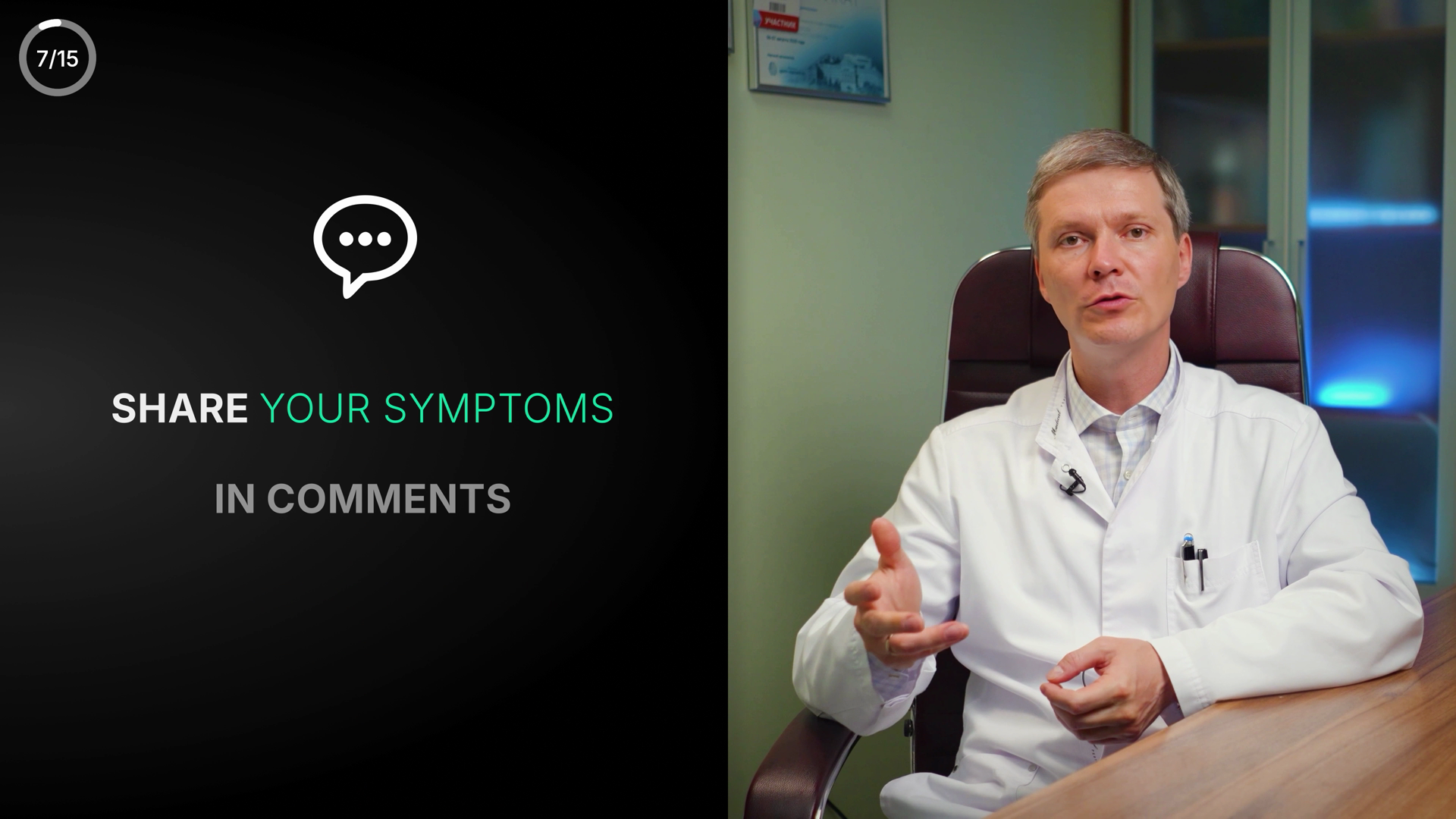
#6✏️🔴 ИсправитьCTA «Поделитесь симптомами в комментариях»7/15
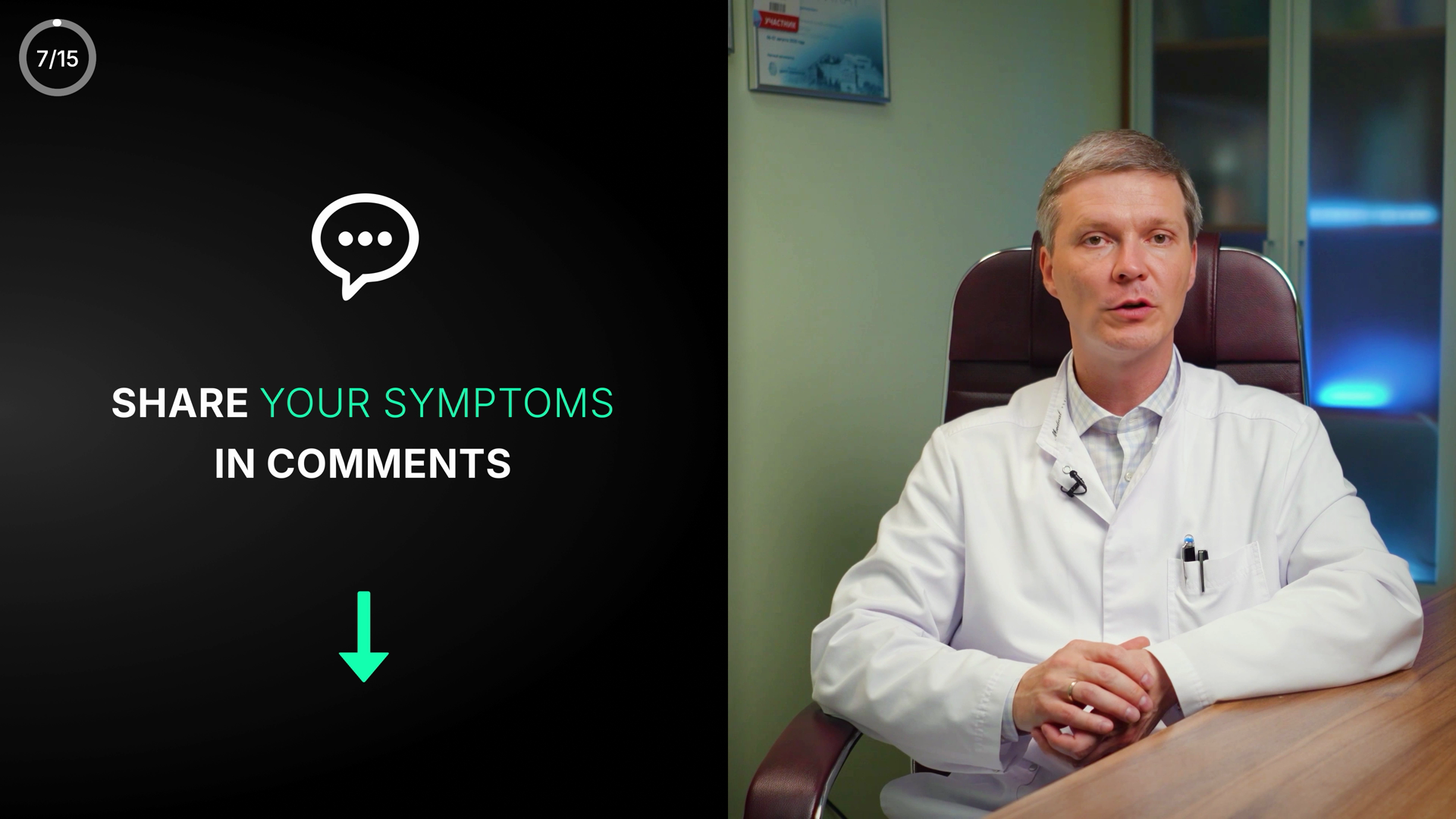
как естьSHARE YOUR SYMPTOMS / IN COMMENTS
как надоSHARE YOUR SYMPTOMS
IN THE COMMENTS
IN THE COMMENTS
SHARE YOUR SYMPTOMS
IN THE COMMENTS
Добавить артикль THE во вторую строку CTA.
подробнее: речь + разбор по пунктам
💬 Что говорит врач в этот момент“Feel free to share in the comments the symptoms that are characteristic for you.”
📺 Весь текст экранаSHARE YOUR SYMPTOMS | IN COMMENTS
- ГрамматикаДобавить артикль THE во вторую строку CTA.
🖼🟢 ОкКарточка главы «MS Course: Relapses & Remissions»
📺 На экране
MS Course: Relapses & Remissions
🟢 Правок нет — экран чистый.
подробнее: речь + разбор по пунктам
💬 Что говорит врач в этот момент“Multiple sclerosis doesn't typically progress in a constant, steady manner.”
📺 Весь текст экранаMS Course: Relapses & Remissions
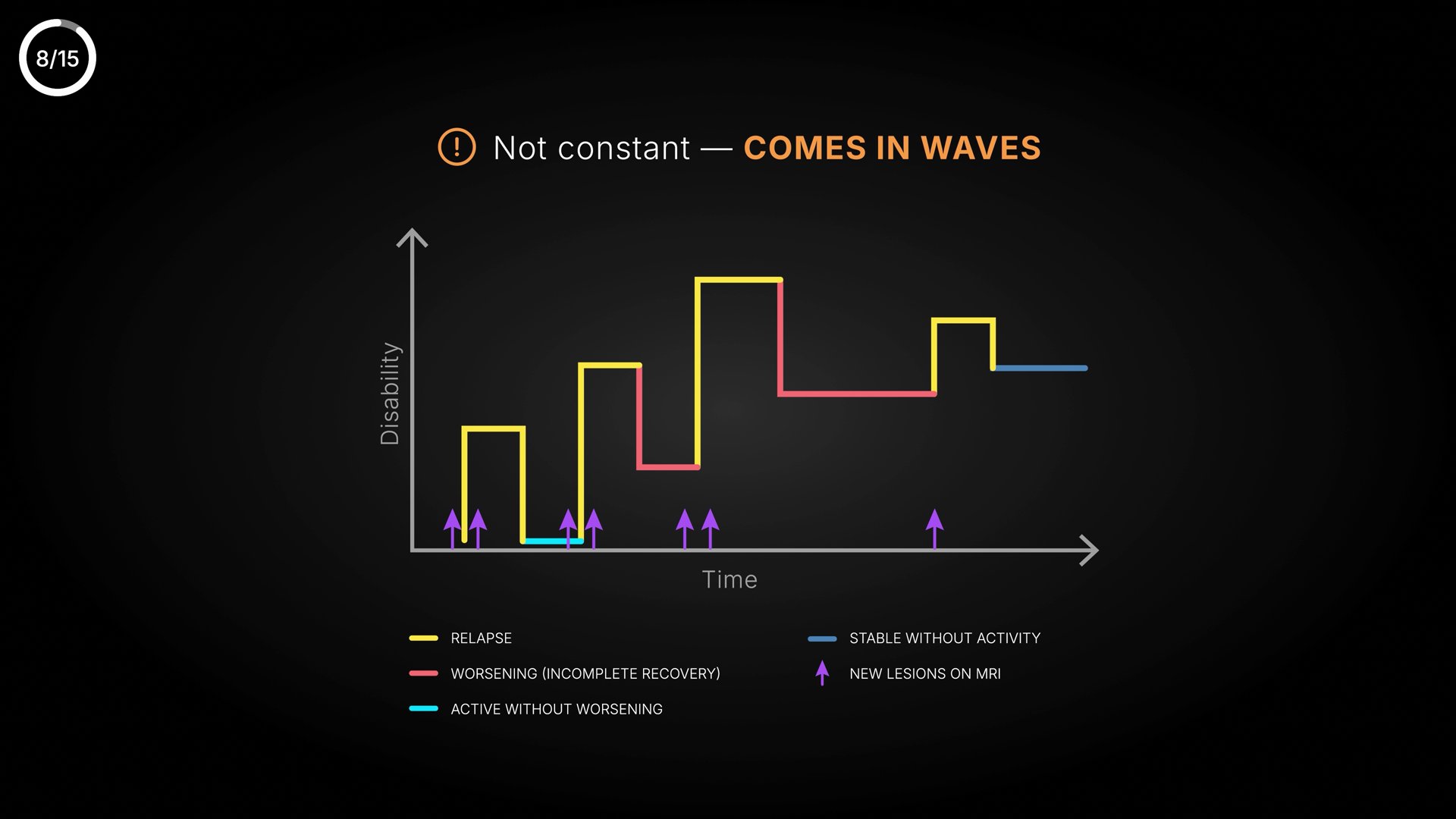
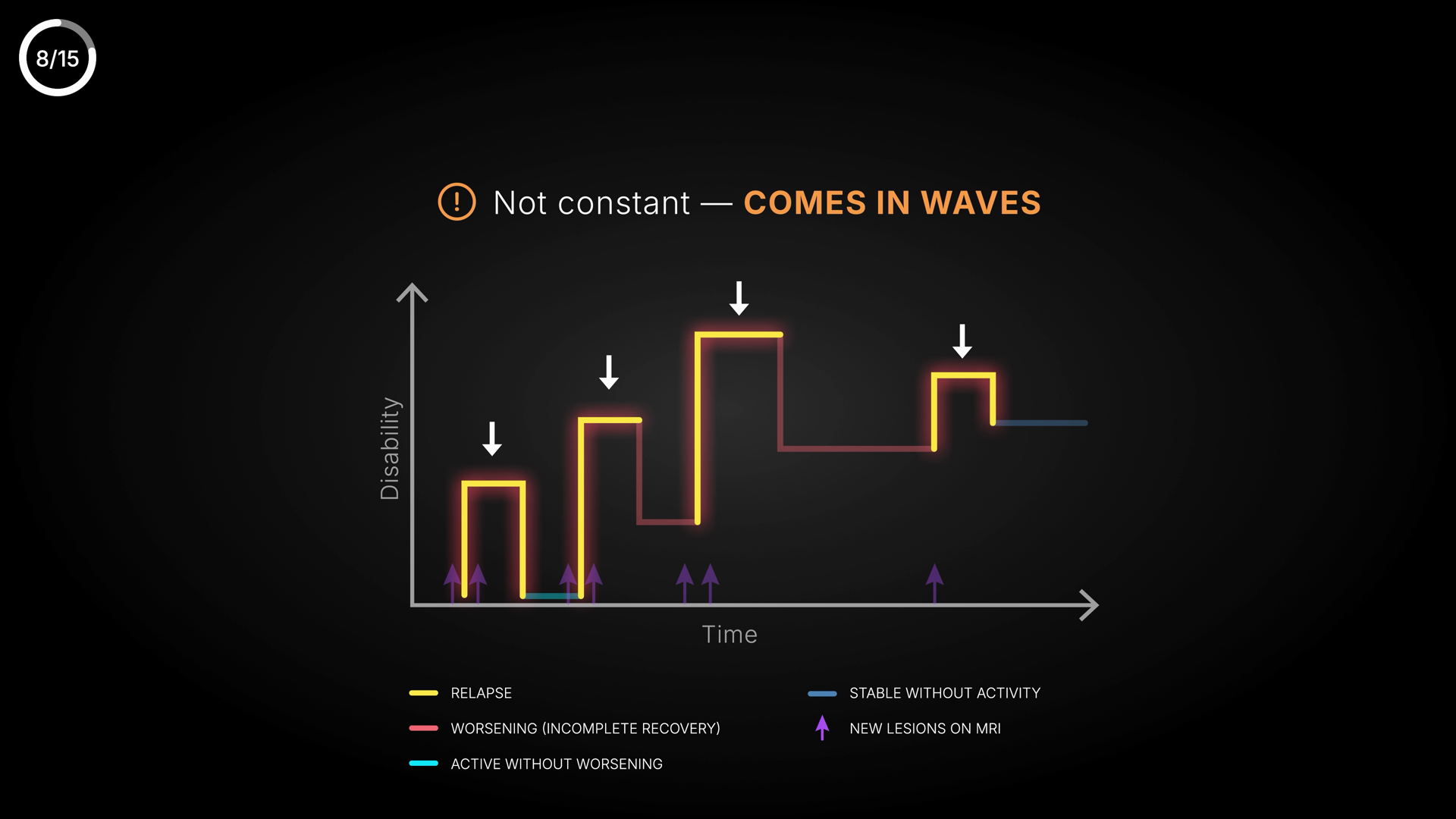
🖼🟢 ОкГрафик течения РС «Not constant — comes in waves»8/15
📺 На экране
(!) Not constant — COMES IN WAVES | Disability | Time | RELAPSE | WORSENING (INCOMPLETE RECOVERY) | ACTIVE WITHOUT WORSENING | STABLE WITHOUT ACTIVITY | NEW LESIONS ON MRI
🟢 Правок нет — экран чистый.
подробнее: речь + разбор по пунктам
💬 Что говорит врач в этот момент“It's characterized by a relapsing, remitting course. There are episodes called relapses, when the person feels unwell, when a symptom appears, vision decreased in one eye, an arm went numb,”
📺 Весь текст экрана(!) Not constant — COMES IN WAVES | Disability | Time | RELAPSE | WORSENING (INCOMPLETE RECOVERY) | ACTIVE WITHOUT WORSENING | STABLE WITHOUT ACTIVITY | NEW LESIONS ON MRI
#7🧠🔴 ИсправитьПримеры симптомов обострения + правило 24 часов8/15
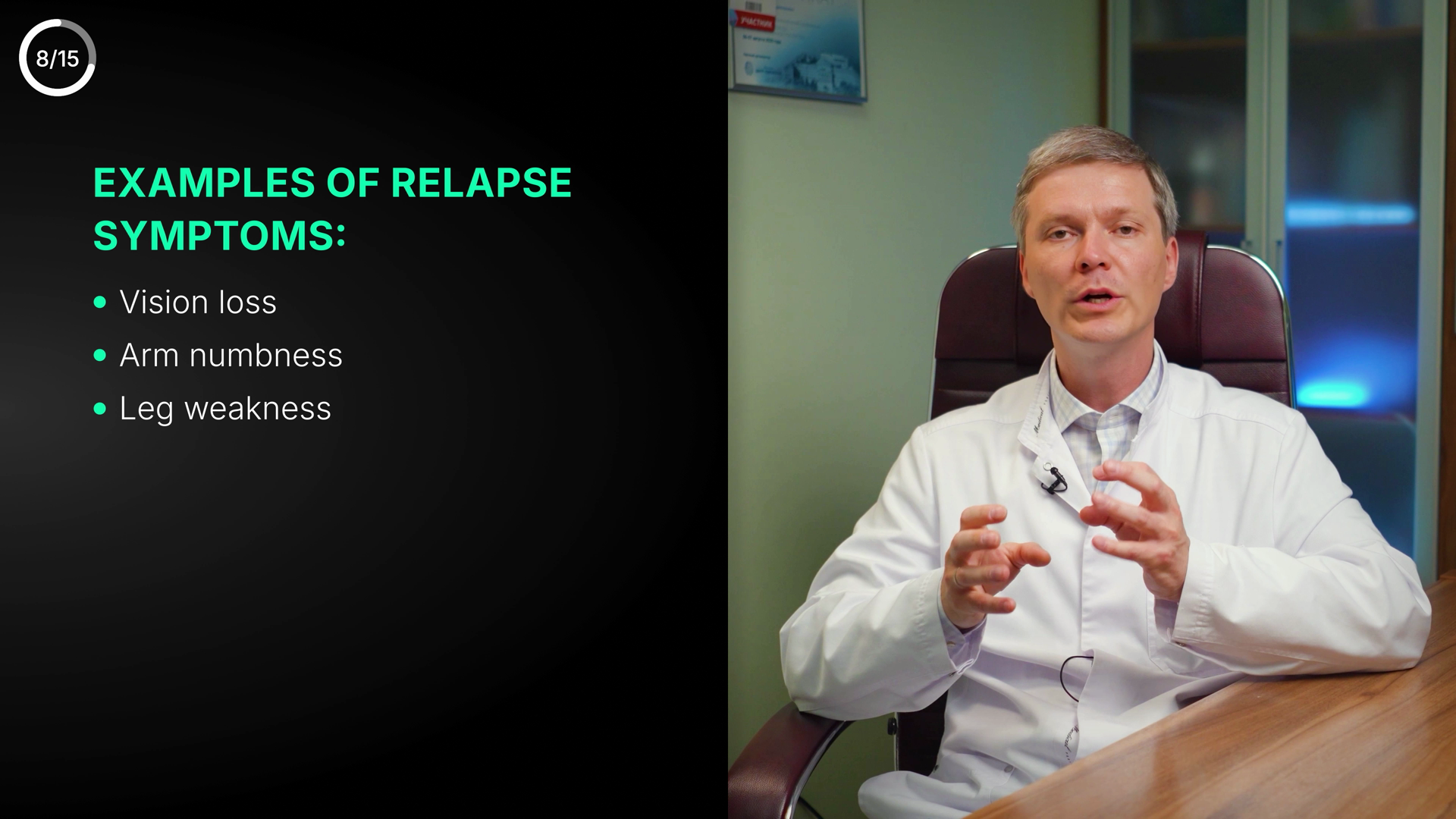
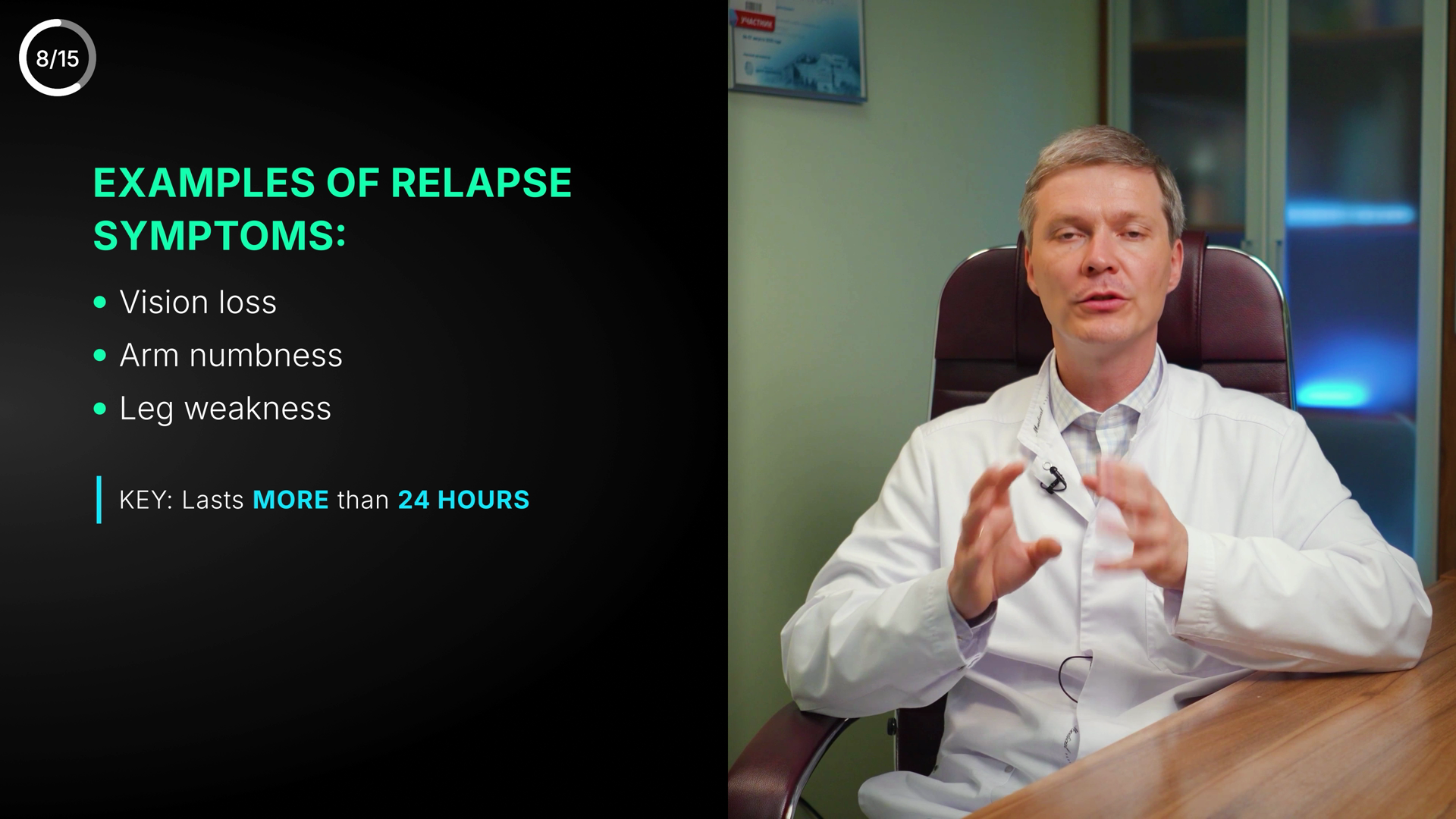
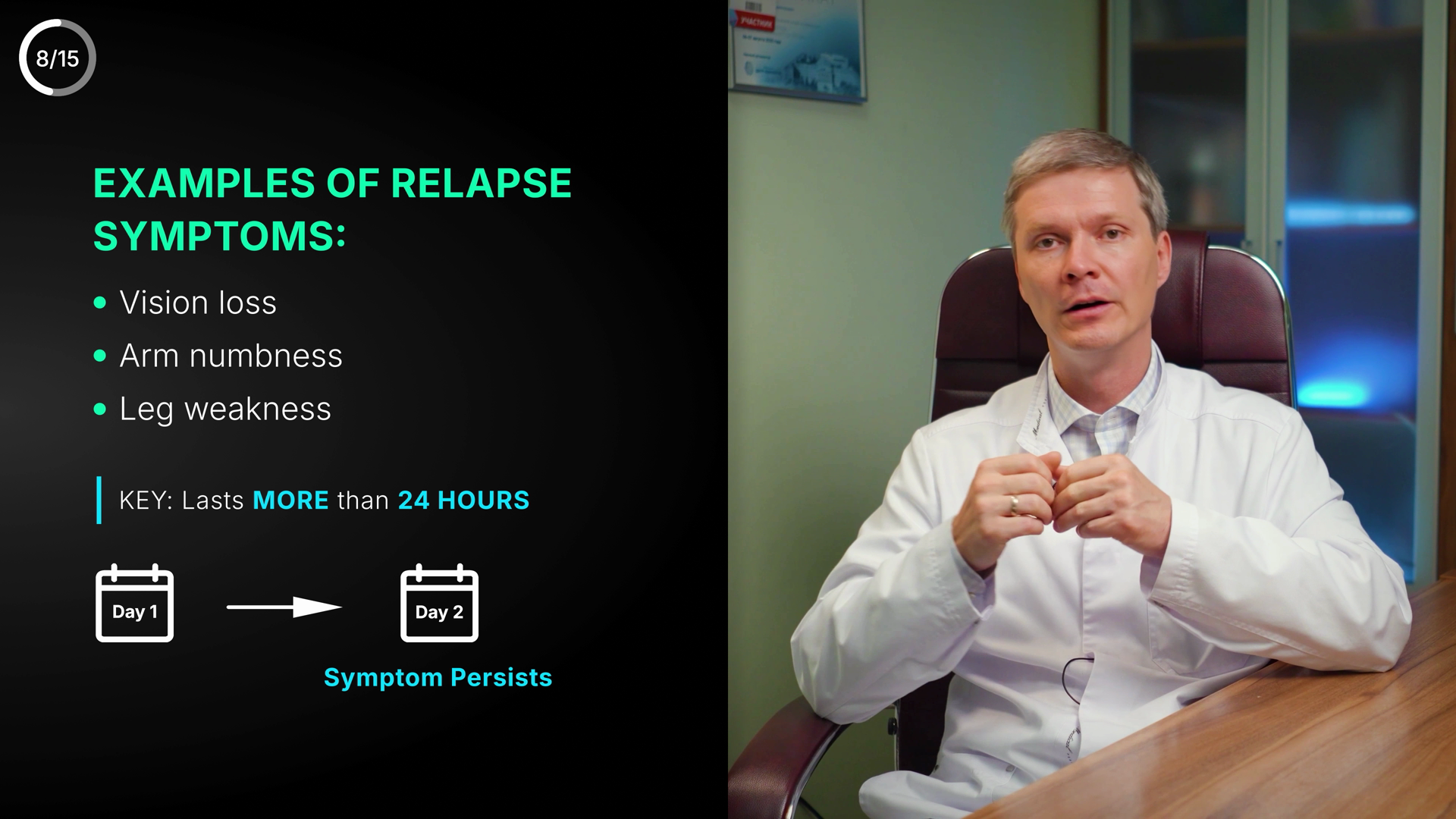
как есть• Vision loss
как надо• Vision loss in one eye
• Vision loss in one eye
Дописать в буллет «in one eye».
подробнее: речь + разбор по пунктам
💬 Что говорит врач в этот момент“when a symptom appears, vision decreased in one eye, an arm went numb, or a leg became weak. If such a symptom appears and lasts more than 24 hours, that's important. You still have it? It appeared today, tomorrow you wake up and the symptom is still there. there, this could be an MS relapse, either the disease onset,”
📺 Весь текст экранаEXAMPLES OF RELAPSE SYMPTOMS: | • Vision loss | • Arm numbness | • Leg weakness | KEY: Lasts MORE than 24 HOURS | Day 1 | Day 2 | Symptom Persists
- СмыслДописать в буллет «in one eye».
#8🧠🔴 ИсправитьПлашка «Это может быть обострение»8/15
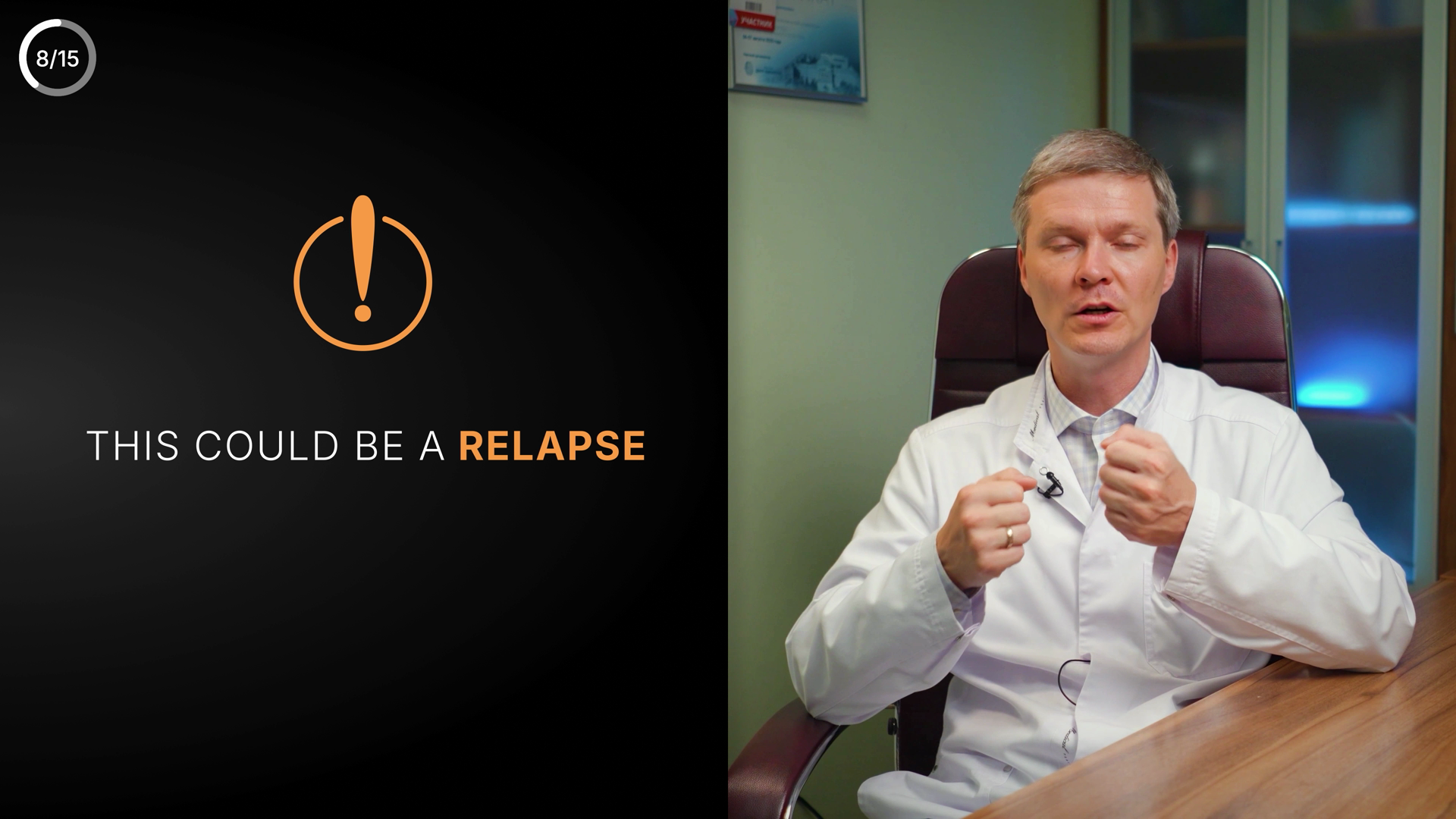
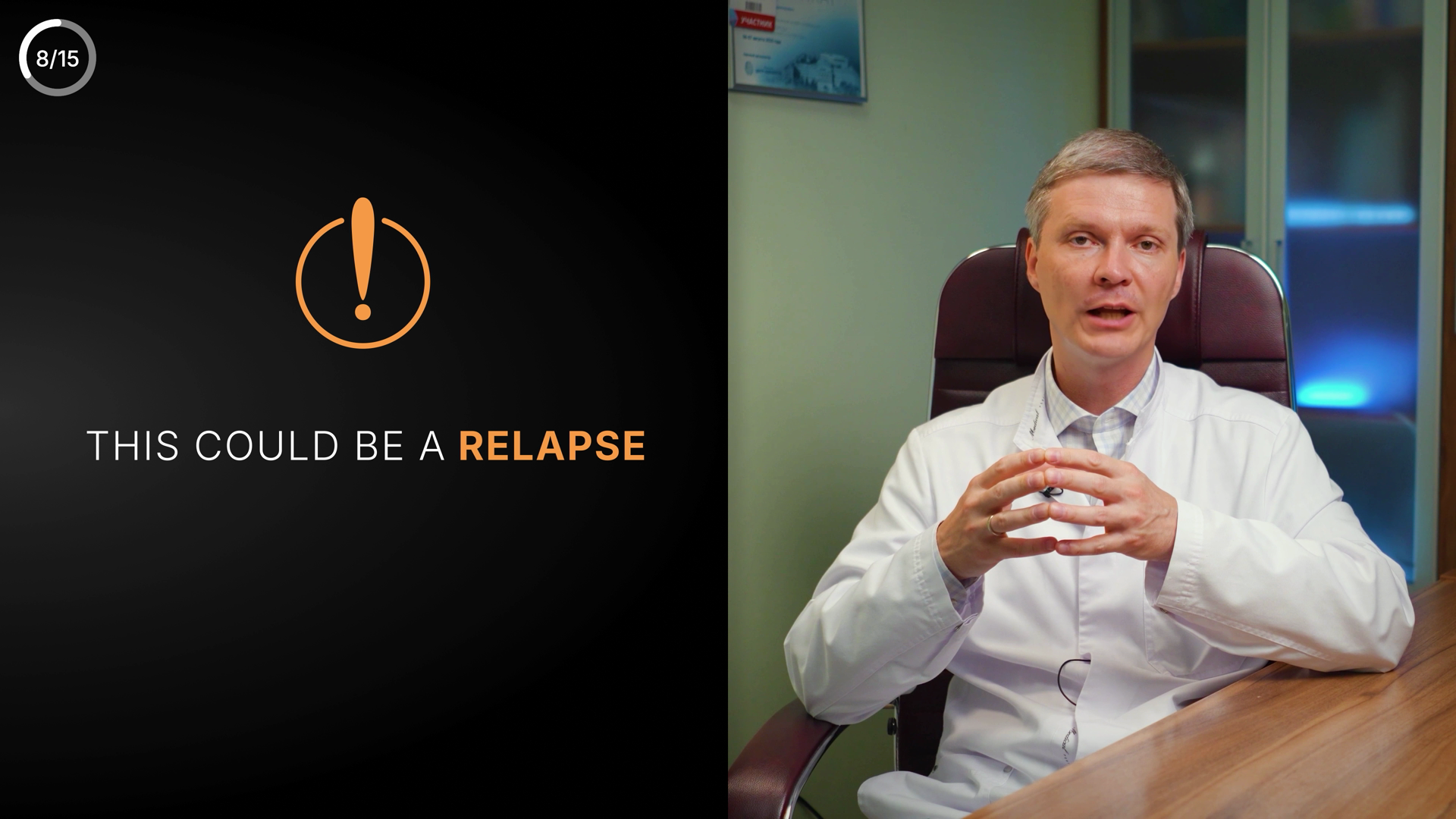
как естьTHIS COULD BE A RELAPSE
как надоTHIS COULD BE MS
ONSET OR RELAPSE
ONSET OR RELAPSE
THIS COULD BE MS
ONSET OR RELAPSE
Переписать титр в две строки, вернув дебют болезни.
подробнее: речь + разбор по пунктам
💬 Что говорит врач в этот момент“there, this could be an MS relapse, either the disease onset, or if you already have MS, the beginning of a relapse. In this situation, you need to see a doctor immediately, preferably an MS”
📺 Весь текст экрана8/15 | THIS COULD BE A RELAPSE
- СмыслПереписать титр в две строки, вернув дебют болезни.
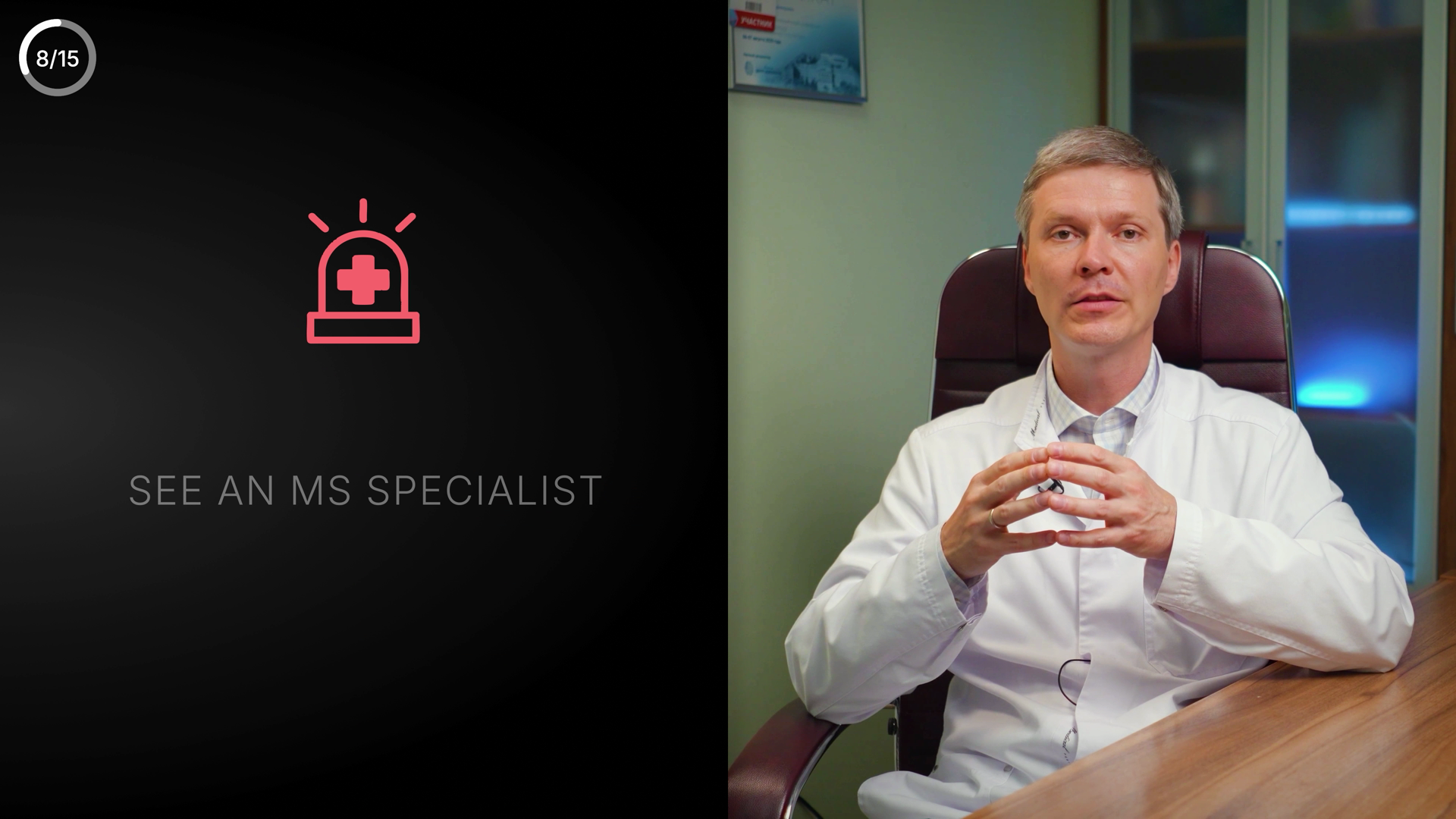
#9🧠🔴 ИсправитьПлашка «Срочно к специалисту по РС»8/15



как естьSEE AN MS SPECIALIST | IMMEDIATELY
как надоSEE A DOCTOR IMMEDIATELY
IDEALLY AN MS SPECIALIST
IDEALLY AN MS SPECIALIST
SEE A DOCTOR IMMEDIATELY
IDEALLY AN MS SPECIALIST
Перебрать титр в две строки: срочность — к врачу, MS-специалист — как пожелание (строка 2 красным).
подробнее: речь + разбор по пунктам
💬 Что говорит врач в этот момент“In this situation, you need to see a doctor immediately, preferably an MS specialist, so they can determine whether this is a relapse or not.”
📺 Весь текст экрана8/15 | SEE AN MS SPECIALIST | IMMEDIATELY
- СмыслПеребрать титр в две строки: срочность — к врачу, MS-специалист — как пожелание (строка 2 красным).
#10🧪🔴 ИсправитьСхема «Диагноз → лечение → восстановление функции»8/15
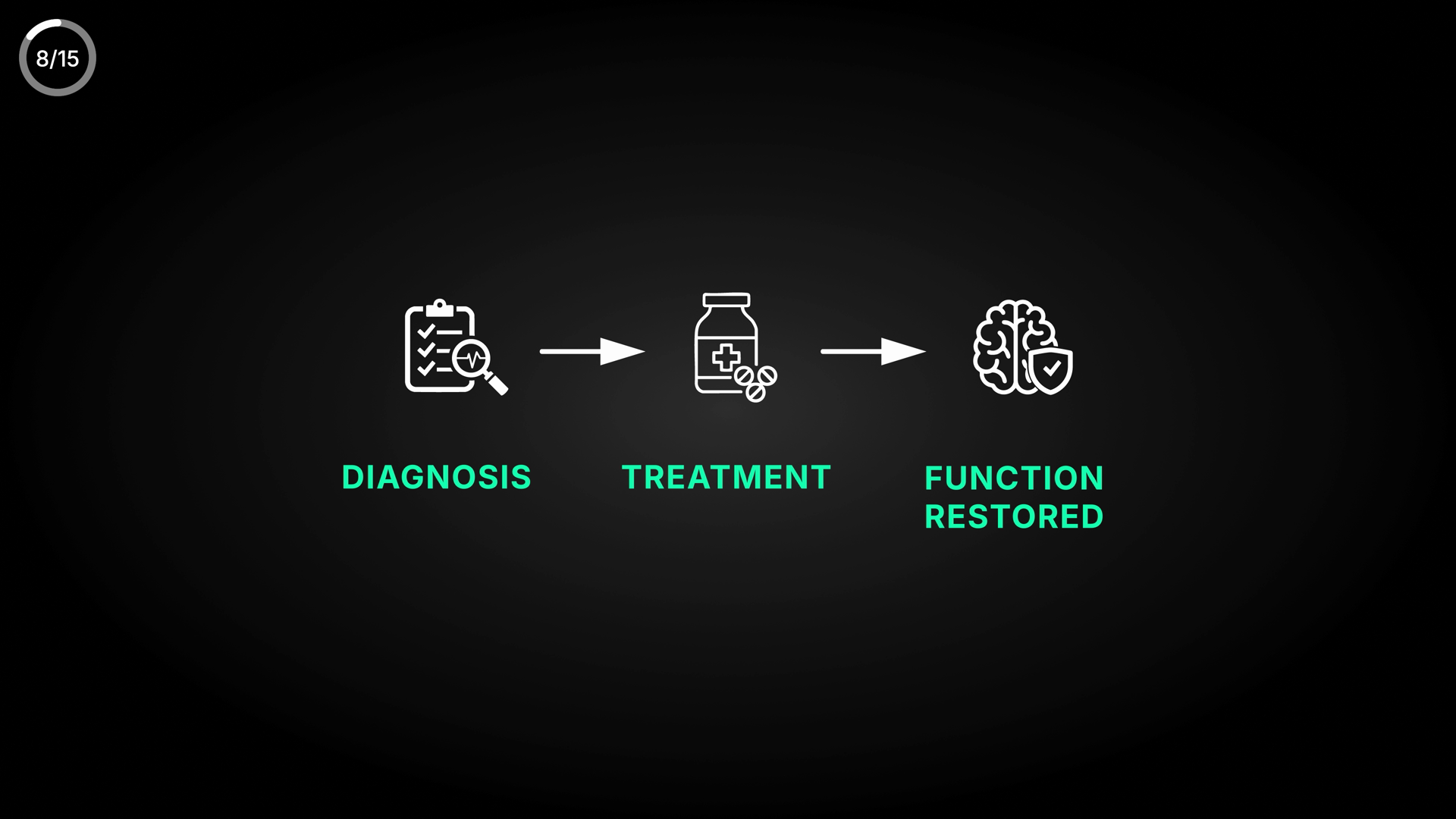
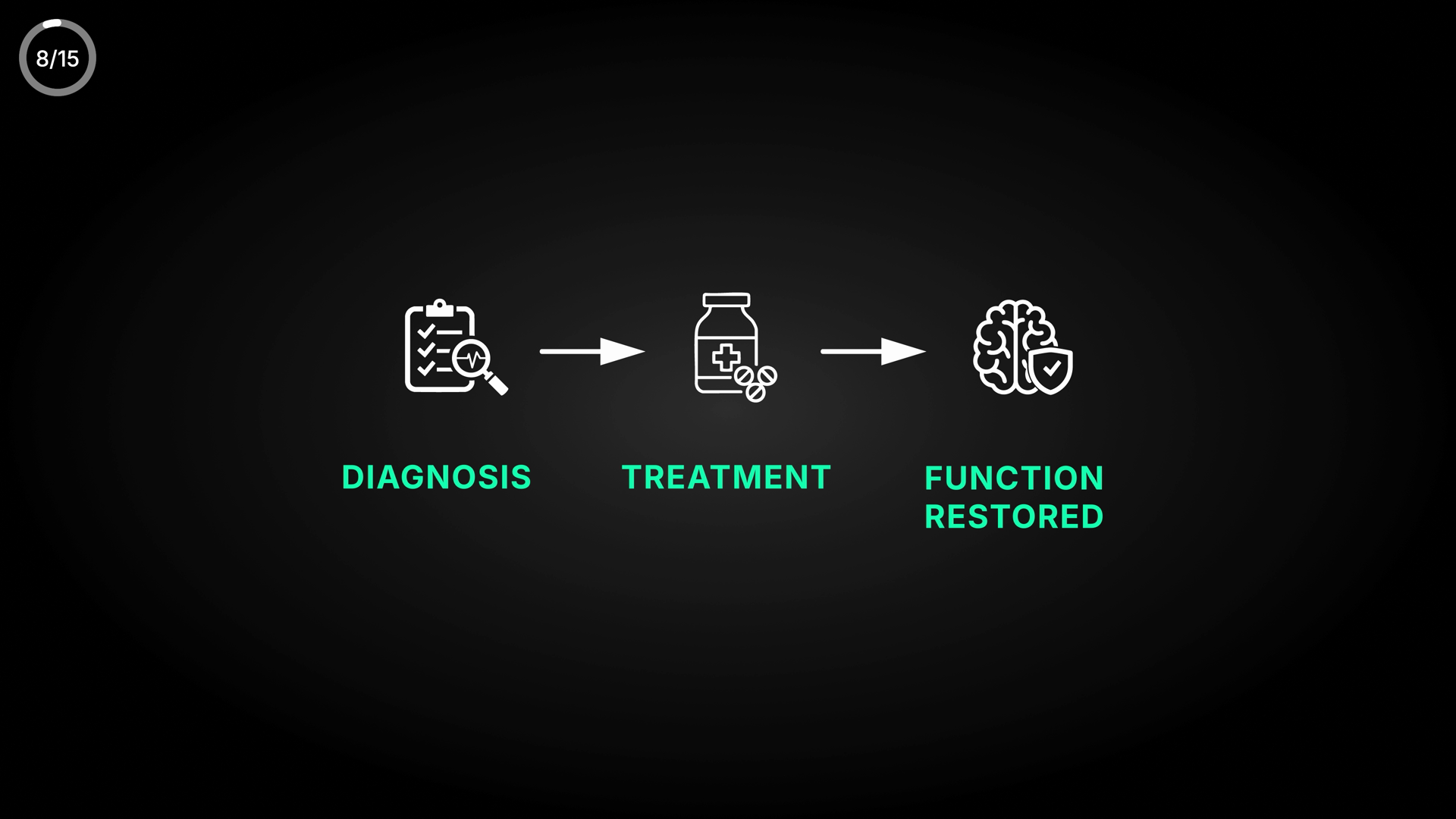
как естьStep 2 icon: a pill bottle with a cross and three loose tablets
как надоReplace with an IV drip / infusion-bag icon in the same line-icon family (steroid pulse therapy).
Replace with an IV drip / infusion-bag icon in the same line-icon family (steroid pulse therapy).
Заменить иконку пузырька с таблетками на капельницу/инфузионный пакет в том же стиле линейных иконок.
подробнее: речь + разбор по пунктам
💬 Что говорит врач в этот момент“specialist, so they can determine whether this is a relapse or not. And if it is a relapse, they'll provide treatment to restore the impaired function as quickly as possible, the function that brought you to the doctor.”
📺 Весь текст экрана8/15 | DIAGNOSIS | TREATMENT | FUNCTION RESTORED
- ФактыЗаменить иконку пузырька с таблетками на капельницу/инфузионный пакет в том же стиле линейных иконок.
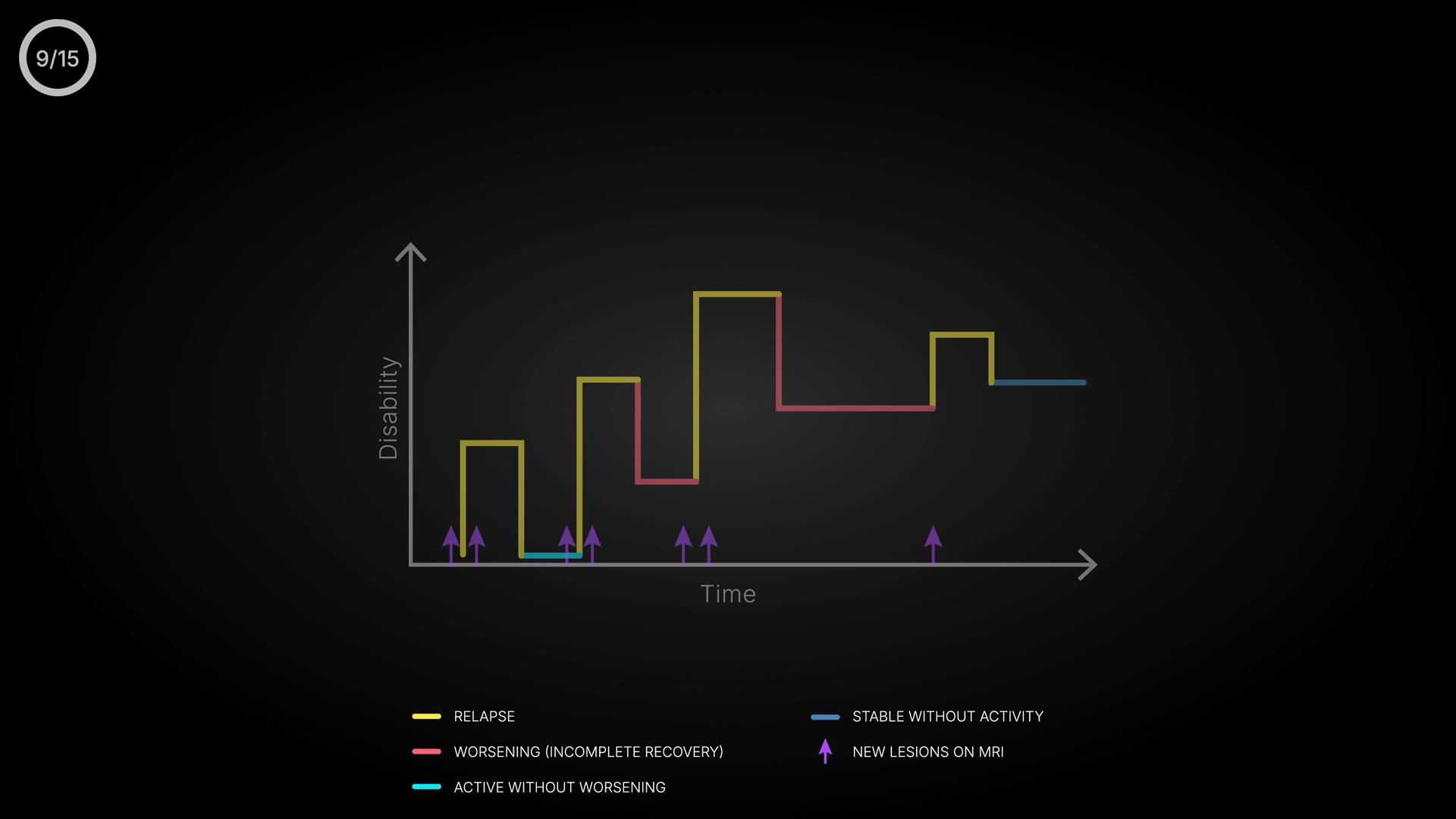
🖼🟢 ОкГрафик «инвалидизация / время» без заголовка (вход в главу «Ремиссия»)9/15
📺 На экране
9/15 | Disability | Time | RELAPSE | WORSENING (INCOMPLETE RECOVERY) | ACTIVE WITHOUT WORSENING | STABLE WITHOUT ACTIVITY | NEW LESIONS ON MRI
🟢 Правок нет — экран чистый.
подробнее: речь + разбор по пунктам
💬 Что говорит врач в этот момент“The second part of this relapsing -remitting course is remission,”
📺 Весь текст экрана9/15 | Disability | Time | RELAPSE | WORSENING (INCOMPLETE RECOVERY) | ACTIVE WITHOUT WORSENING | STABLE WITHOUT ACTIVITY | NEW LESIONS ON MRI
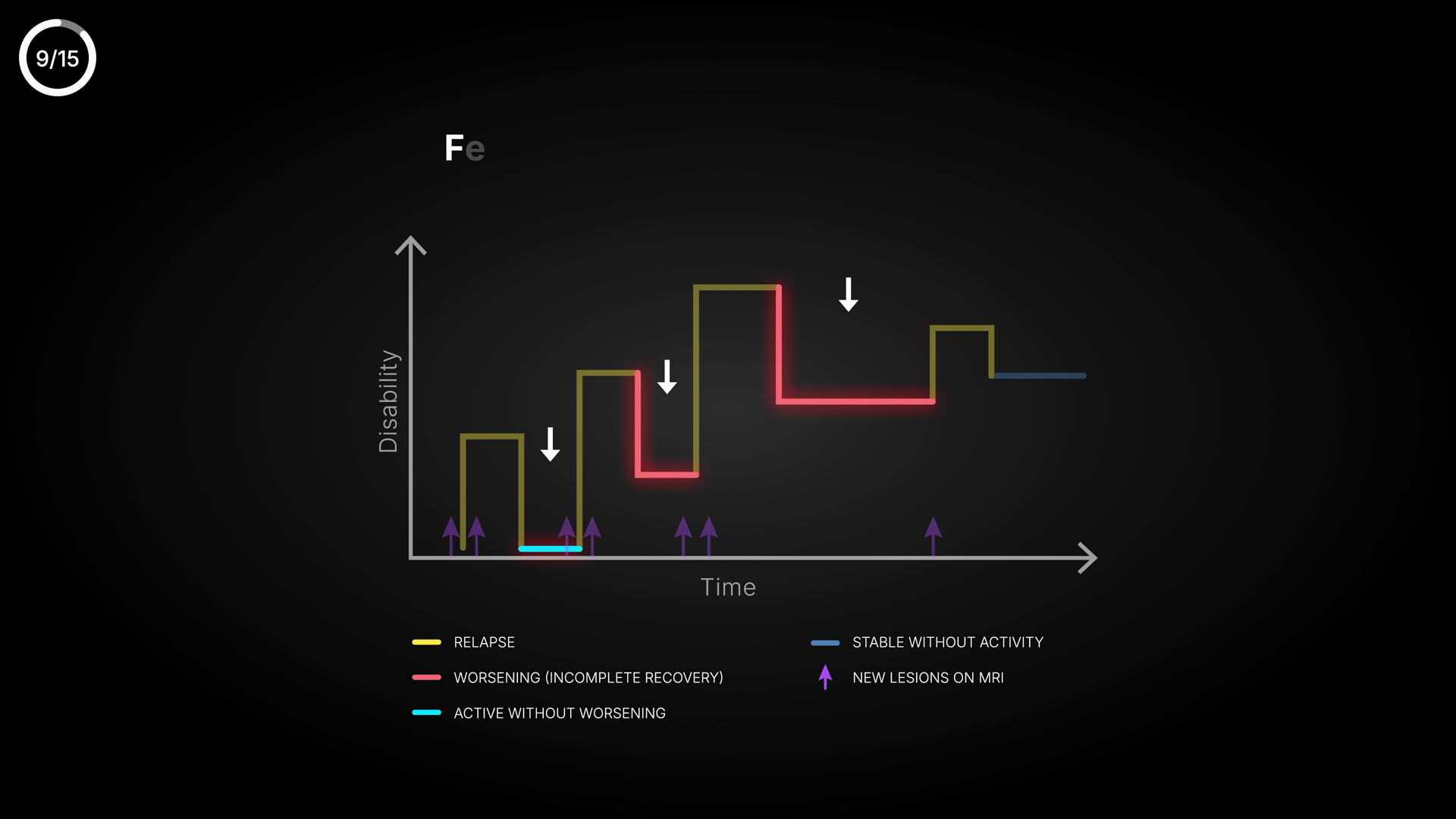
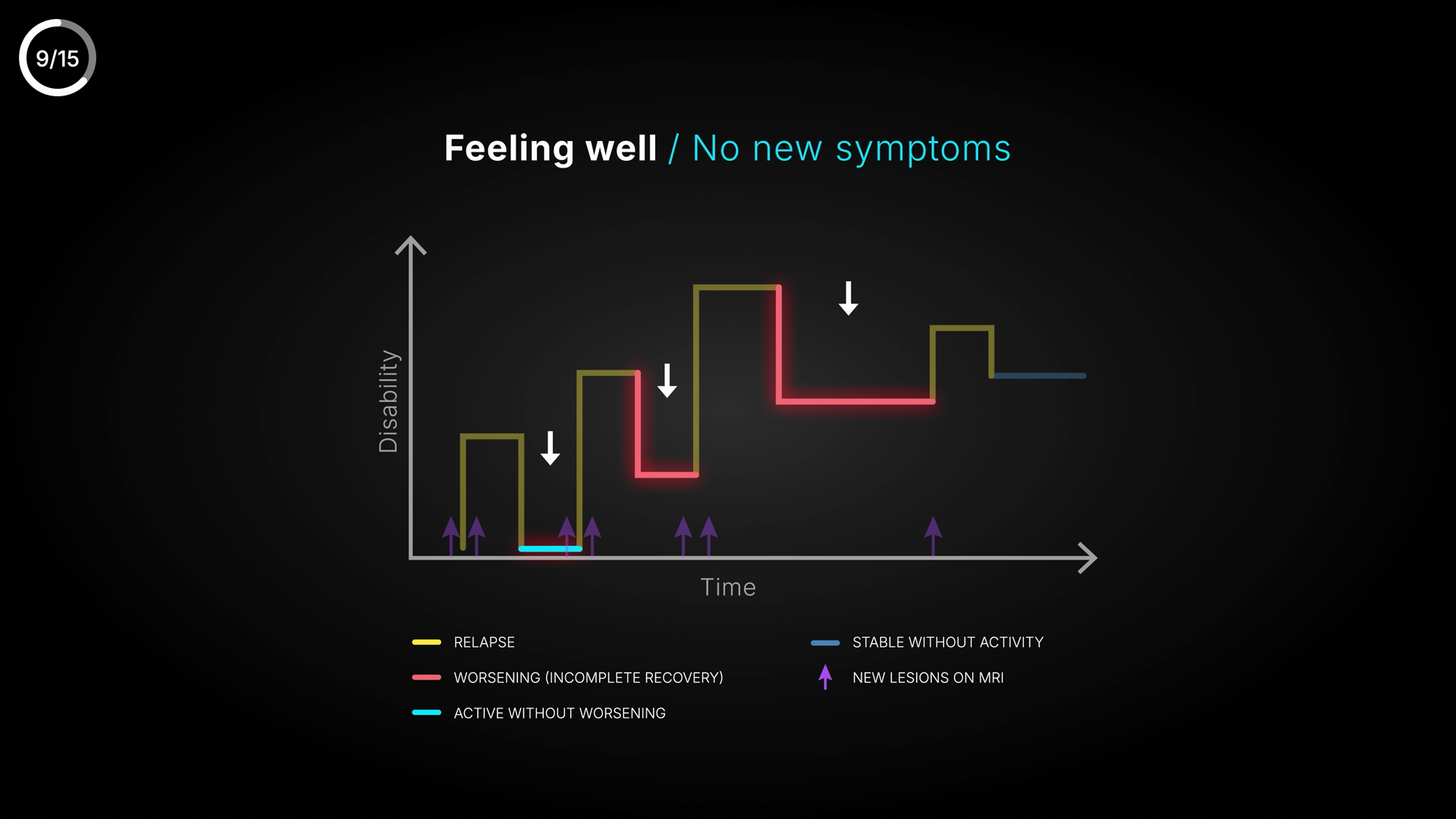
🖼🟢 ОкГрафик с подписью «Feeling well / No new symptoms» (ремиссия)9/15

📺 На экране
9/15 | Feeling well / No new symptoms | Disability | Time | RELAPSE | WORSENING (INCOMPLETE RECOVERY) | ACTIVE WITHOUT WORSENING | STABLE WITHOUT ACTIVITY | NEW LESIONS ON MRI
🟢 Правок нет — экран чистый.
подробнее: речь + разбор по пунктам
💬 Что говорит врач в этот момент“The second part of this relapsing -remitting course is remission, when the person feels well or has some lingering issues that bothered them before. No new symptoms appear during this time, and this state of remission is what we need to extend as much as possible using”
📺 Весь текст экрана9/15 | Feeling well / No new symptoms | Disability | Time | RELAPSE | WORSENING (INCOMPLETE RECOVERY) | ACTIVE WITHOUT WORSENING | STABLE WITHOUT ACTIVITY | NEW LESIONS ON MRI
#11✏️🔴 ИсправитьГрафик с ПИТРС и выводом «Longer remission = lower disability risk»9/15
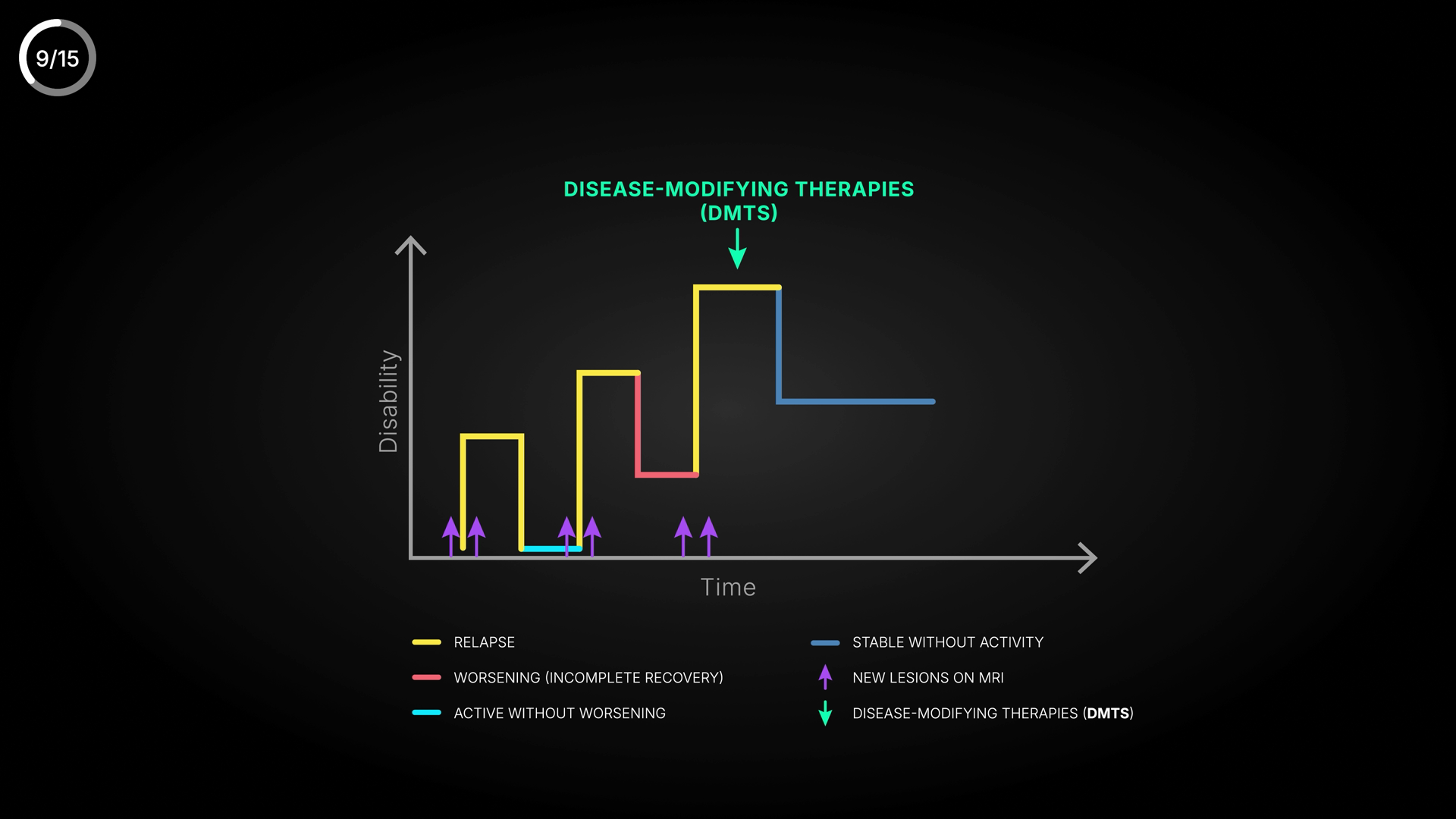
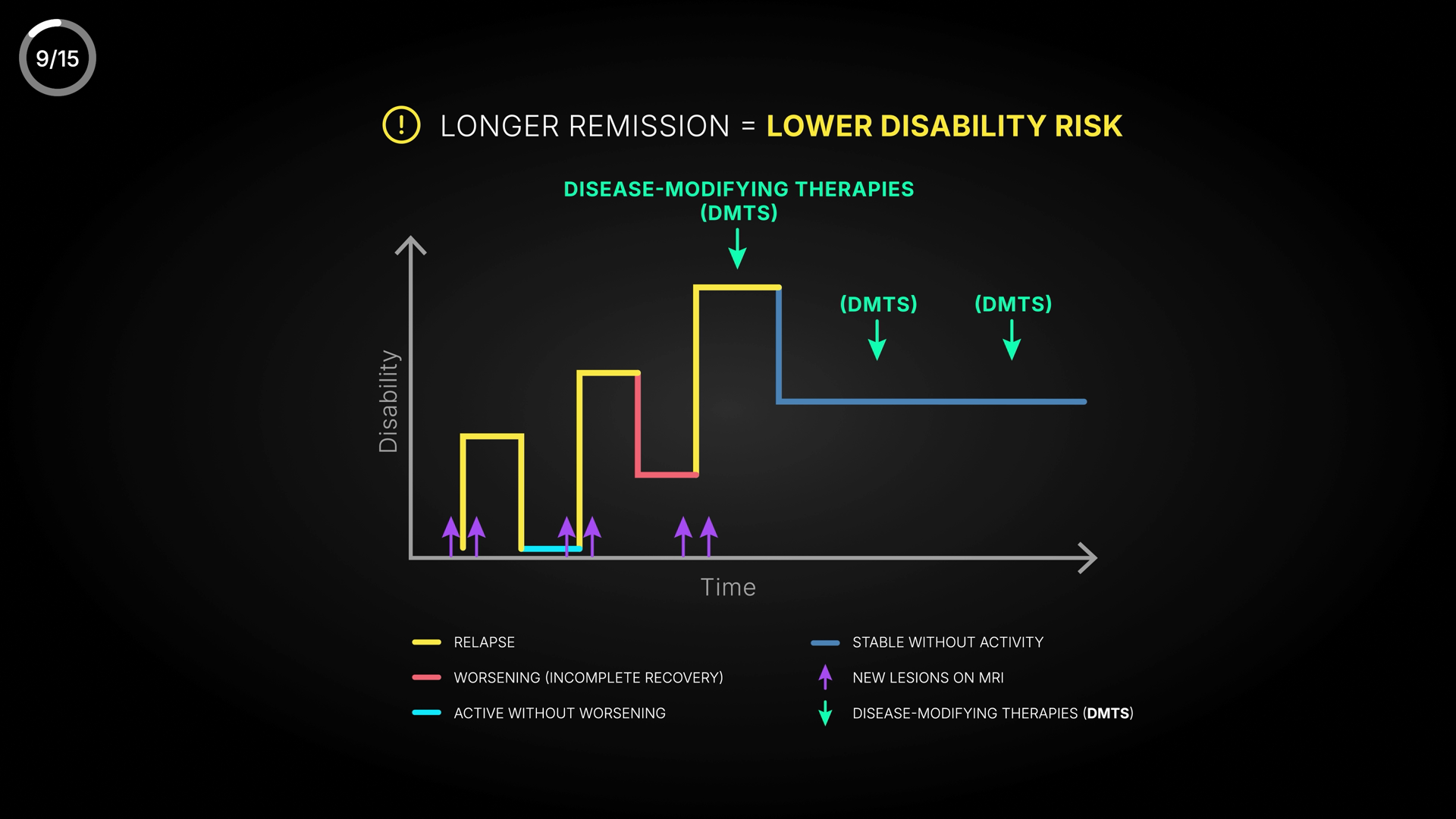

как естьDISEASE-MODIFYING THERAPIES (DMTS) / (DMTS) / (DMTS) on the chart vs "DISEASE-MODIFYING THERAPIES (DMTs)" in the legend
как надоDISEASE-MODIFYING THERAPIES (DMTs)
DISEASE-MODIFYING THERAPIES (DMTs)
✏️ Что сделать
- Убрать жёлтый «!» с позитивной строки; если нужен значок — мятная галочка ✓ в том же кружке.
как есть: yellow "!" warning badge in front of "LONGER REMISSION = LOWER DISABILITY RISK"
как надо: Remove the "!" badge; if an icon is wanted, use a mint #21FFB6 check mark "✓" in the same circle - Перекрасить «LOWER DISABILITY RISK» в мятный, жёлтый оставить только за линией RELAPSE.
как есть: "LOWER DISABILITY RISK" set in #FAE946 — the exact yellow of the RELAPSE legend swatch
как надо: LONGER REMISSION = LOWER DISABILITY RISK
Исправить (DMTS) на (DMTs) во всех трёх подписях на графике.
подробнее: речь + разбор по пунктам
💬 Что говорит врач в этот момент“and this state of remission is what we need to extend as much as possible using disease modifying therapies for MS, maximizing the remission interval. The longer we maintain it, the lower the chance of developing a disabling complication in the future. In a person with MS, MS.”
📺 Весь текст экрана9/15 | (!) LONGER REMISSION = LOWER DISABILITY RISK | DISEASE-MODIFYING THERAPIES (DMTS) | (DMTS) | (DMTS) | Disability | Time | RELAPSE | WORSENING (INCOMPLETE RECOVERY) | ACTIVE WITHOUT WORSENING | STABLE WITHOUT ACTIVITY | NEW LESIONS ON MRI | DISEASE-MODIFYING THERAPIES (DMTs)
- ГрамматикаИсправить (DMTS) на (DMTs) во всех трёх подписях на графике.
- СмыслУбрать жёлтый «!» с позитивной строки; если нужен значок — мятная галочка ✓ в том же кружке.
- СмыслПерекрасить «LOWER DISABILITY RISK» в мятный, жёлтый оставить только за линией RELAPSE.
🖼🟢 ОкТитр главы «Why Relapses Happen»

📺 На экране
WHY RELAPSES HAPPEN
🟢 Правок нет — экран чистый.
подробнее: речь + разбор по пунктам
💬 Что говорит врач в этот момент“complication in the future. In a person with MS, MS. Relapses occur because the immune system at some point becomes activated.”
📺 Весь текст экранаWHY RELAPSES HAPPEN
🖼🟢 ОкПанель «Autoimmune disease — периодические атаки»10/15
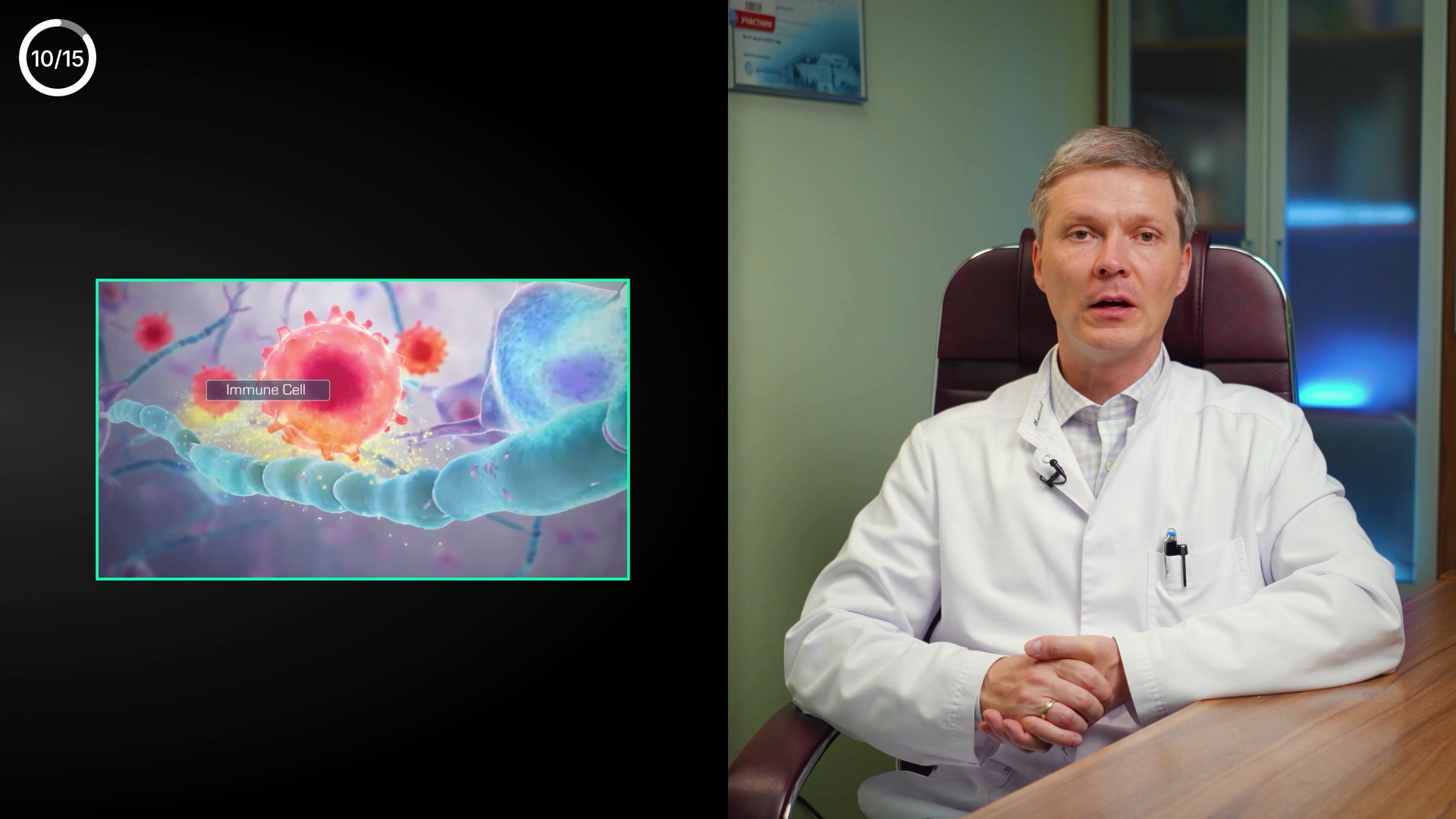
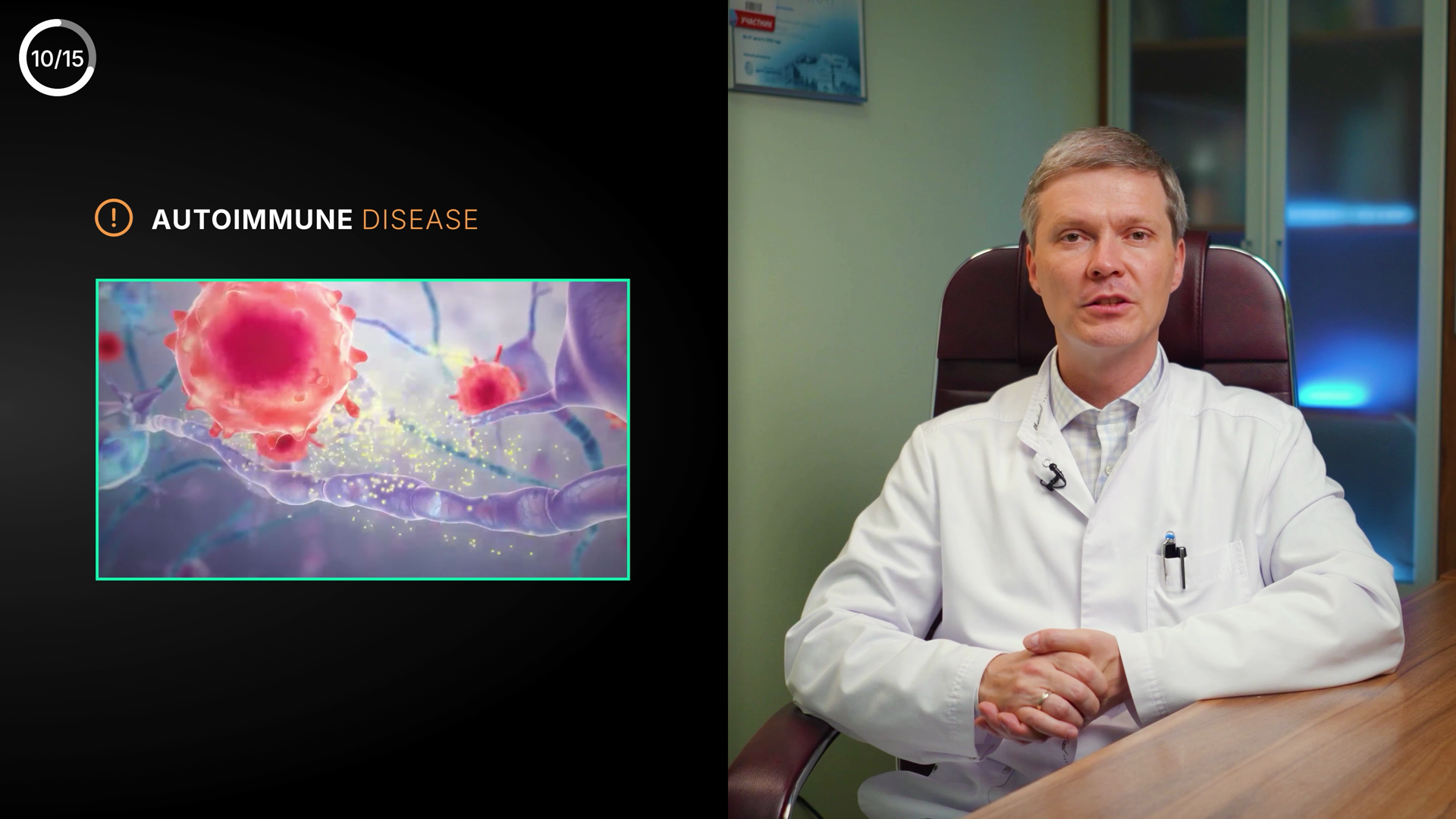
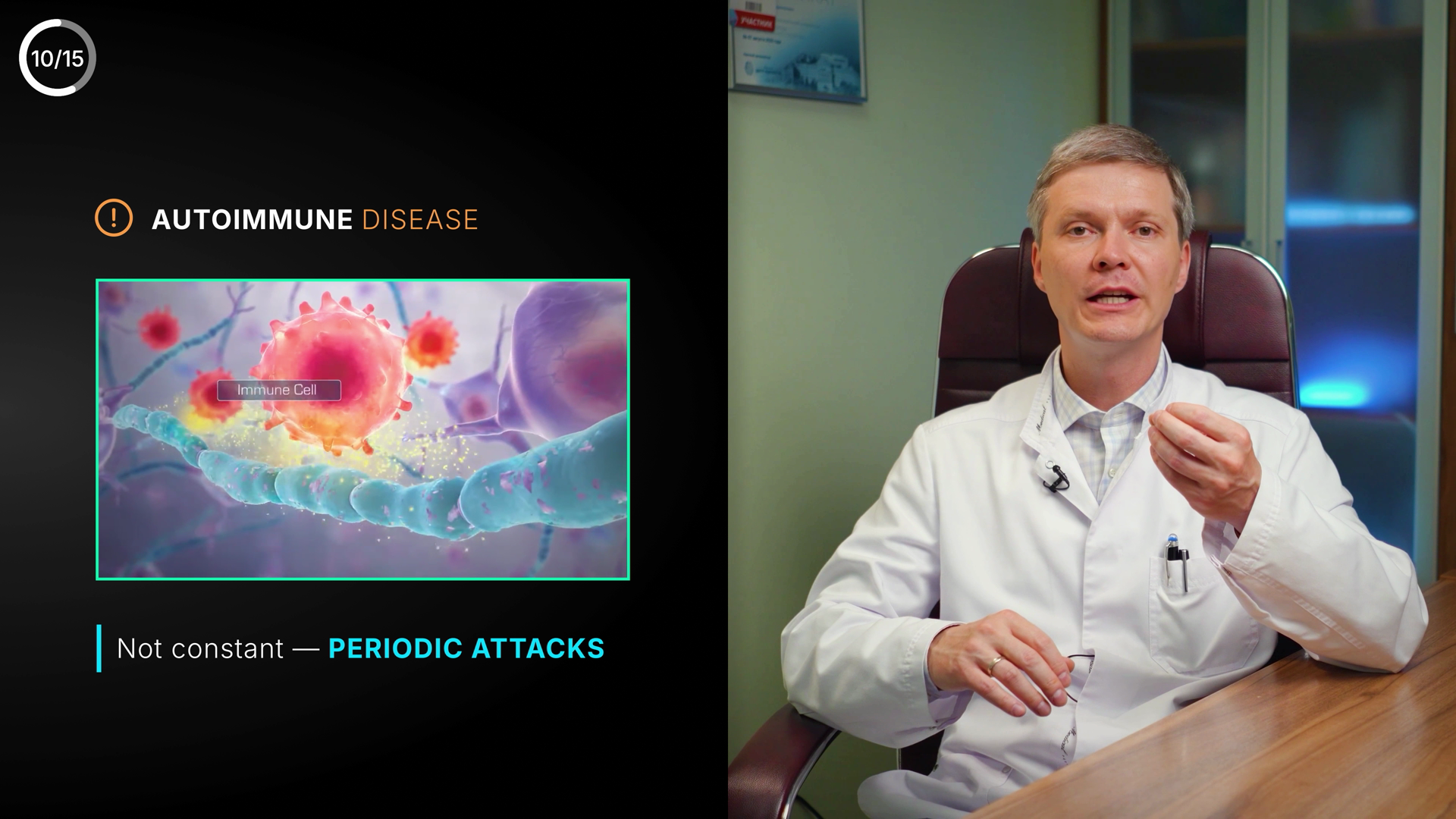
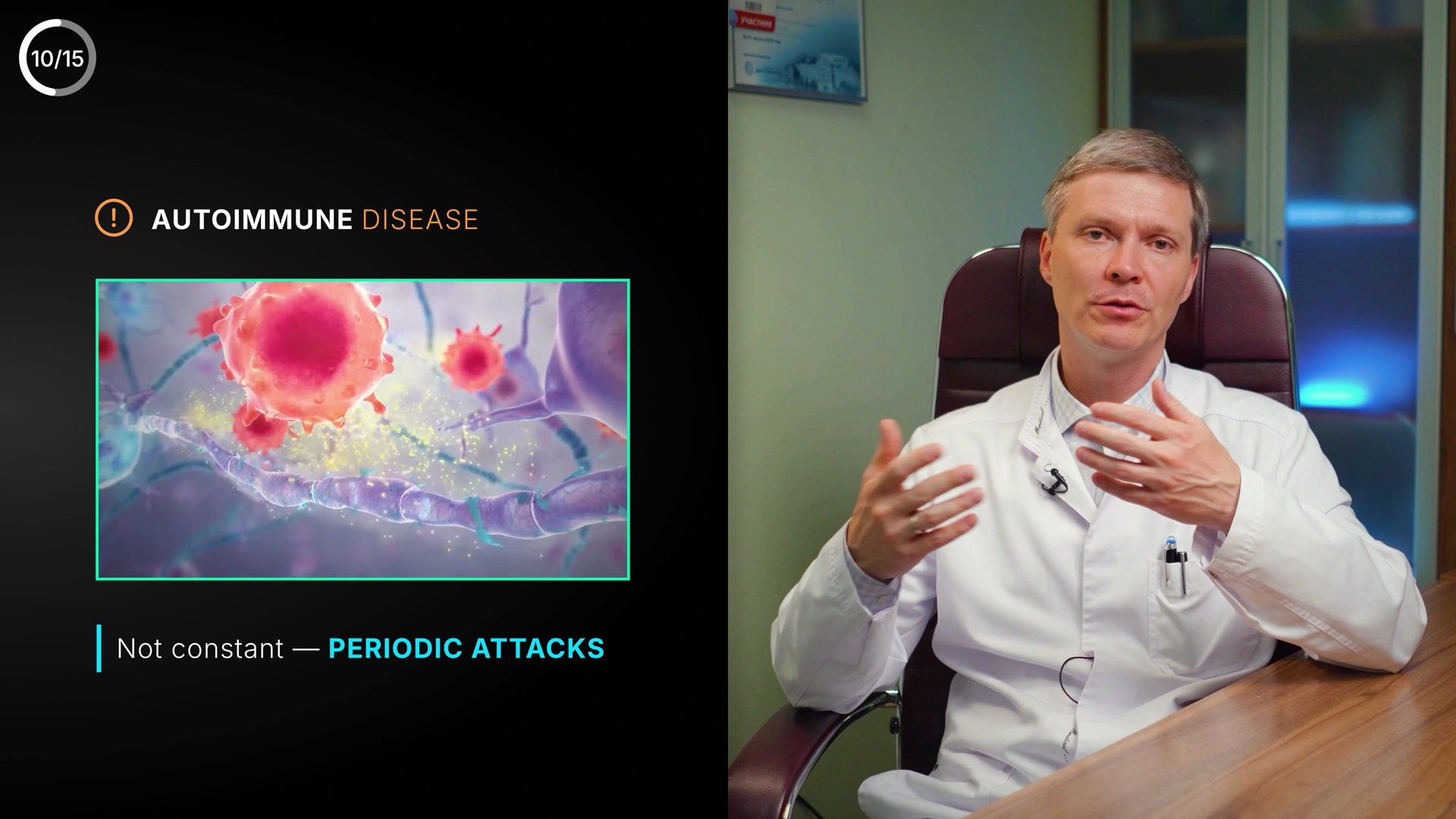
📺 На экране
AUTOIMMUNE DISEASE | Immune Cell | Not constant — PERIODIC ATTACKS
🟢 Правок нет — экран чистый.
подробнее: речь + разбор по пунктам
💬 Что говорит врач в этот момент“Relapses occur because the immune system at some point becomes activated. You need to understand that in MS, we're dealing with autoimmunity. The disease doesn't mean the immune system is constantly destroying myelin. No, it destroys myelin during relatively brief time intervals. A sudden immune activation begins. Immune cells enter the brain,”
📺 Весь текст экранаAUTOIMMUNE DISEASE | Immune Cell | Not constant — PERIODIC ATTACKS
🖼🟢 ОкВрезка «T Cell» (сток)10/15
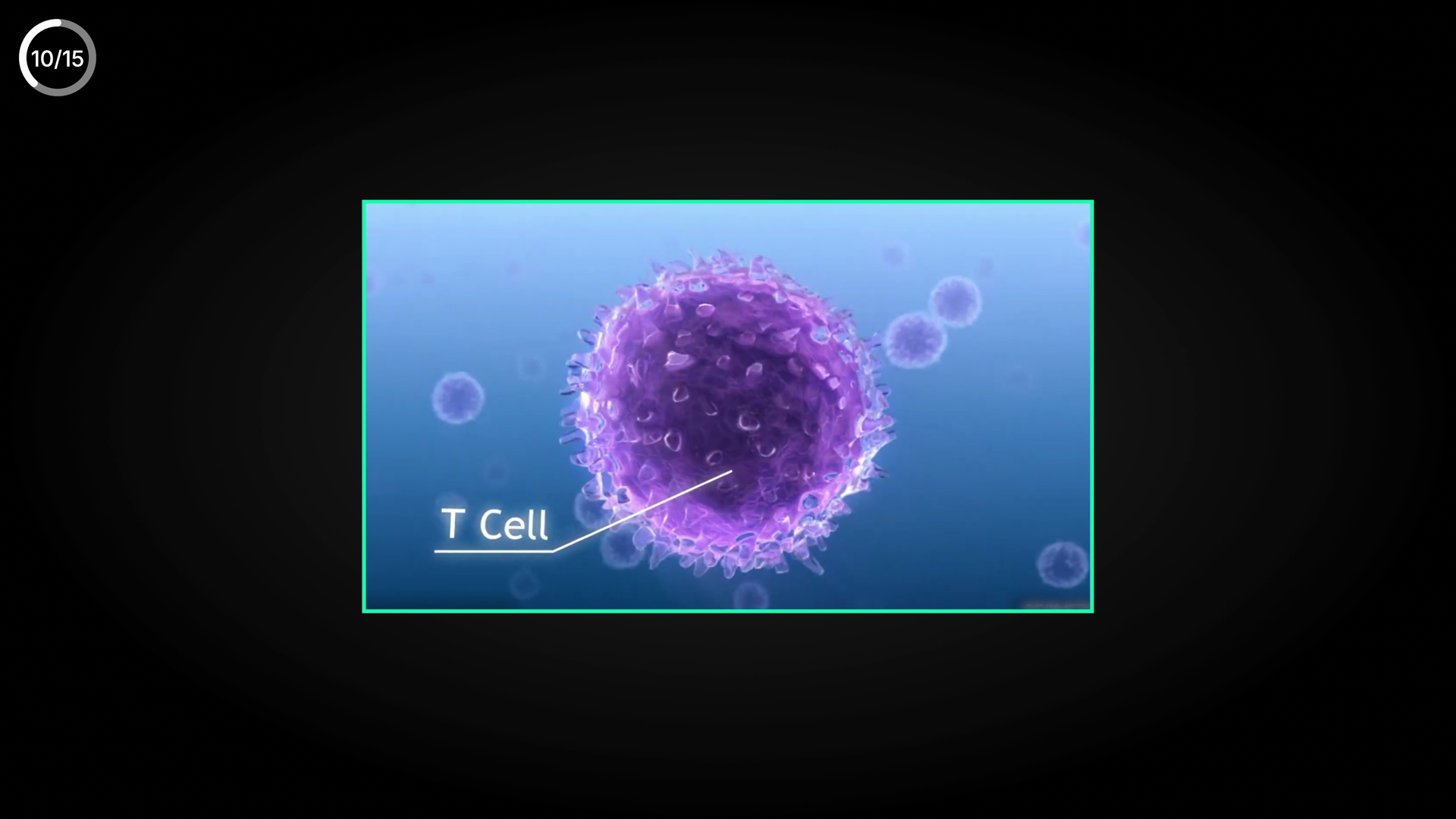
📺 На экране
T Cell
🟢 Правок нет — экран чистый.
подробнее: речь + разбор по пунктам
💬 Что говорит врач в этот момент“A sudden immune activation begins. Immune cells enter the brain,”
📺 Весь текст экранаT Cell
🖼🟢 ОкКлеточная анимация (иммунная атака) без подписей10/15
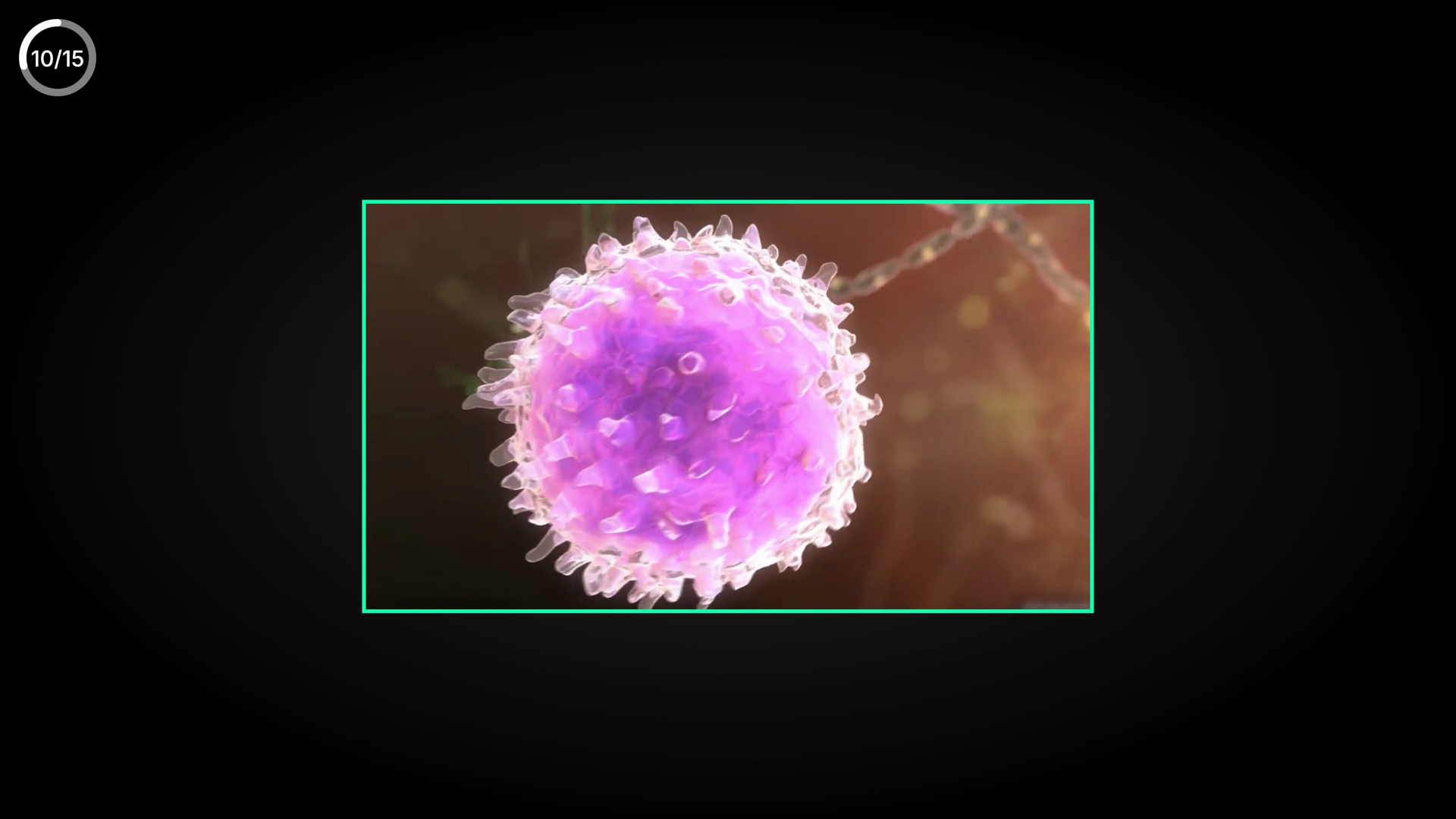
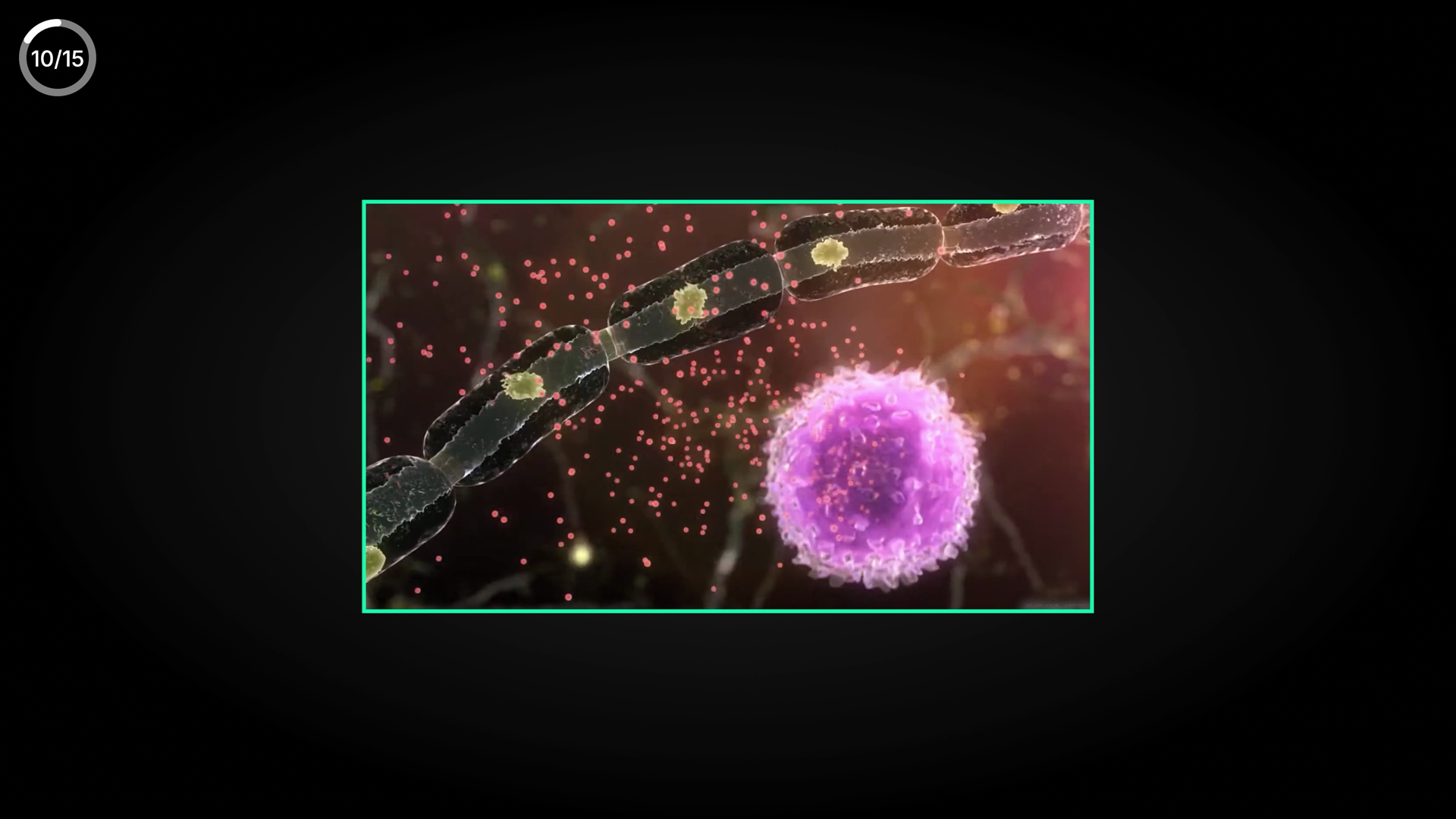
🟢 Правок нет — экран чистый.
подробнее: речь + разбор по пунктам
💬 Что говорит врач в этот момент“A sudden immune activation begins. Immune cells enter the brain, start damaging it, forming new lesions, and then everything subsides. This entry of immune immune cells and appearance of new lesions.”
#12✏️🔴 Исправить«Обострение = воспаление»: врезка + сравнение МРТ10/15 → 11/15
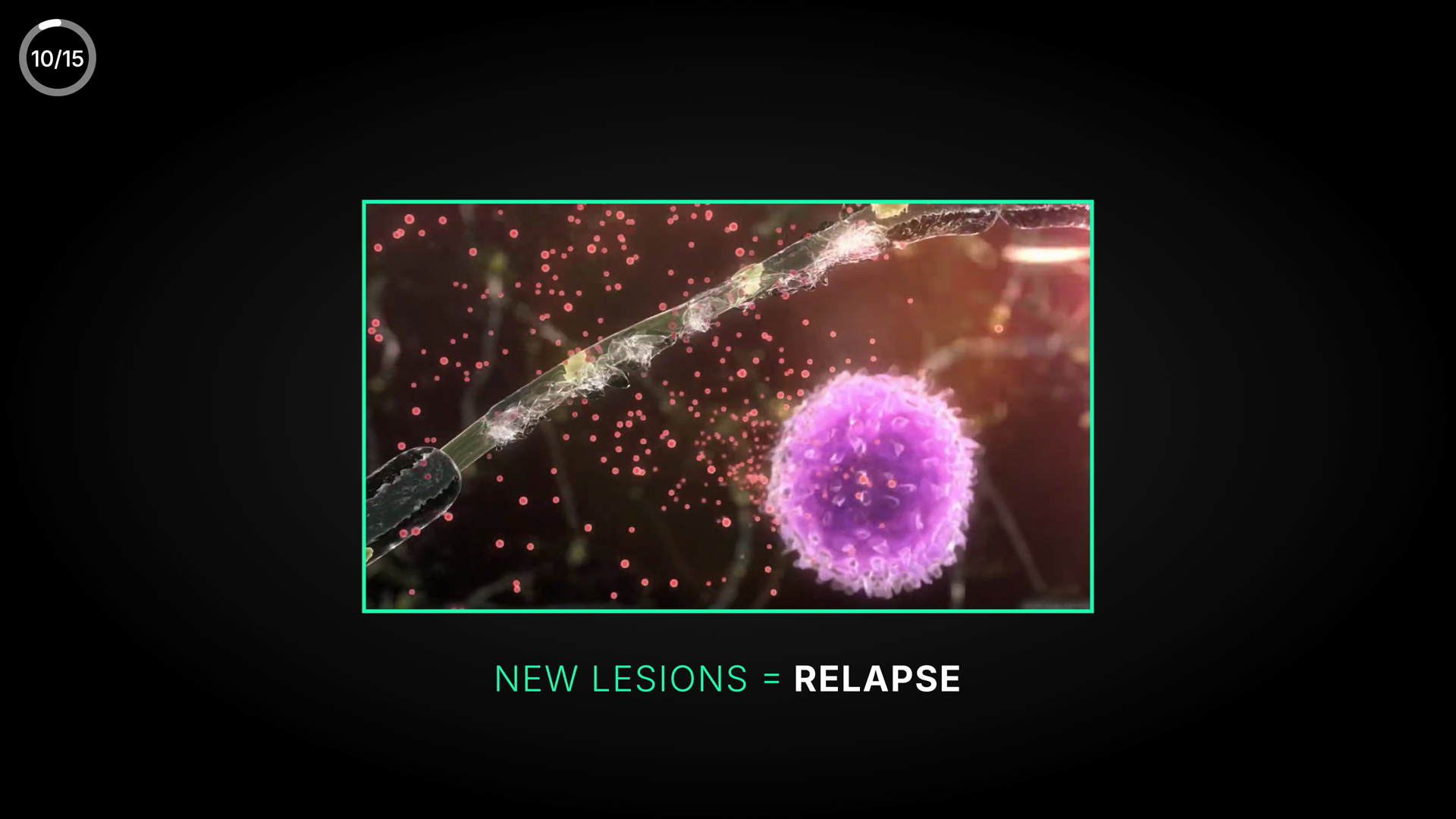
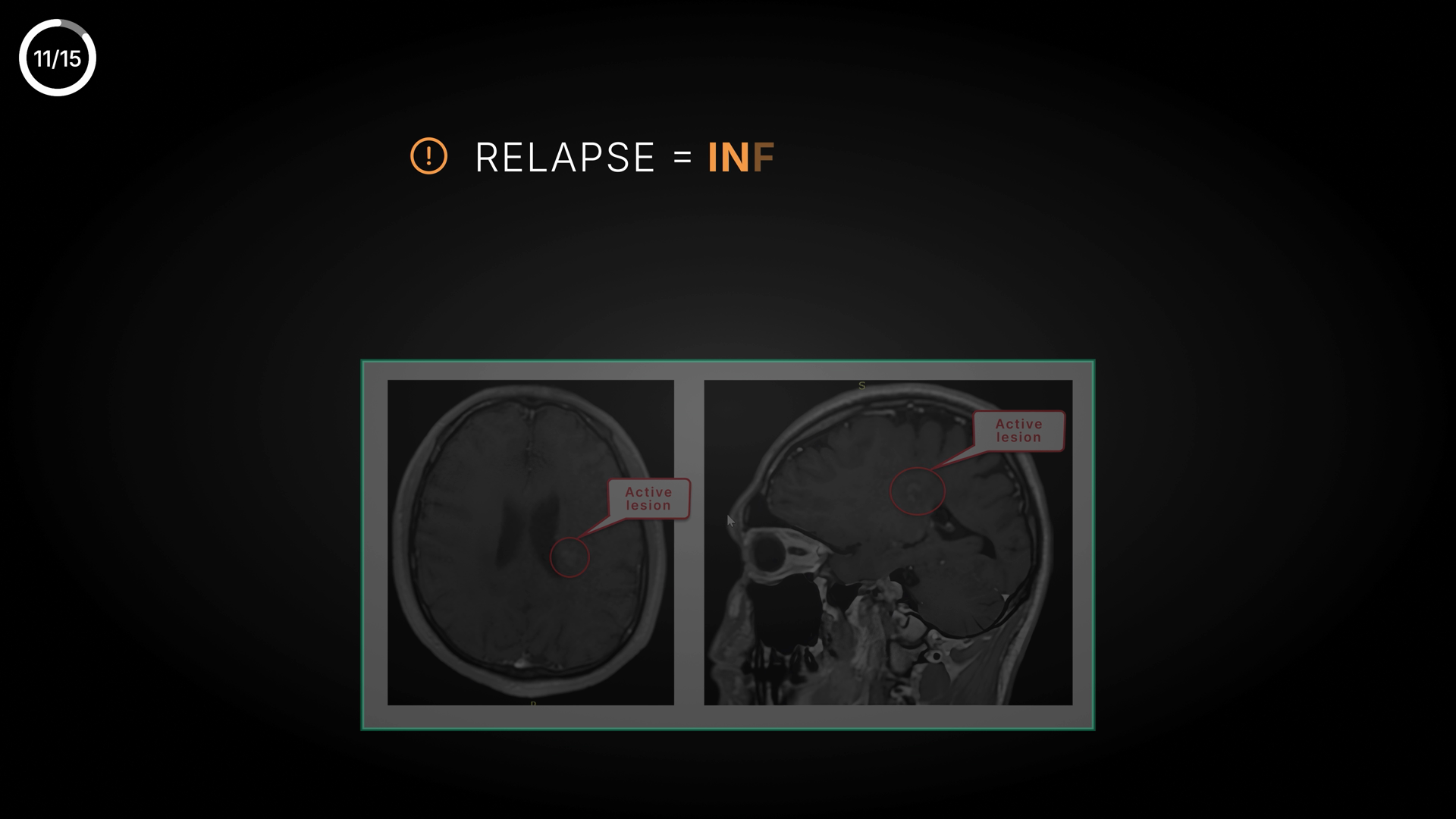
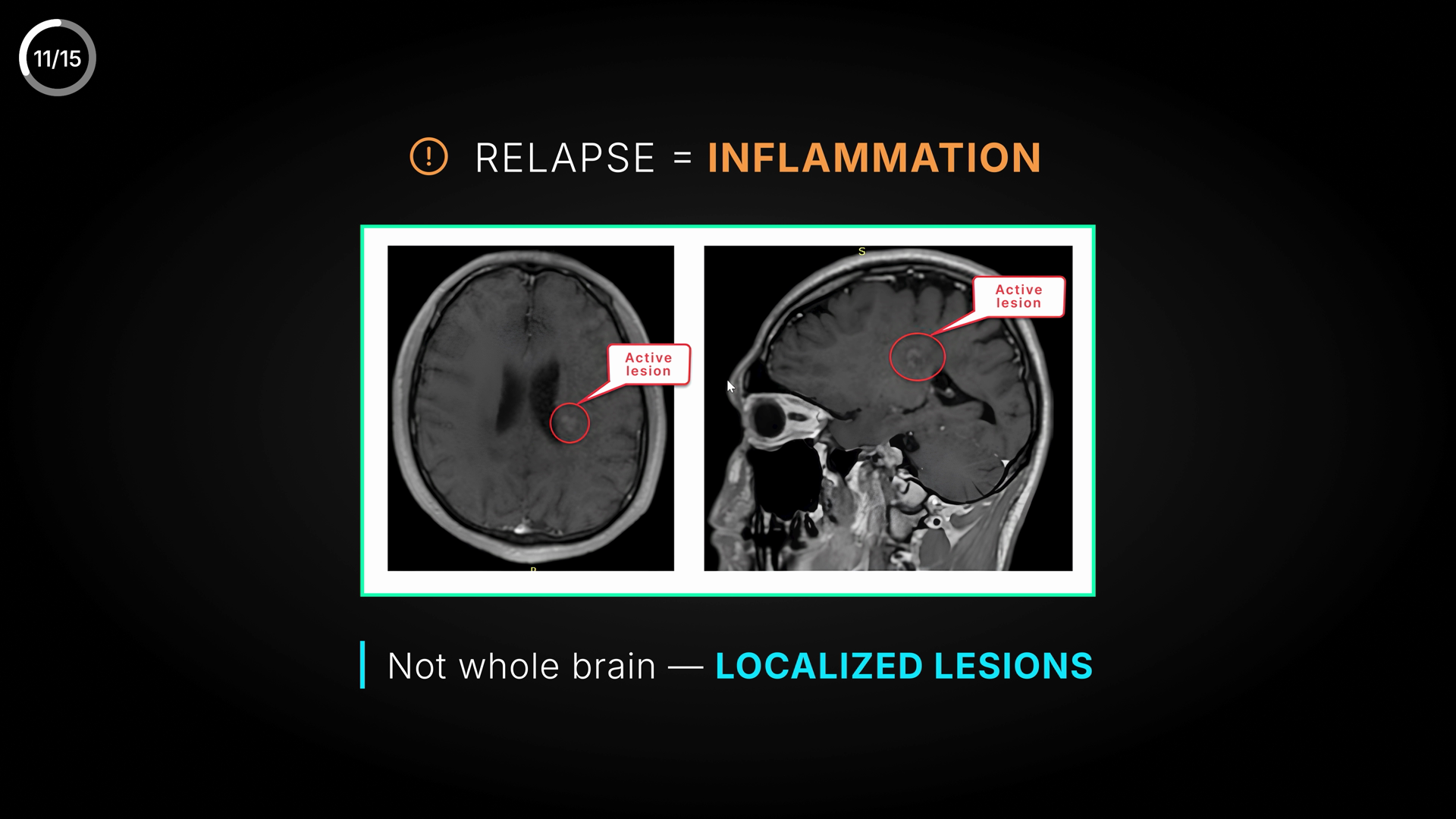

как естьNot whole brain — LOCALIZED LESIONS
как надоNot the whole brain — LOCALIZED LESIONS
Not the whole brain — LOCALIZED LESIONS
Добавить артикль в титре под МРТ.
подробнее: речь + разбор по пунктам
💬 Что говорит врач в этот момент“This entry of immune immune cells and appearance of new lesions. That's what a relapse is. So a relapse is essentially inflammation within the central nervous system, inflammation within the system. In MS, it doesn't involve the entire brain at once. Rather, it comes in measured doses, in the form of new lesions. New lesions appear, and importantly, during a relapse, these lesions begin to”
📺 Весь текст экранаNEW LESIONS = RELAPSE | (!) RELAPSE = INFLAMMATION | Active lesion | Active lesion | Not whole brain — LOCALIZED LESIONS
- ГрамматикаДобавить артикль в титре под МРТ.
🖼🟢 ОкПлашка «Очаги накапливают контраст» рядом с врачом11/15

📺 На экране
(!) | LESIONS ACCUMULATE | CONTRAST
🟢 Правок нет — экран чистый.
подробнее: речь + разбор по пунктам
💬 Что говорит врач в этот момент“New lesions appear, and importantly, during a relapse, these lesions begin to accumulate contrast agent. That's why we do MRI with contrast,”
📺 Весь текст экрана(!) | LESIONS ACCUMULATE | CONTRAST
🖼🟢 ОкТитульная карточка «MRI with Contrast»12/15

📺 На экране
MRI with Contrast
🟢 Правок нет — экран чистый.
подробнее: речь + разбор по пунктам
💬 Что говорит врач в этот момент“accumulate contrast agent. That's why we do MRI with contrast, to see if there's active inflammation in the brain.”
📺 Весь текст экранаMRI with Contrast
🖼🟢 ОкВрач в кадре — «почему очаги накапливают контраст?»12/15

🟢 Правок нет — экран чистый.
подробнее: речь + разбор по пунктам
💬 Что говорит врач в этот момент“to see if there's active inflammation in the brain. But why do these lesions accumulate contrast?”
🖼🟢 ОкСхема: контраст → кровоток → мозг12/15
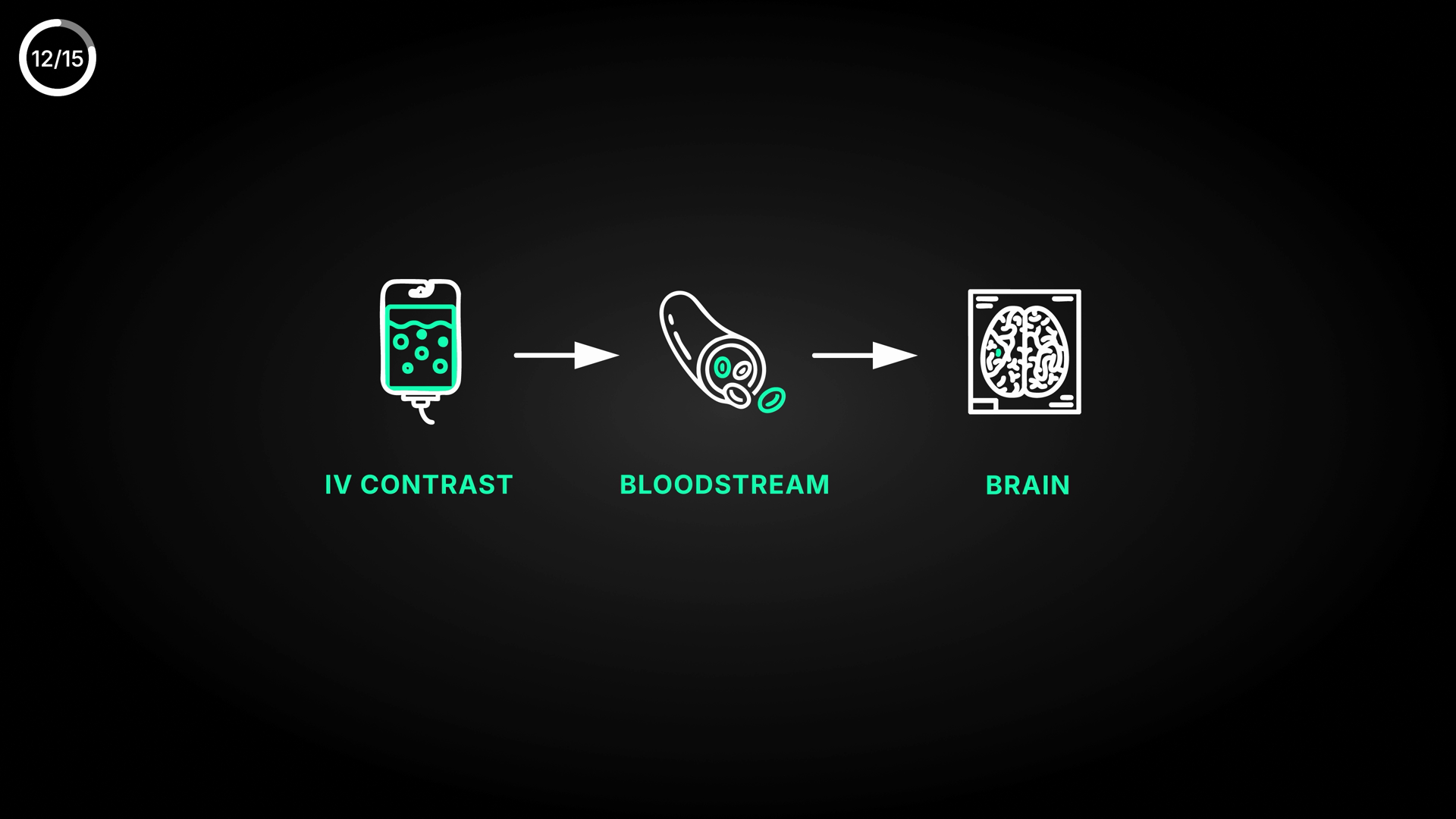
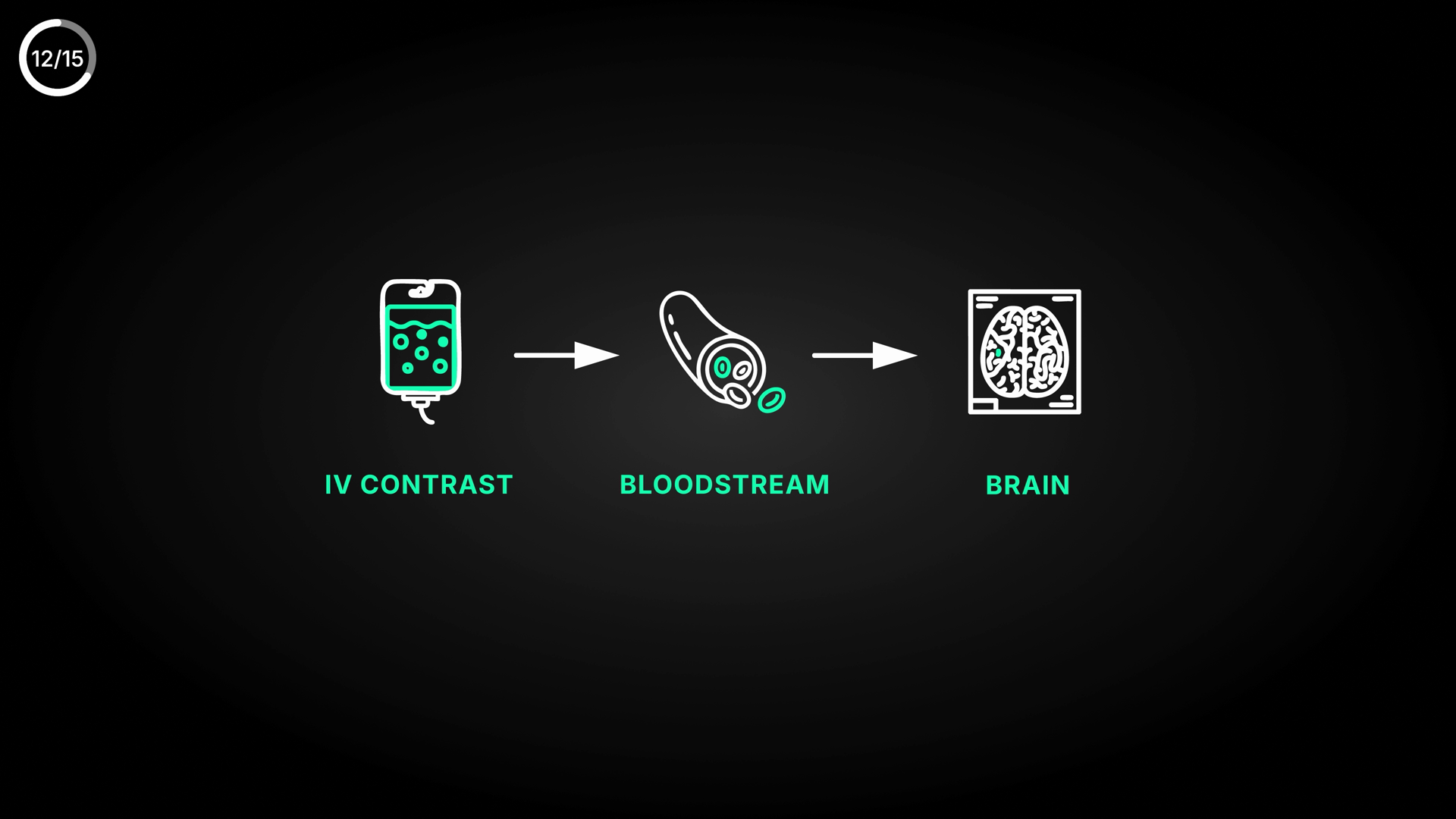
📺 На экране
IV CONTRAST | BLOODSTREAM | BRAIN | BLOOD-BRAIN BARRIER (выезжает на 7:36)
🟢 Правок нет — экран чистый.
подробнее: речь + разбор по пунктам
💬 Что говорит врач в этот момент“We administer contrast agent intravenously, so it's in the bloodstream. The brain is separated from our blood system by what's called the blood -brain barrier. This barrier is completely impermeable to most molecules.”
📺 Весь текст экранаIV CONTRAST | BLOODSTREAM | BRAIN | BLOOD-BRAIN BARRIER (выезжает на 7:36)
🖼🟢 ОкГематоэнцефалический барьер: норма vs воспаление12/15
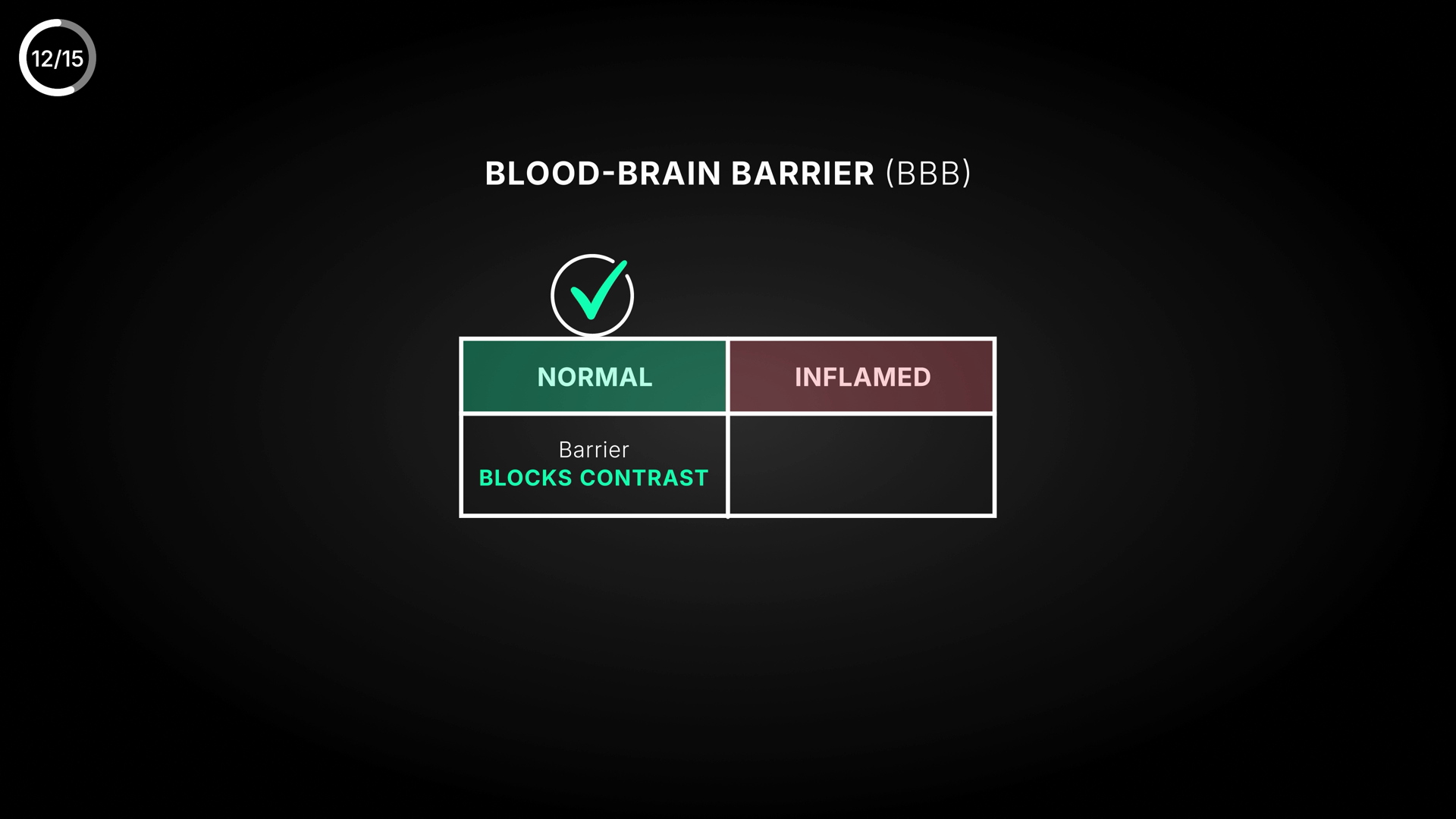
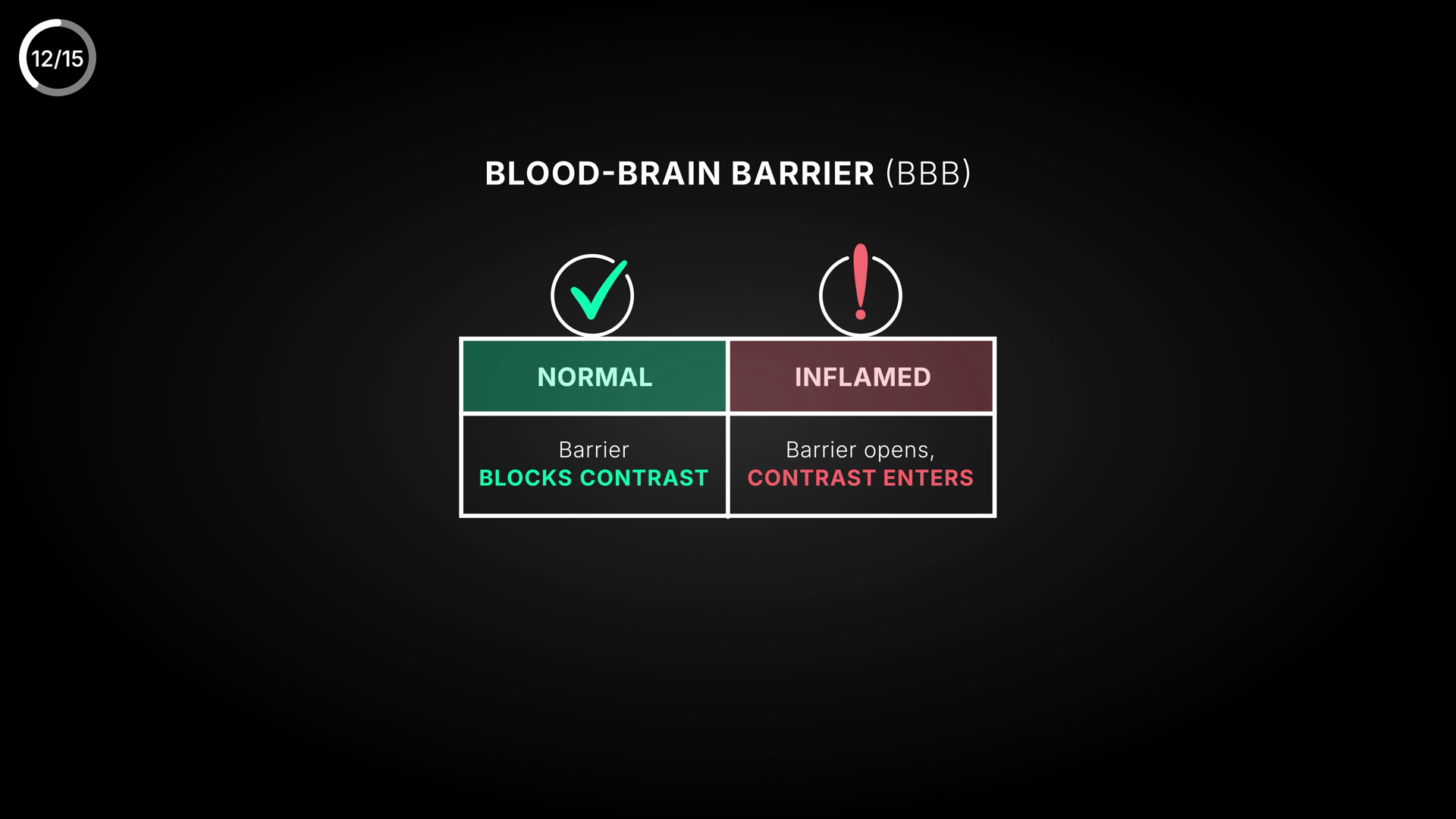
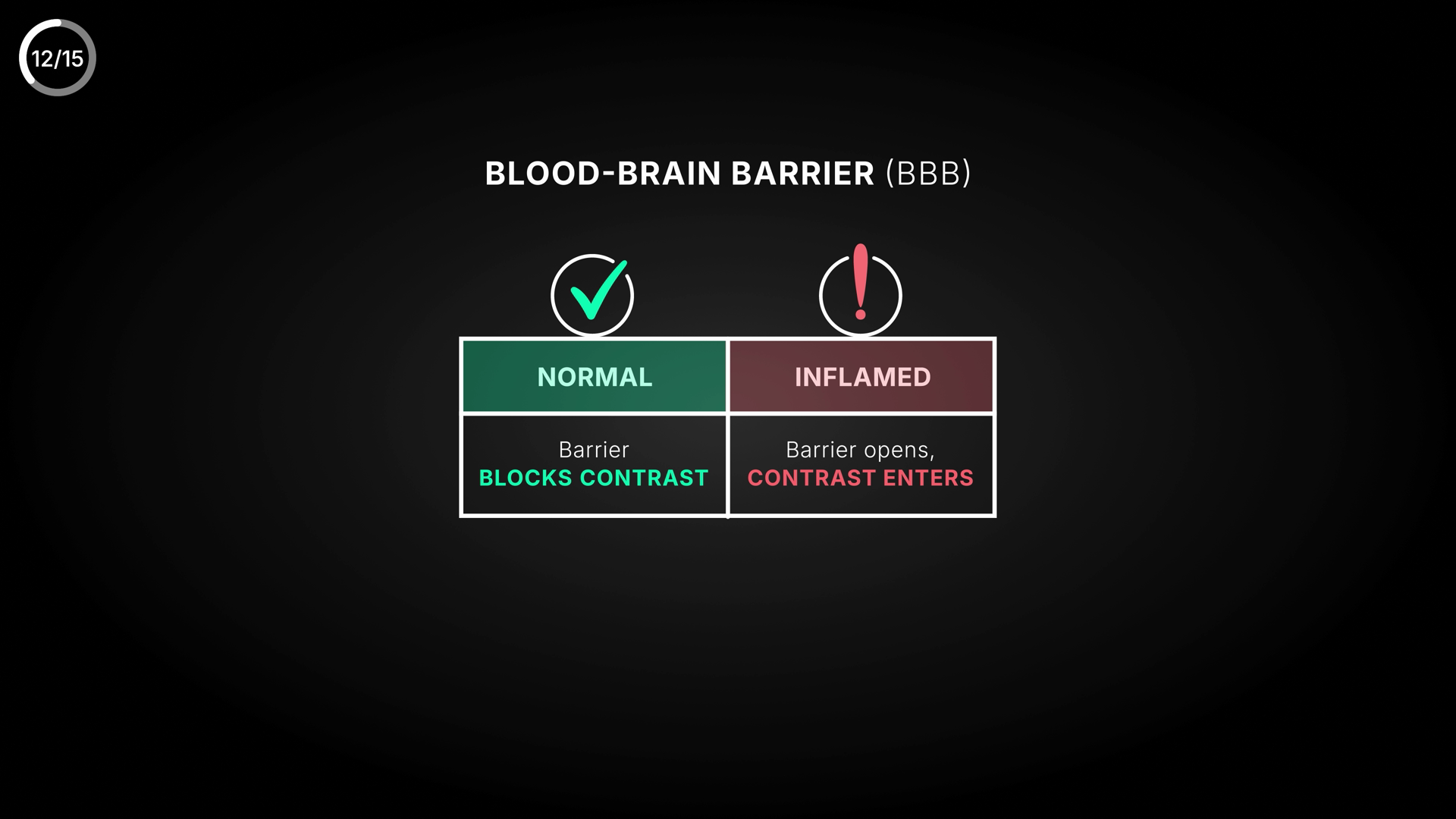
📺 На экране
BLOOD-BRAIN BARRIER (BBB) | NORMAL | INFLAMED | Barrier BLOCKS CONTRAST | Barrier opens, CONTRAST ENTERS | 12/15
🟢 Правок нет — экран чистый.
подробнее: речь + разбор по пунктам
💬 Что говорит врач в этот момент“barrier. This barrier is completely impermeable to most molecules. But if an area of inflammation develops, then in that area, this section of the barrier becomes becomes permeable and various substances rush”
📺 Весь текст экранаBLOOD-BRAIN BARRIER (BBB) | NORMAL | INFLAMED | Barrier BLOCKS CONTRAST | Barrier opens, CONTRAST ENTERS | 12/15
🖼🟢 ОкМРТ с контрастом — чужая вертикальная вставка12/15
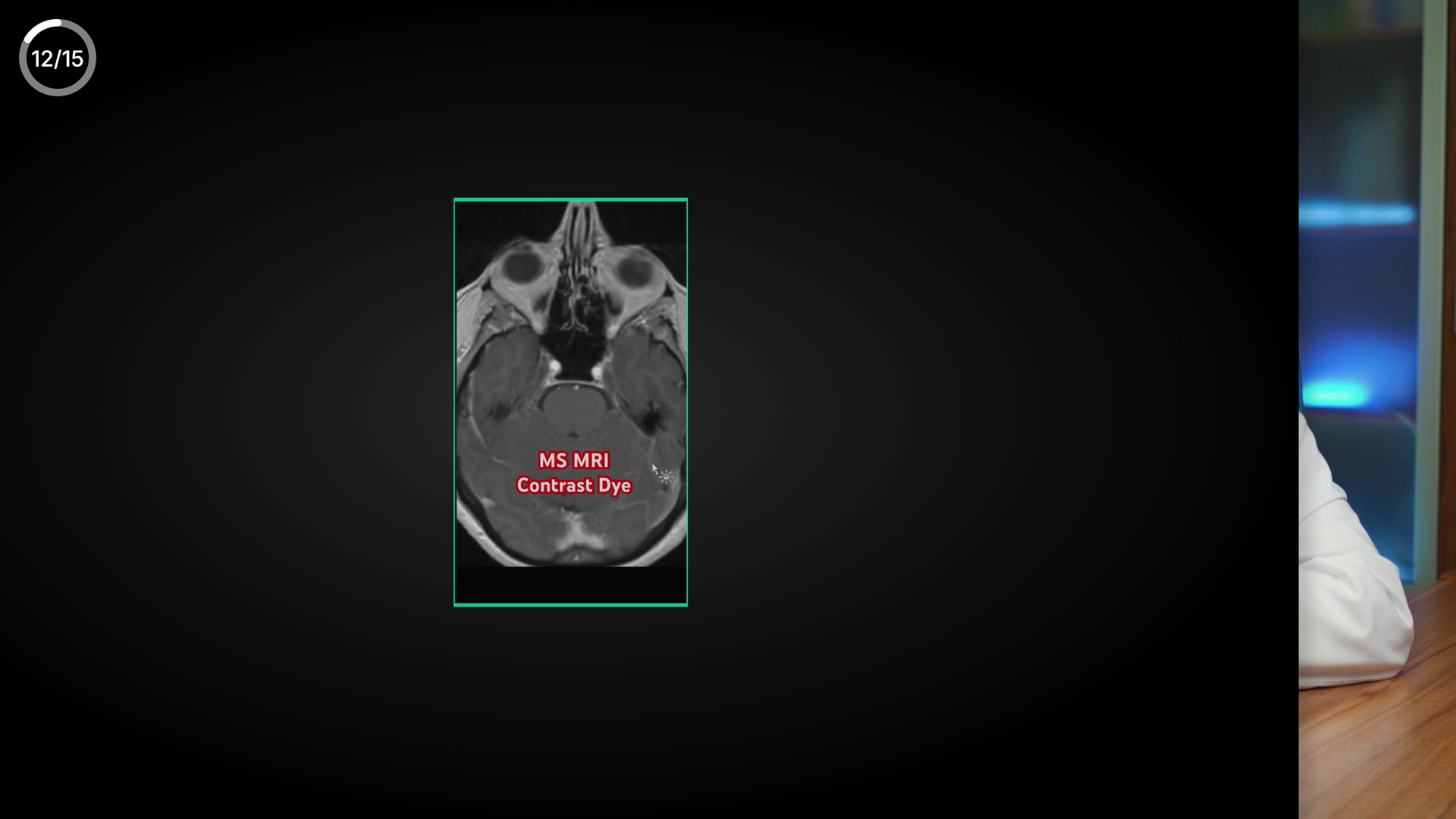
📺 На экране
MS MRI | Contrast Dye | 12/15
🟢 Правок нет — экран чистый.
подробнее: речь + разбор по пунктам
💬 Что говорит врач в этот момент“It penetrates into this limited area of the new lesion. And we see this and say, you've developed acute inflammation in the brain in the form of a lesion and it”
📺 Весь текст экранаMS MRI | Contrast Dye | 12/15
🖼🟢 ОкАктивный очаг = нужно лечение (МРТ, панели A/B)12/15
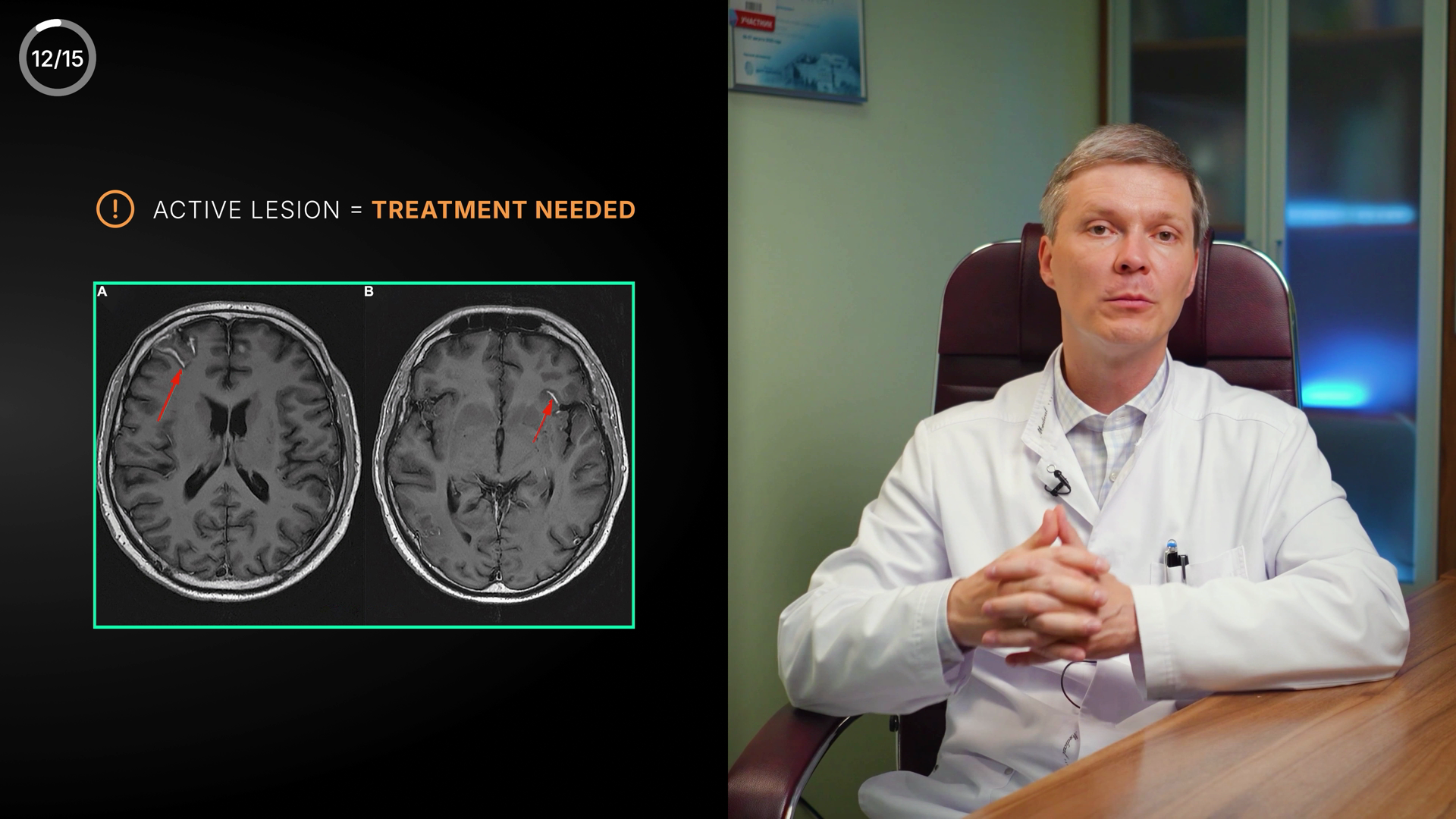
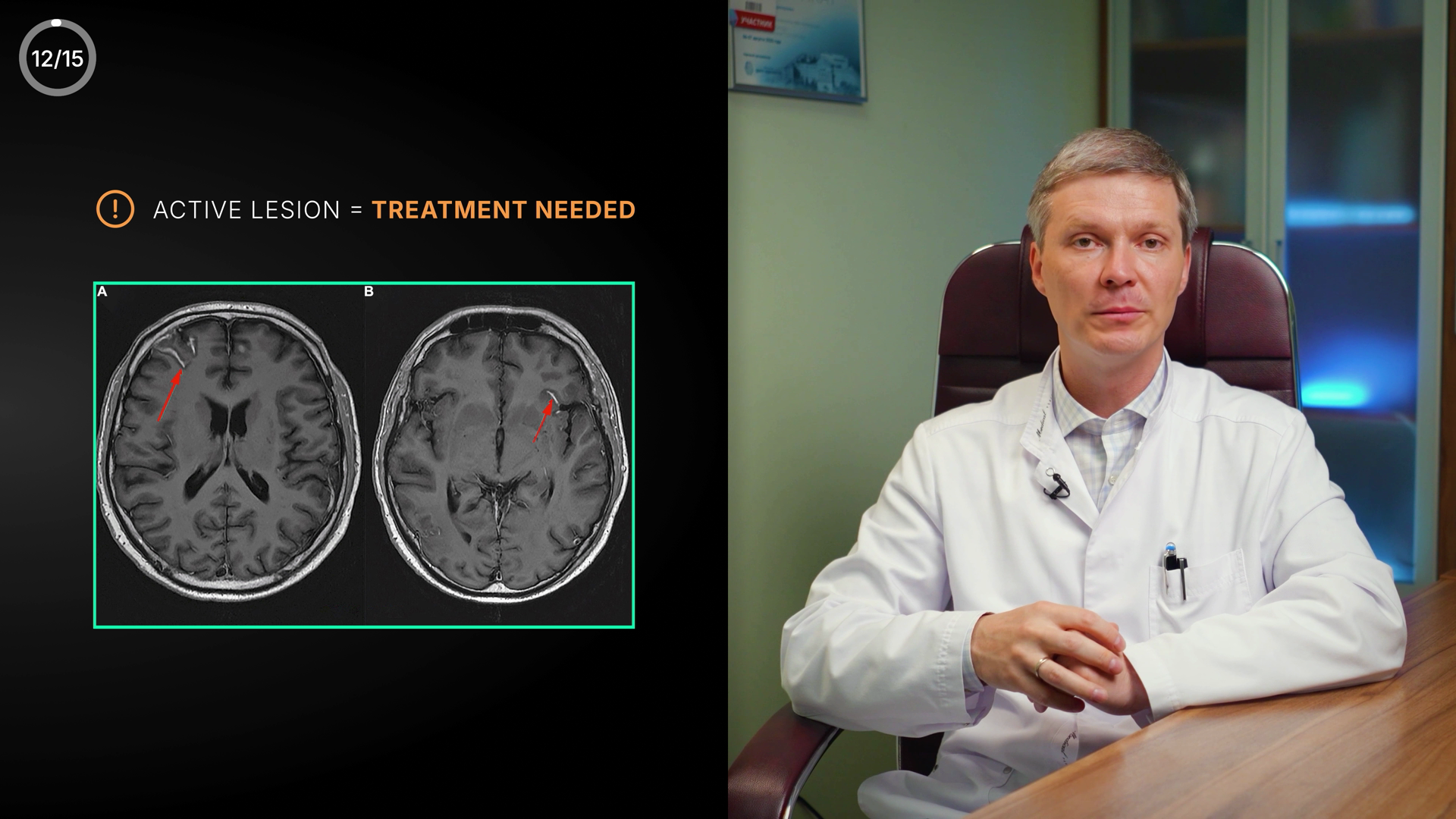
📺 На экране
ACTIVE LESION = TREATMENT NEEDED | A | B | 12/15
🟢 Правок нет — экран чистый.
подробнее: речь + разбор по пунктам
💬 Что говорит врач в этот момент“you've developed acute inflammation in the brain in the form of a lesion and it requires treatment. A new lesion forming in the brain or spinal cord carries certain manifestations.”
📺 Весь текст экранаACTIVE LESION = TREATMENT NEEDED | A | B | 12/15
🖼🟢 ОкТитр «Новый очаг = симптомы»
📺 На экране
NEW LESION = SYMPTOMS
🟢 Правок нет — экран чистый.
подробнее: речь + разбор по пунктам
💬 Что говорит врач в этот момент“A new lesion forming in the brain or spinal cord carries certain manifestations.”
📺 Весь текст экранаNEW LESION = SYMPTOMS
🖼🟢 ОкB-roll: иммунная клетка разрушает миелин (без подписи)13/15
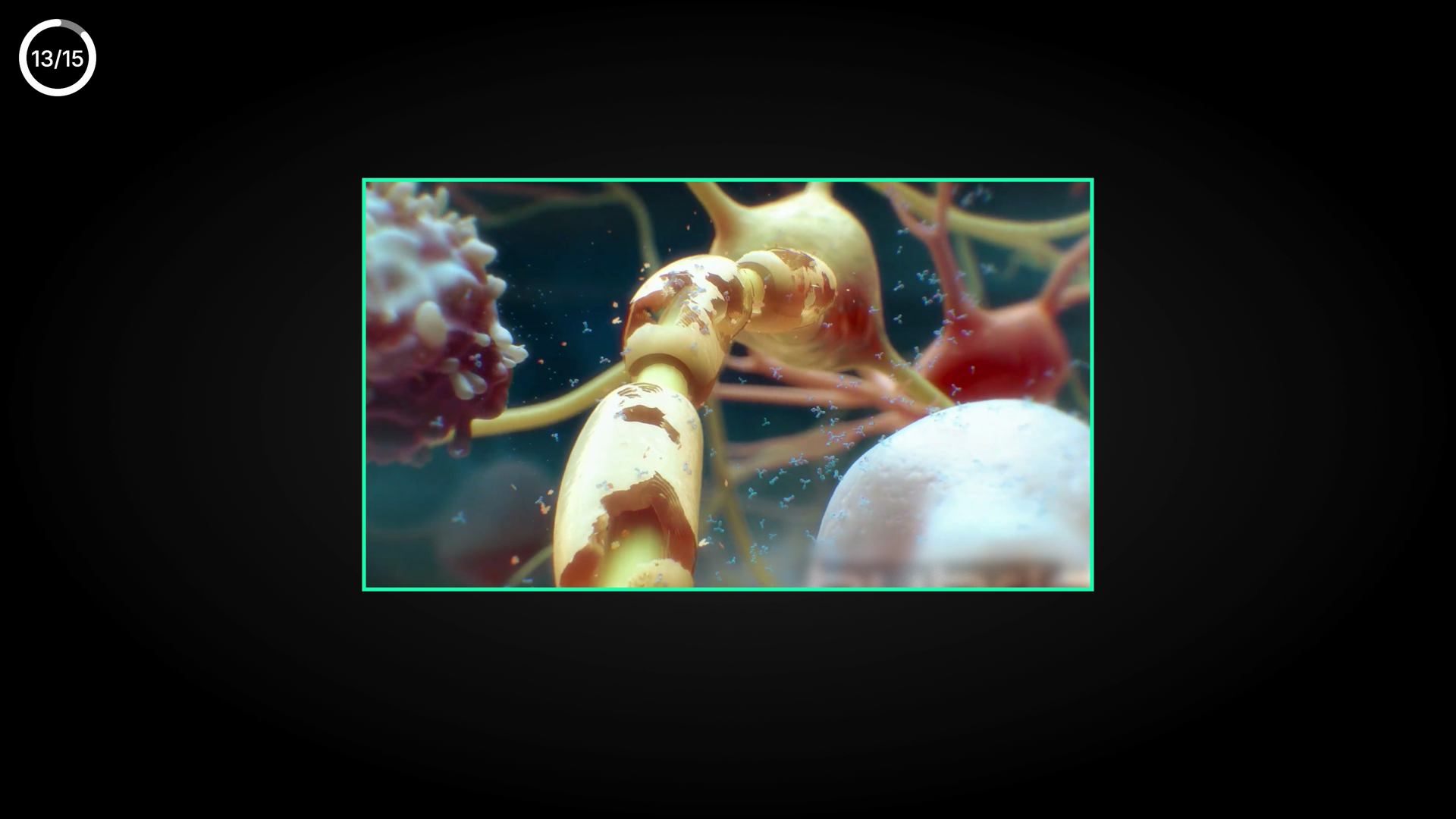
🟢 Правок нет — экран чистый.
подробнее: речь + разбор по пунктам
💬 Что говорит врач в этот момент“These are disruptions along the path of nerve impulses that manifest as movement problems, typically or sensory disturbances.”
🖼🟢 ОкB-roll с подписью «Двигательные проблемы / нарушения чувствительности»13/15
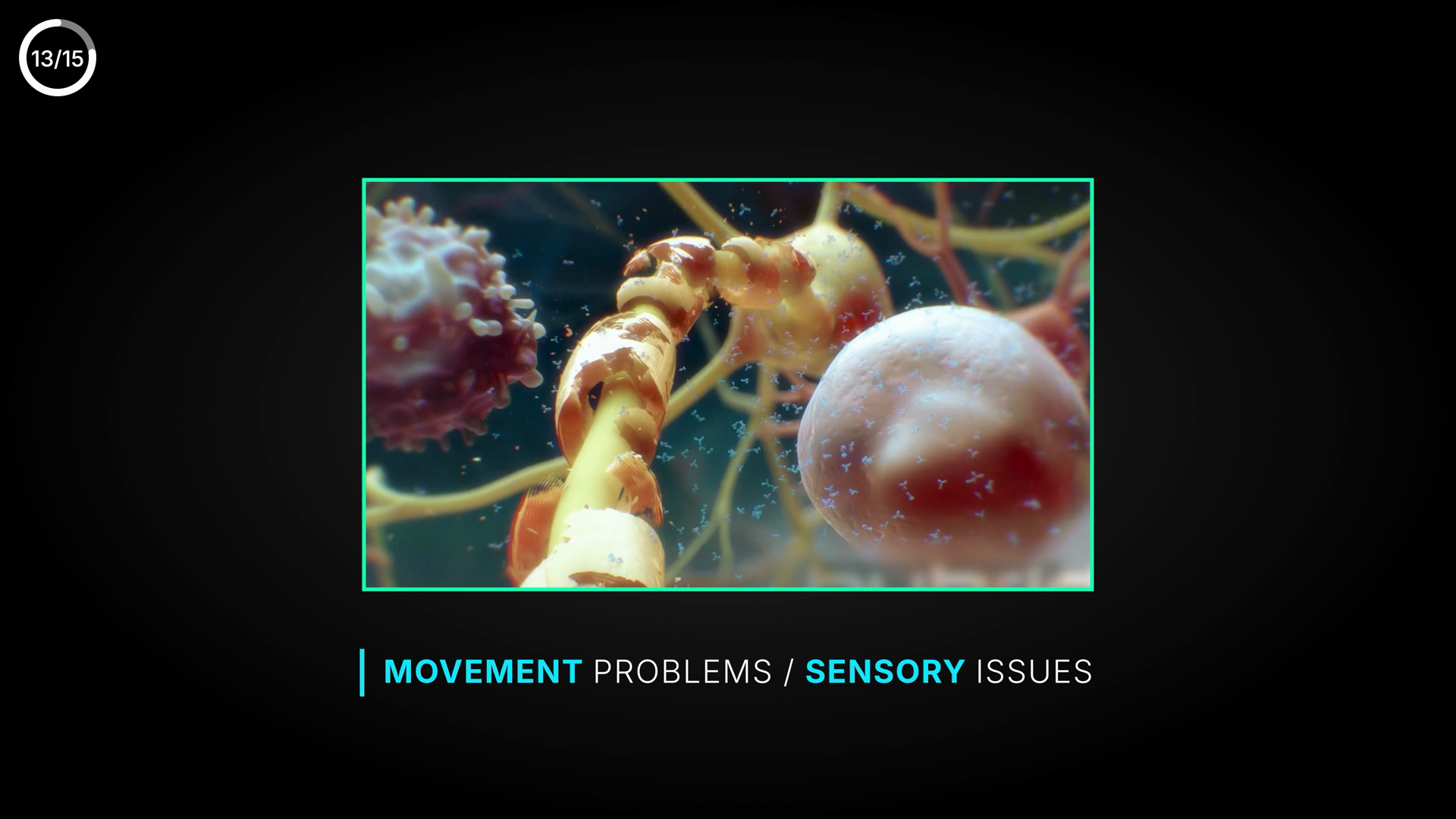
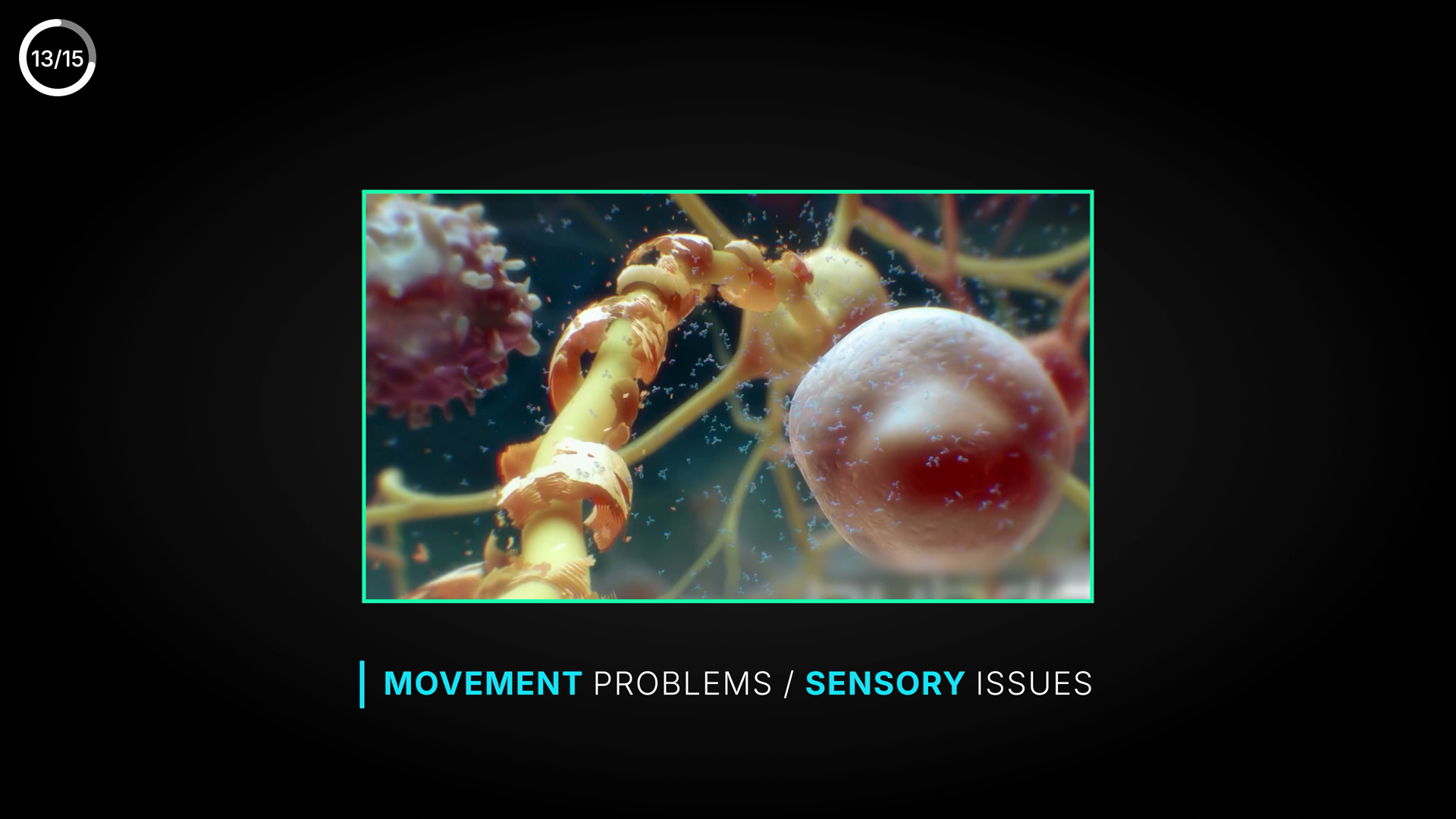
📺 На экране
MOVEMENT PROBLEMS / SENSORY ISSUES
🟢 Правок нет — экран чистый.
подробнее: речь + разбор по пунктам
💬 Что говорит врач в этот момент“problems, typically or sensory disturbances. So, if we start treating the relapse quickly enough, extinguishing this”
📺 Весь текст экранаMOVEMENT PROBLEMS / SENSORY ISSUES
#13🧠🔴 ИсправитьСхема лечения: быстрое лечение → воспаление → функция13/15
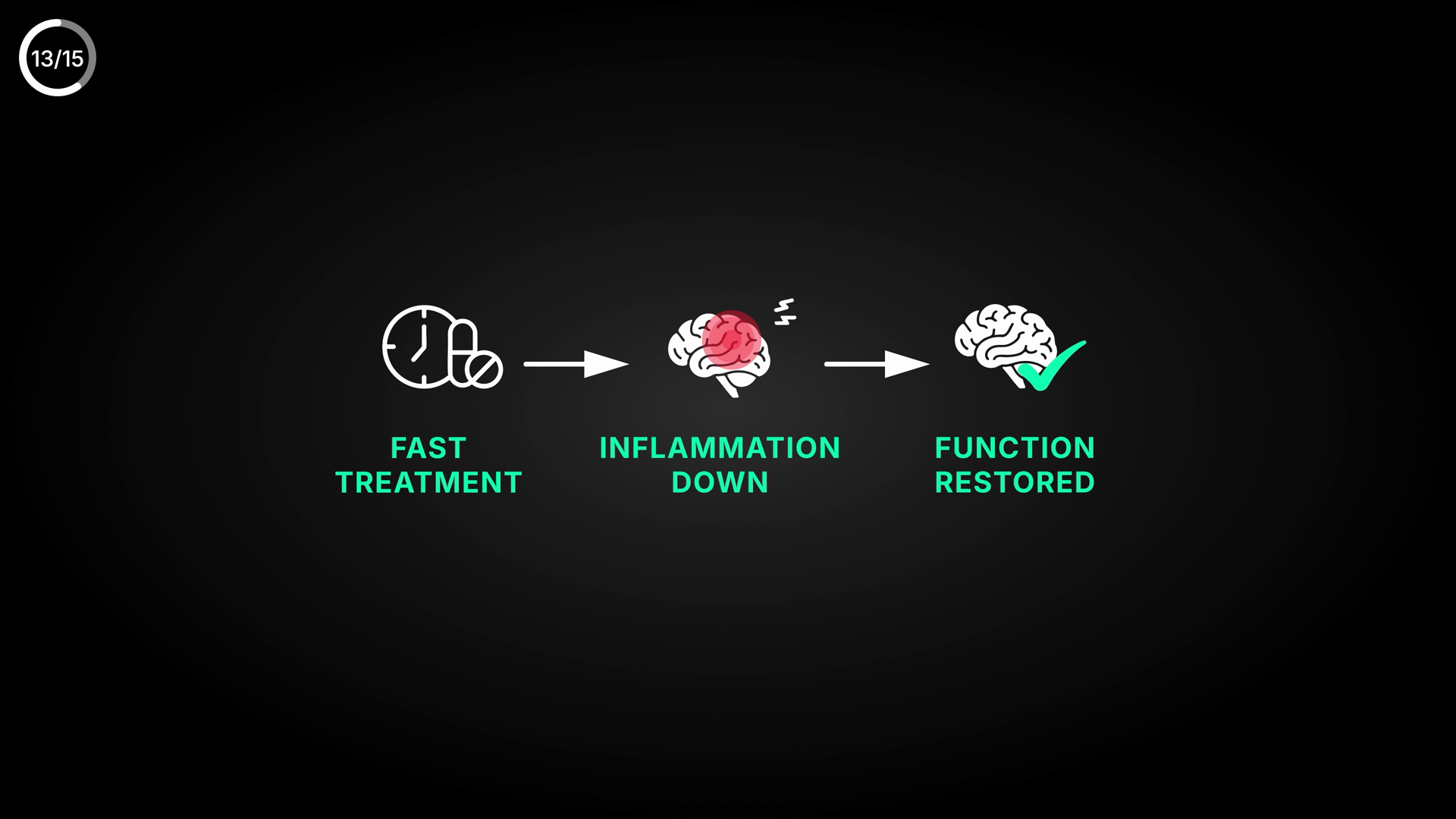
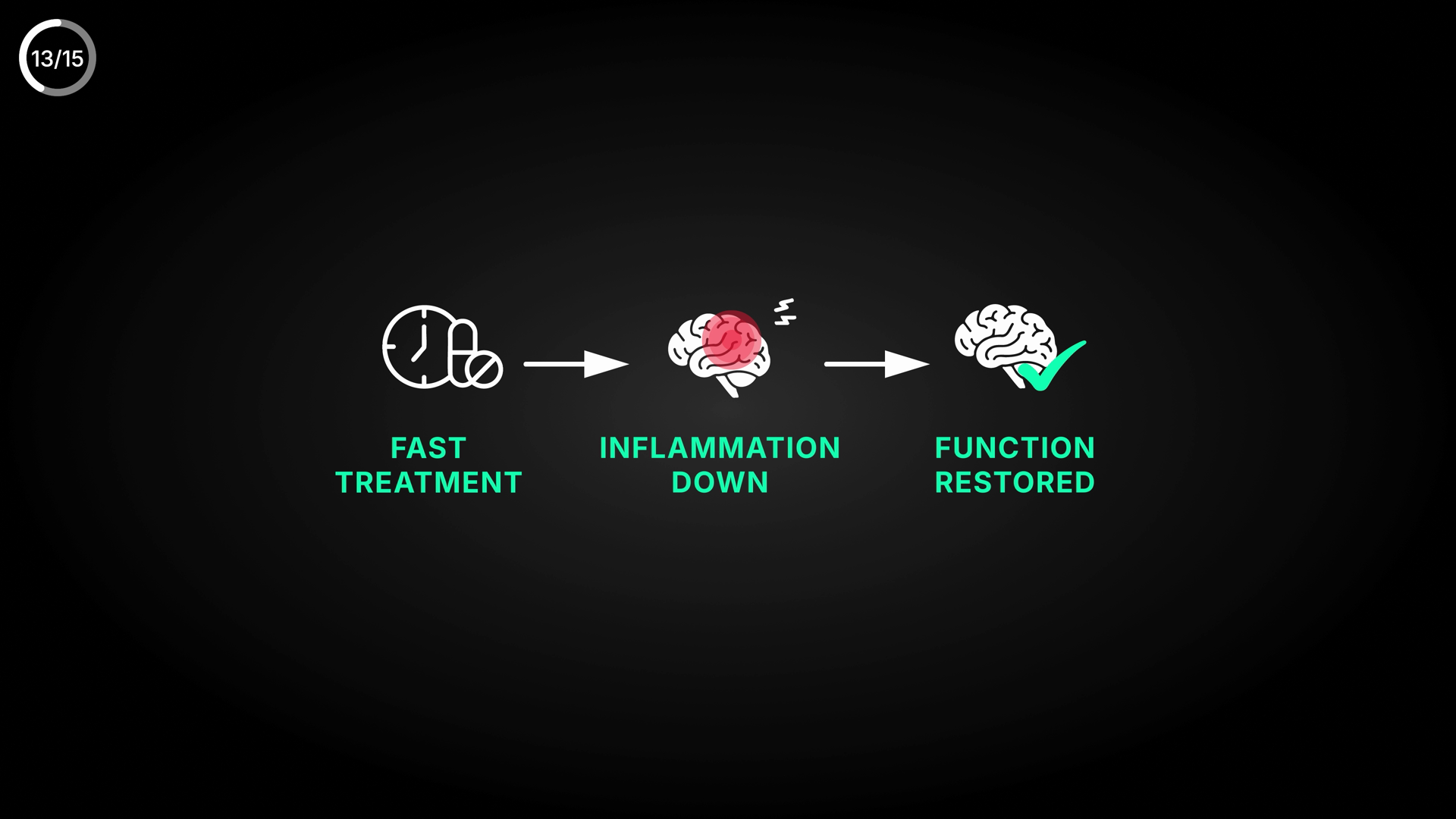
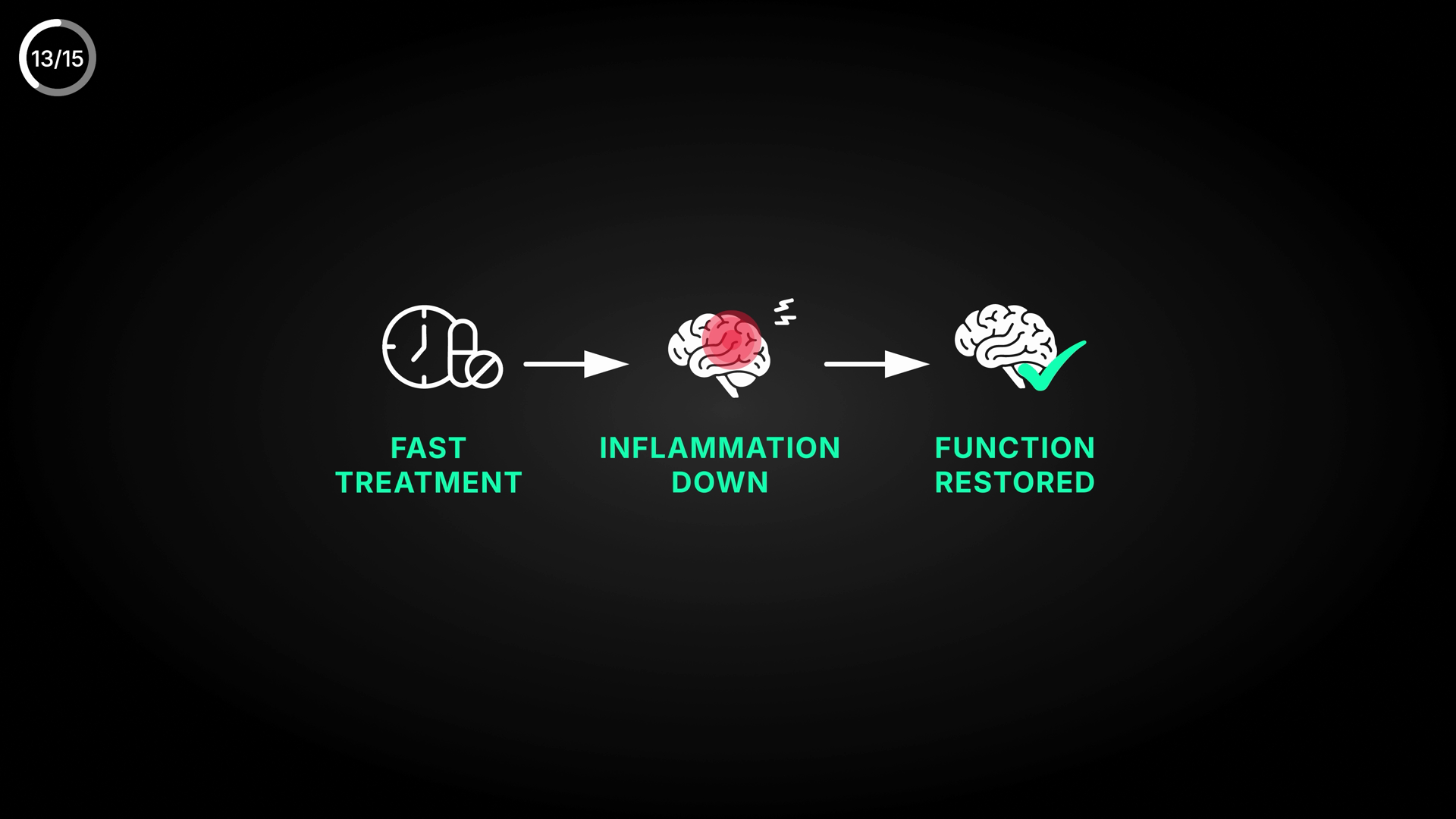
как естьStep 2 icon: a brain with a red inflammation blob that grows in from a dot (8:16.5) to full size (8:17.5) and then holds, with pain/lightning bolts beside it — captioned "INFLAMMATION DOWN".
как надоStep 2 icon: reverse the animation — the red lesion starts large and shrinks and fades to ~15% opacity over ~1 s, the lightning bolts fade out with it, and a small downward arrow appears next to the brain. Caption stays "INFLAMMATION DOWN".
Step 2 icon: reverse the animation — the red lesion starts large and shrinks and fades to ~15% opacity over ~1 s, the lightning bolts fade out with it, and a small downward arrow appears next to the brain. Caption stays "INFLAMMATION DOWN".
✏️ Что сделать
- Заменить иконку таблеток на капельницу (IV) на обоих экранах — 8:26 и 8:34.
как есть: Step 1 icon: clock + capsule + round tablet (oral medication), captioned "FAST TREATMENT".
как надо: Step 1 icon: clock + IV bag with a drip line (relapse treatment is an IV steroid pulse), matching the icon fix on the 8:34 screen.
Развернуть анимацию: очаг уменьшается и гаснет, молнии боли исчезают, подпись оставить.
подробнее: речь + разбор по пунктам
💬 Что говорит врач в этот момент“So, if we start treating the relapse quickly enough, extinguishing this inflammation, the lesion becomes non -inflammatory, movement is restored, and you feel that your function has recovered. This is typically achieved with certain medications.”
📺 Весь текст экранаFAST TREATMENT | INFLAMMATION DOWN | FUNCTION RESTORED
- СмыслРазвернуть анимацию: очаг уменьшается и гаснет, молнии боли исчезают, подпись оставить.
- ФактыЗаменить иконку таблеток на капельницу (IV) на обоих экранах — 8:26 и 8:34.
#14🧪🔴 ИсправитьМетилпреднизолон → очаг становится неактивным13/15
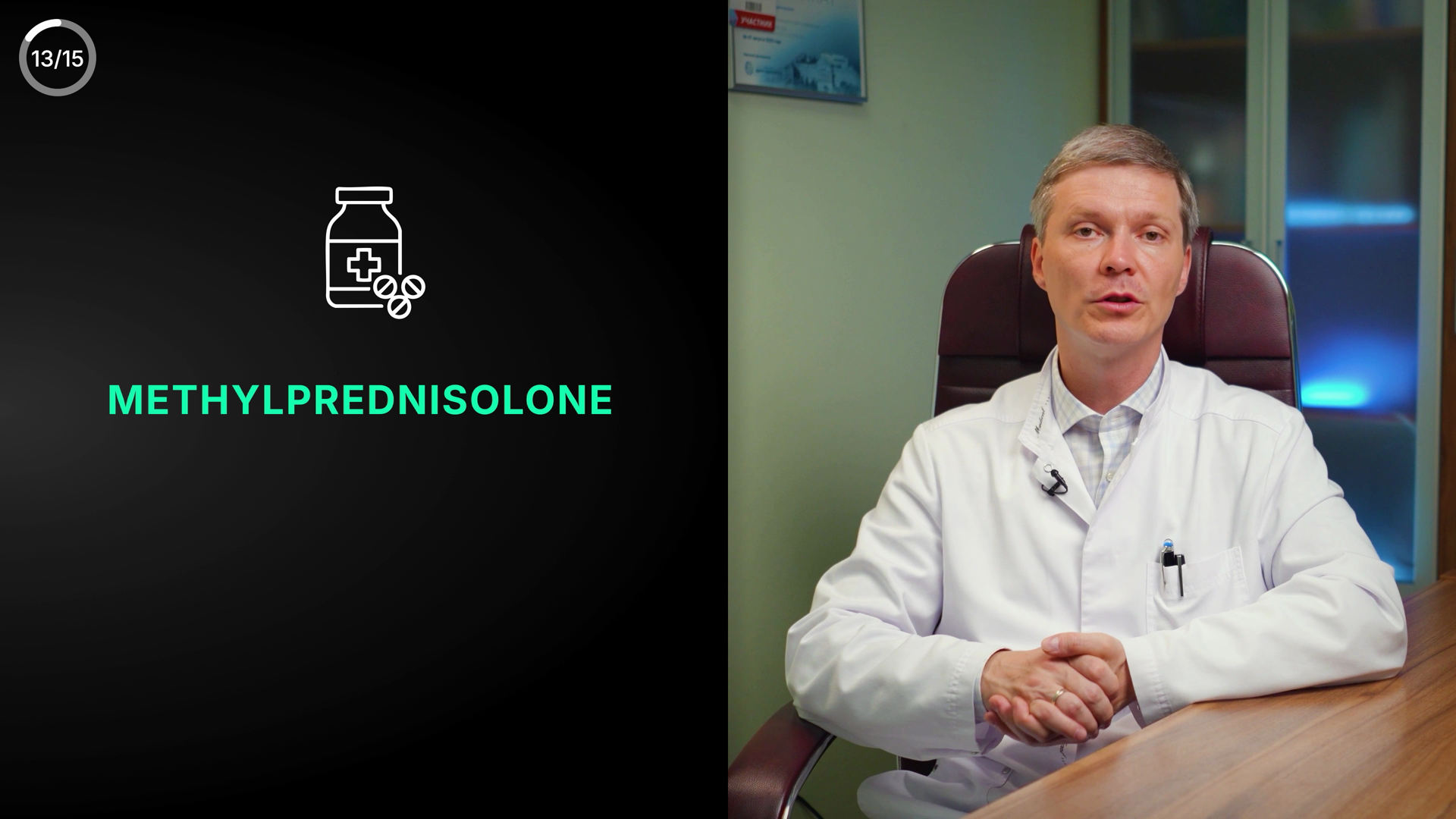
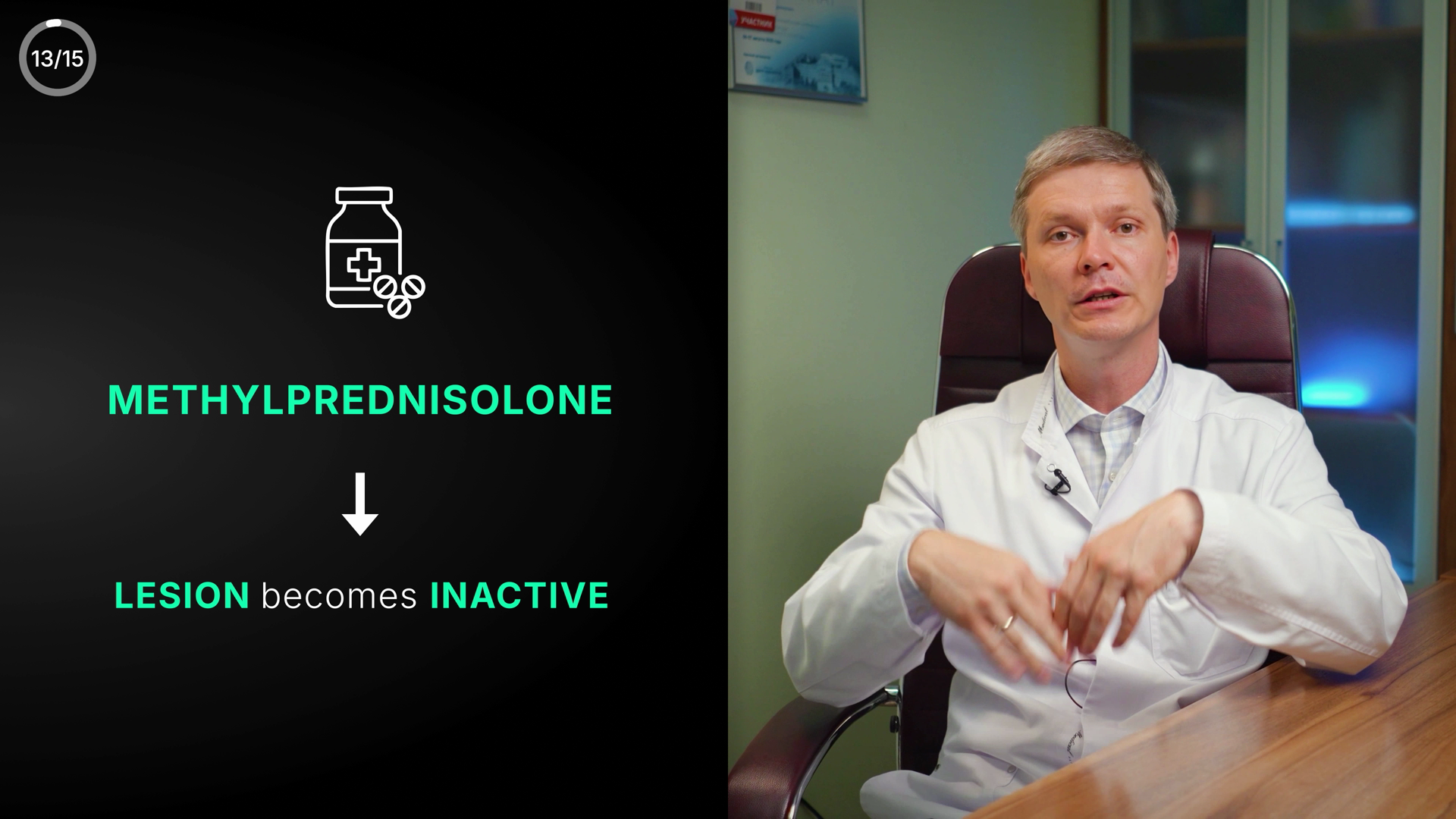
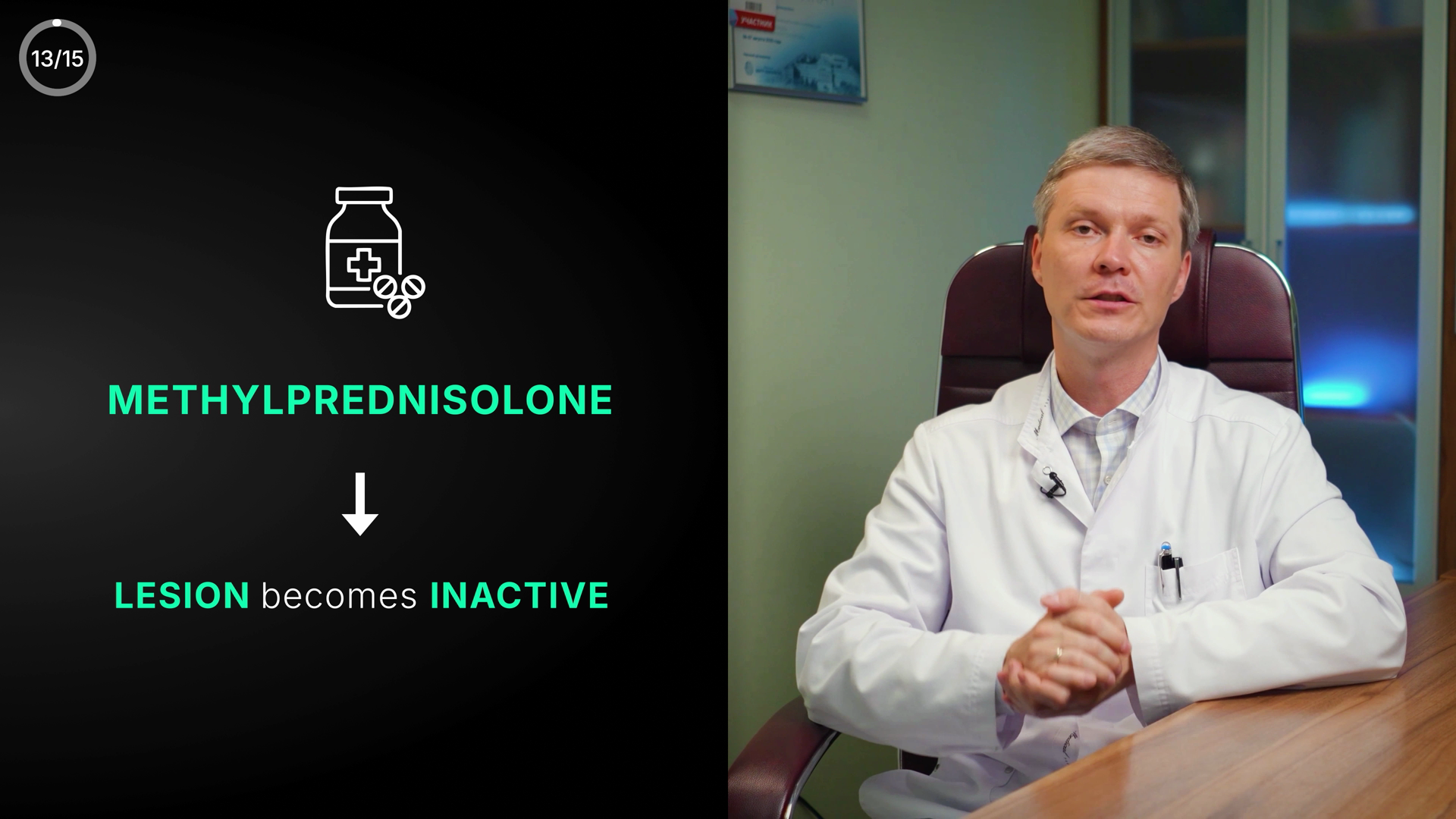
как естьIcon above the title: a pill bottle with a medical cross and three round tablets; title "METHYLPREDNISOLONE".
как надоMETHYLPREDNISOLONE
IV pulse therapy
IV pulse therapy
METHYLPREDNISOLONE
IV pulse therapy
Заменить иконку баночки с таблетками на капельницу (пакет на стойке) и подписать способ введения.
подробнее: речь + разбор по пунктам
💬 Что говорит врач в этот момент“First and foremost, we administer methylprednisolone, suppress the inflammation, and the lesion becomes inactive. Function is restored. In addition to actual relapses, there are also so -called pseudo -relapses.”
📺 Весь текст экранаMETHYLPREDNISOLONE | LESION becomes INACTIVE
- ФактыЗаменить иконку баночки с таблетками на капельницу (пакет на стойке) и подписать способ введения.
🖼🟢 ОкКарточка главы «PSEUDO-RELAPSE»— (на карточке главы счётчика нет — как и на других карточках глав; сразу после неё 14/15)

📺 На экране
PSEUDO-RELAPSE
🟢 Правок нет — экран чистый.
подробнее: речь + разбор по пунктам
💬 Что говорит врач в этот момент“In addition to actual relapses, there are also so -called pseudo -relapses.”
📺 Весь текст экранаPSEUDO-RELAPSE
#15🧠🔴 ИсправитьТаблица сравнения: истинное обострение vs псевдообострение14/15
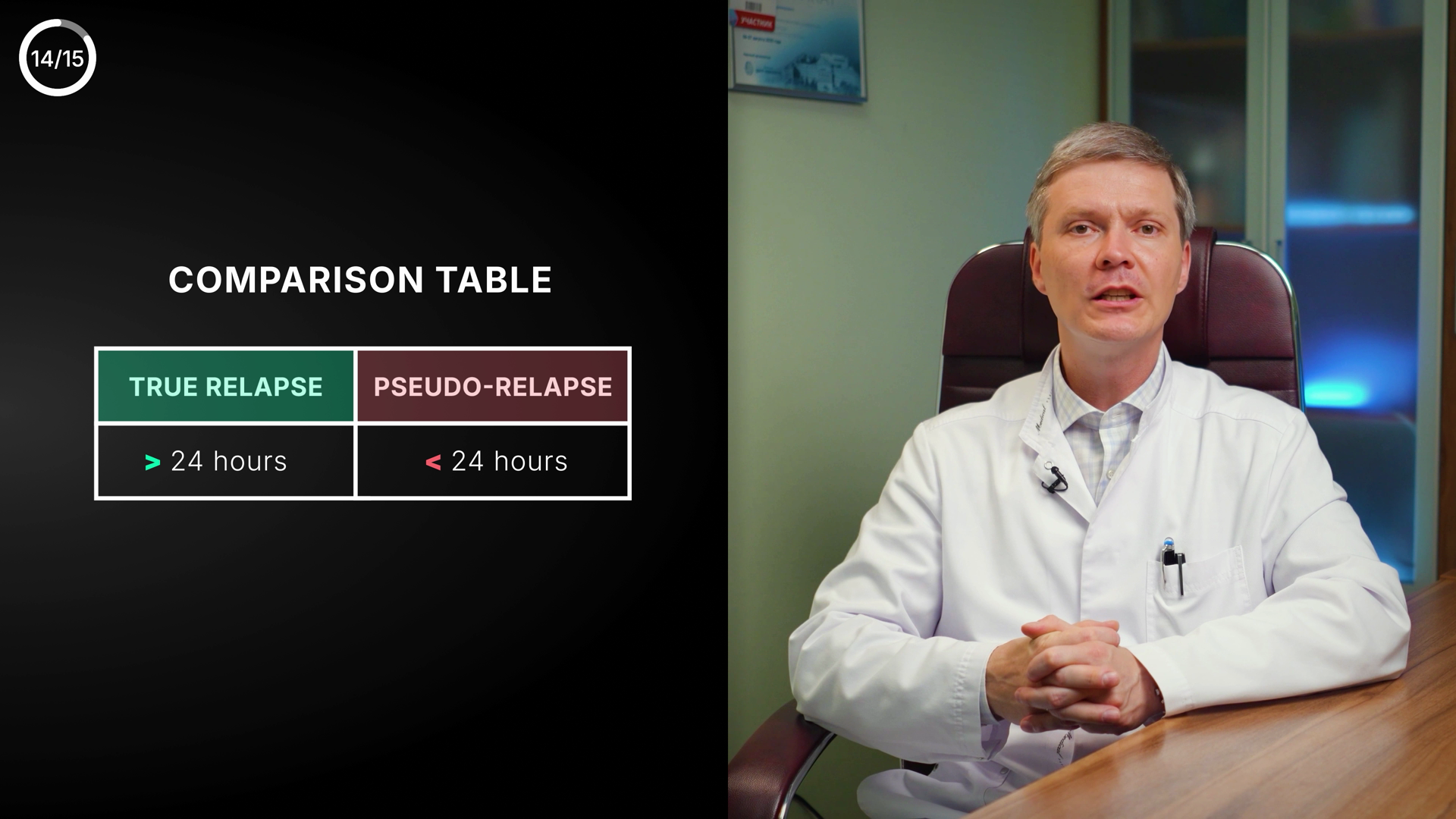
как естьTRUE RELAPSE header = green fill, ">" glyph mint; PSEUDO-RELAPSE header = dark red fill, "<" glyph coral
как надоSwap the semantics: TRUE RELAPSE header fill = coral/red (#F2455F, the same red as the pain marker at 9:07) with white text, and its ">" glyph coral. PSEUDO-RELAPSE header fill = mint (#2EE59D) with near-black text (#0A0D16), and its "<" glyph mint. Text remains: TRUE RELAPSE / > 24 hours · PSEUDO-RELAPSE / < 24 hours.
Swap the semantics: TRUE RELAPSE header fill = coral/red (#F2455F, the same red as the pain marker at 9:07) with white text, and its ">" glyph coral. PSEUDO-RELAPSE header fill = mint (#2EE59D) with near-black text (#0A0D16), and its "<" glyph mint. Text remains: TRUE RELAPSE / > 24 hours · PSEUDO-RELAPSE / < 24 hours.
Поменять заливки шапок местами: TRUE RELAPSE — красная (#F2455F, белый текст), PSEUDO-RELAPSE — мятная (#2EE59D, тёмный текст); знаки «>» и «<» в тон своим шапкам, текст не менять.
подробнее: речь + разбор по пунктам
💬 Что говорит врач в этот момент“The key difference is that pseudo -relapses last several hours, never more than 24 hours. So if you develop a symptom,”
📺 Весь текст экранаCOMPARISON TABLE | TRUE RELAPSE | PSEUDO-RELAPSE | > 24 hours | < 24 hours
- СмыслПоменять заливки шапок местами: TRUE RELAPSE — красная (#F2455F, белый текст), PSEUDO-RELAPSE — мятная (#2EE59D, тёмный текст); знаки «>» и «<» в тон своим шапкам, текст не менять.
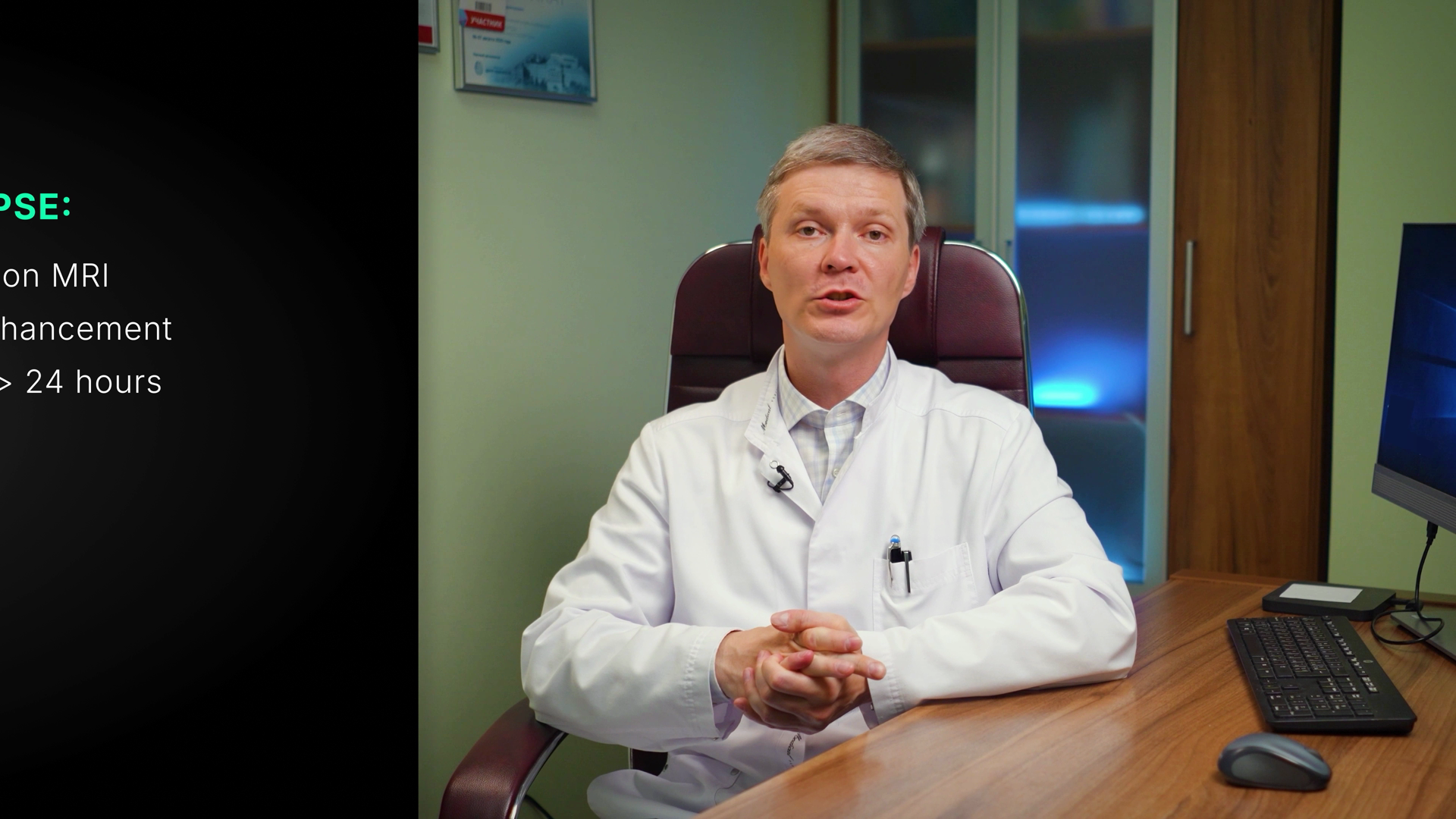
🖼🟢 ОкВрач без графики (хвост таблицы, полнокадровый план)14/15

📺 На экране
TABLE | UDO-RELAPSE | < 24 hours
🟢 Правок нет — экран чистый.
подробнее: речь + разбор по пунктам
💬 Что говорит врач в этот момент“never more than 24 hours. So if you develop a symptom, say some visual flickering or hand numbness, and it lasted one or two hours,”
📺 Весь текст экранаTABLE | UDO-RELAPSE | < 24 hours
#16🧪🔴 ИсправитьСхема-таймлайн «как течёт псевдообострение»14/15
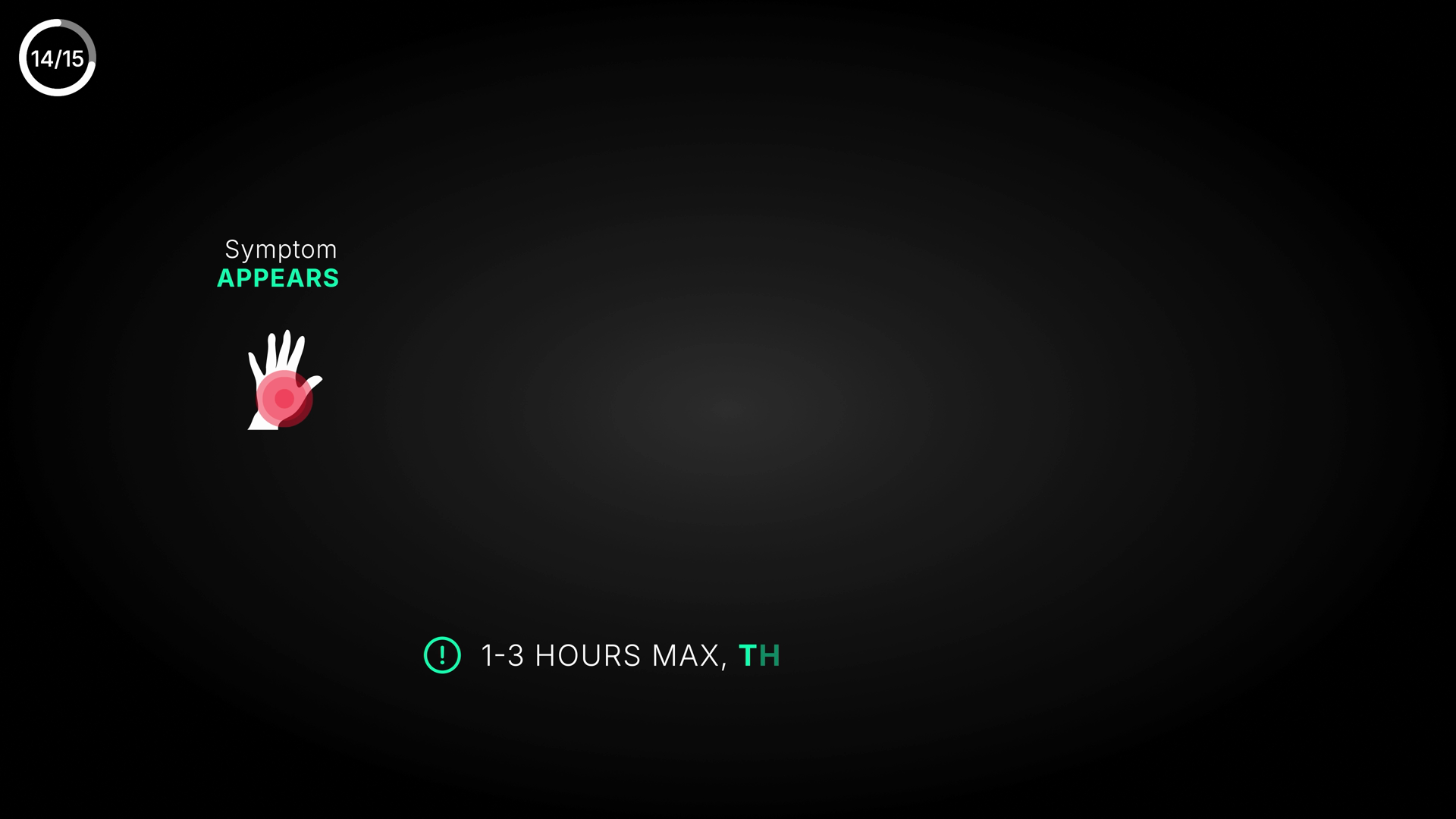
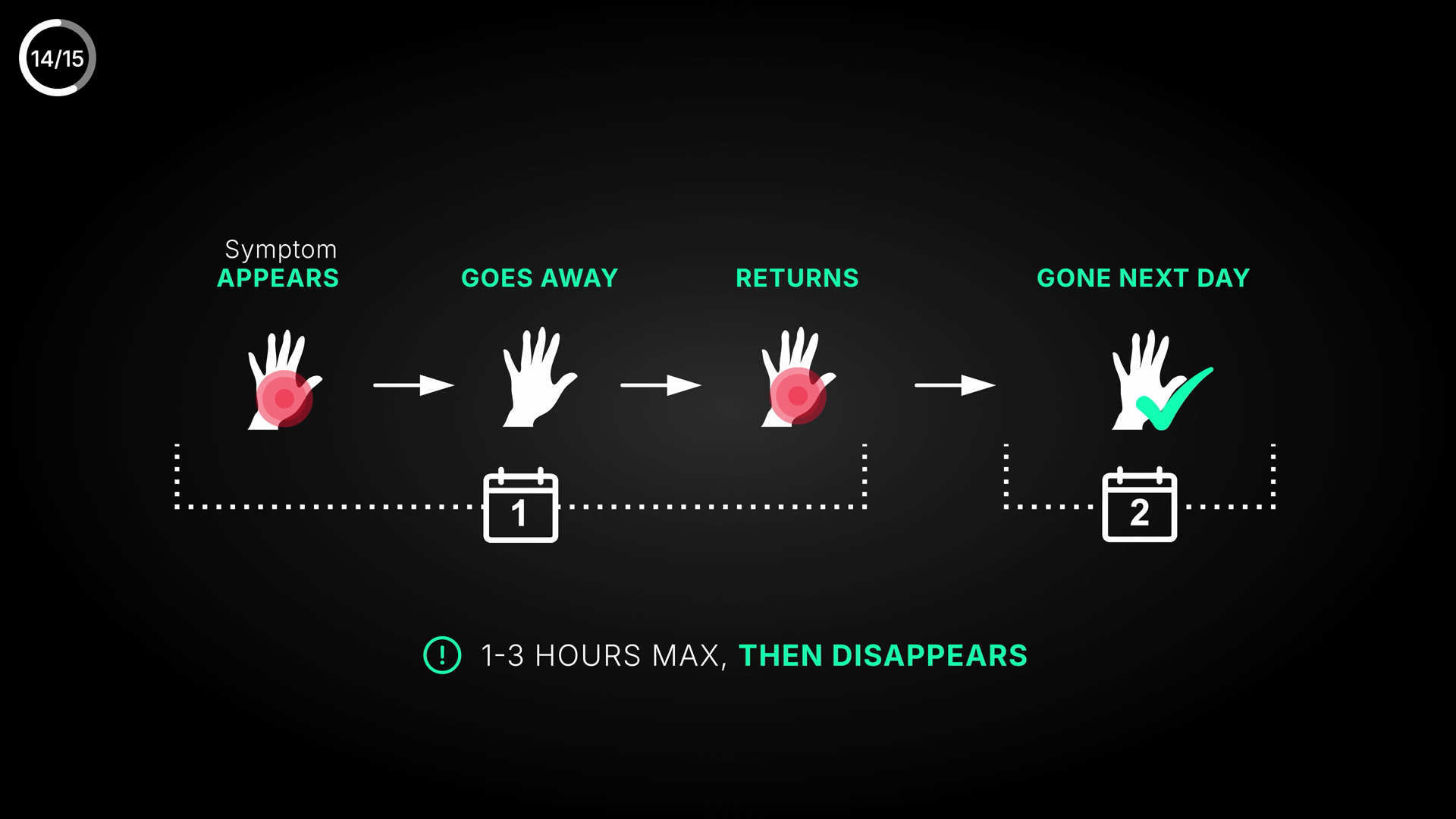
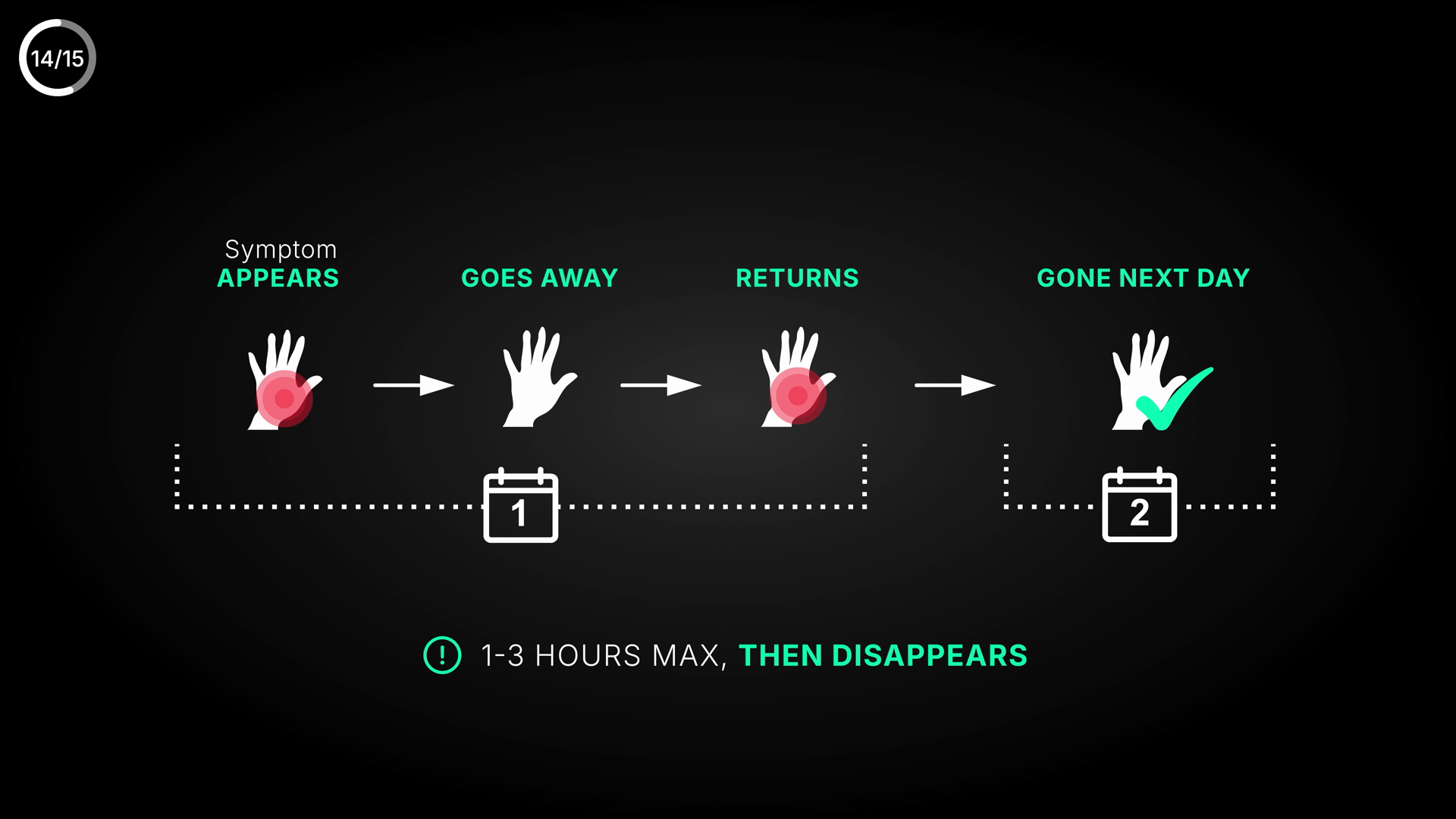
как есть1-3 HOURS MAX, THEN DISAPPEARS
как надоEACH EPISODE 1–3 HOURS · ALWAYS UNDER 24 HOURS
EACH EPISODE 1–3 HOURS · ALWAYS UNDER 24 HOURS
✏️ Что сделать
- Заменить кружок «!» на кружок с часами тем же мятным контуром
как есть: Circled "!" icon (mint stroke) before the duration line
как надо: Replace the circled "!" with a circled clock icon — same mint stroke weight, same diameter, same left offset.
Переписать подпись: эпизод 1–3 часа, всегда меньше 24 часов.
подробнее: речь + разбор по пунктам
💬 Что говорит врач в этот момент“say some visual flickering or hand numbness, and it lasted one or two hours, three at most, then it passed, came back, passed again, and the next day it doesn't appear anymore, this belongs to the pseudo -relapse category. category. What causes them? In people with MS, this can occur due to stress,”
📺 Весь текст экранаSymptom | APPEARS | GOES AWAY | RETURNS | GONE NEXT DAY | 1 | 2 | ! 1-3 HOURS MAX, THEN DISAPPEARS
- ФактыПереписать подпись: эпизод 1–3 часа, всегда меньше 24 часов.
- СмыслЗаменить кружок «!» на кружок с часами тем же мятным контуром
#17🧠🔴 ИсправитьТриггеры псевдообострения + цепочка «триггер→симптом→норма»14/15
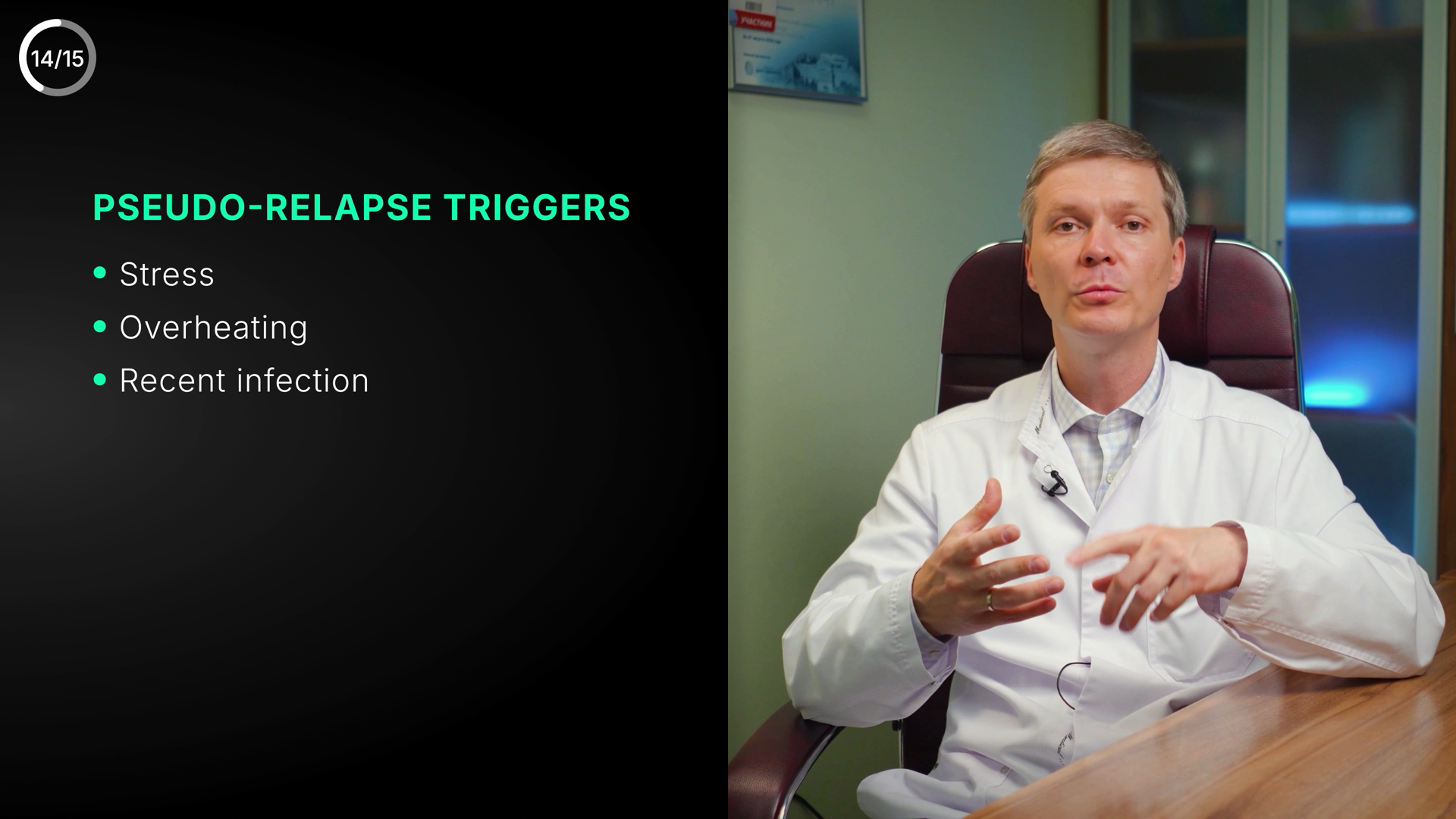
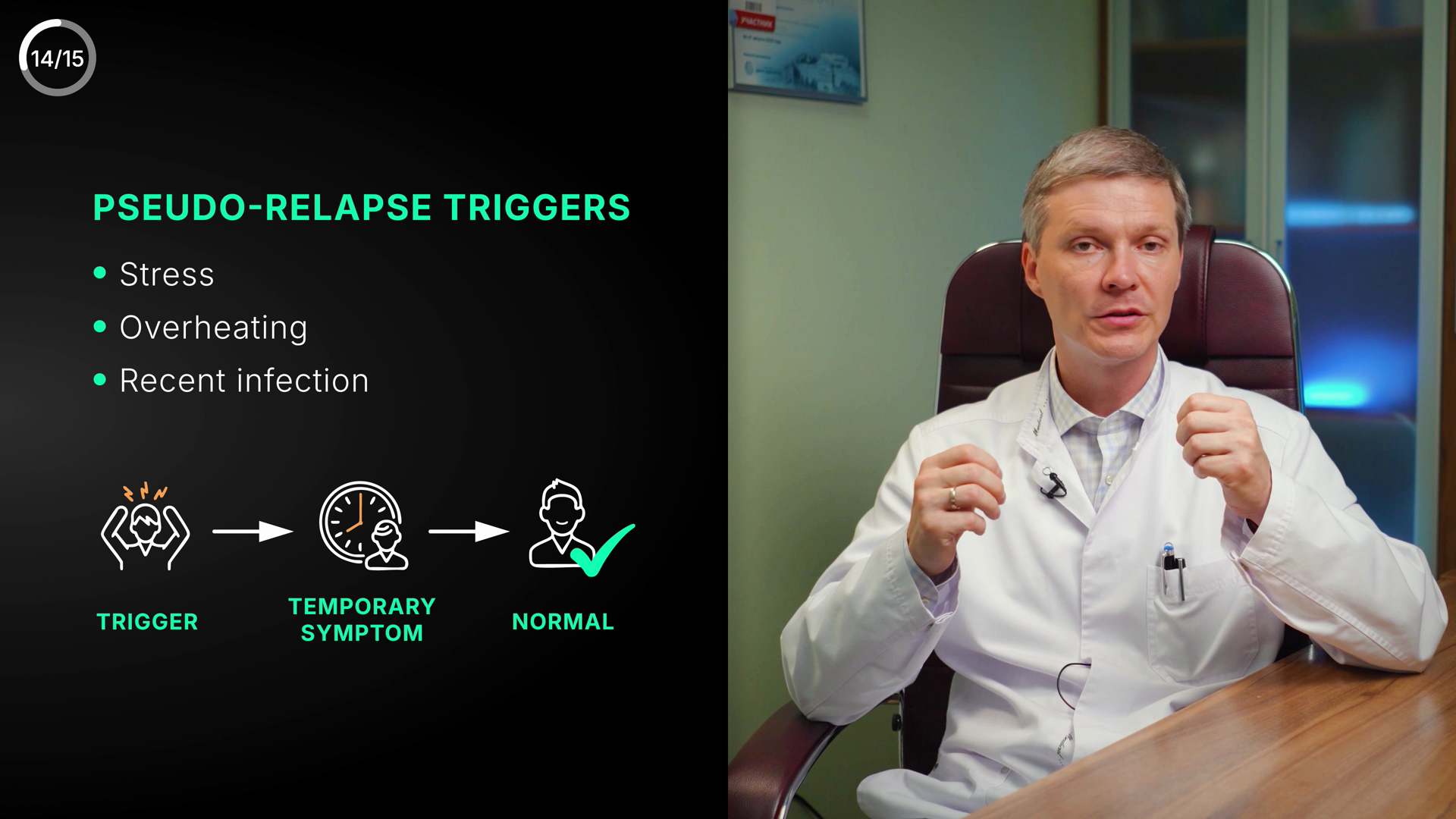
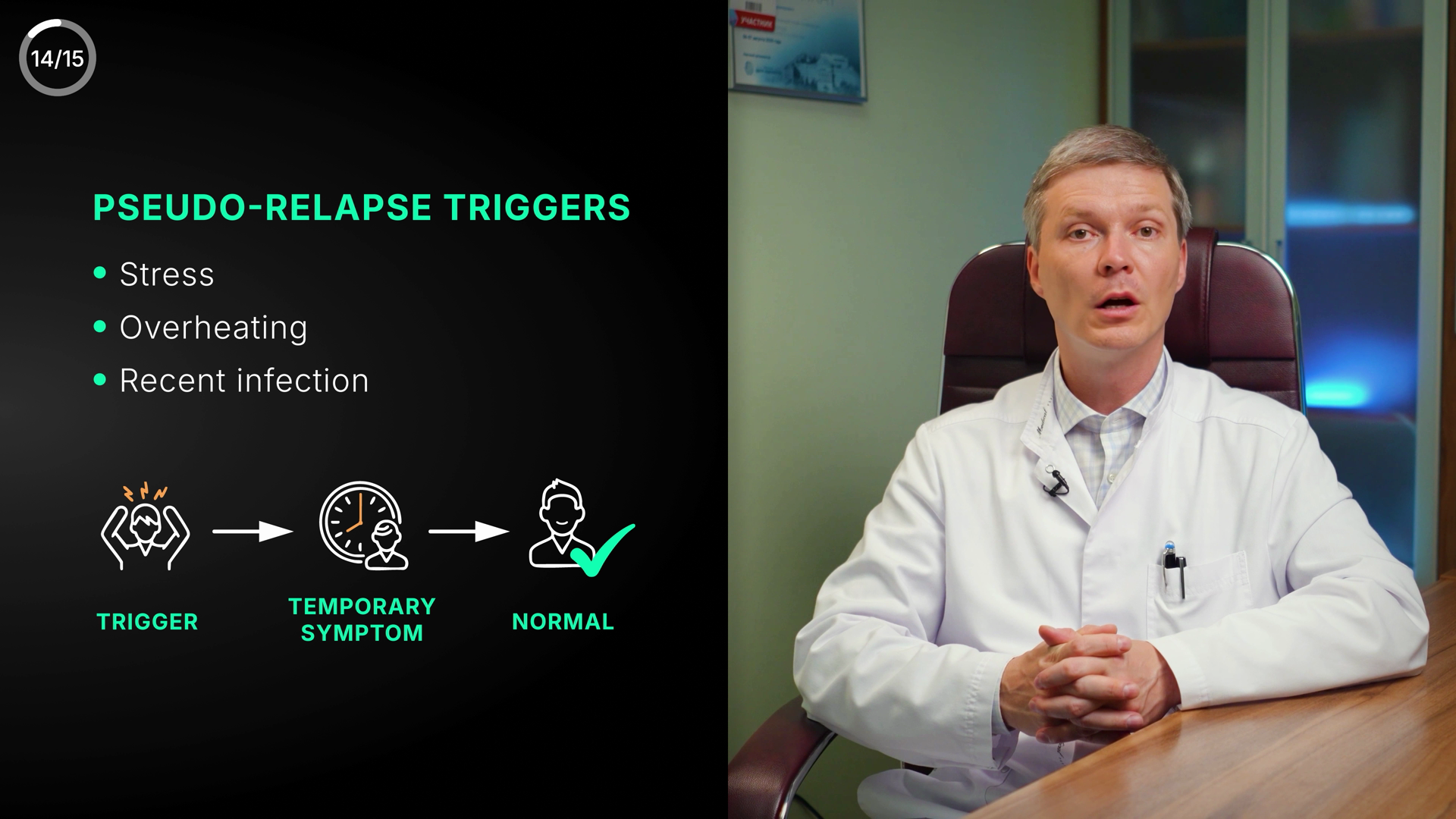
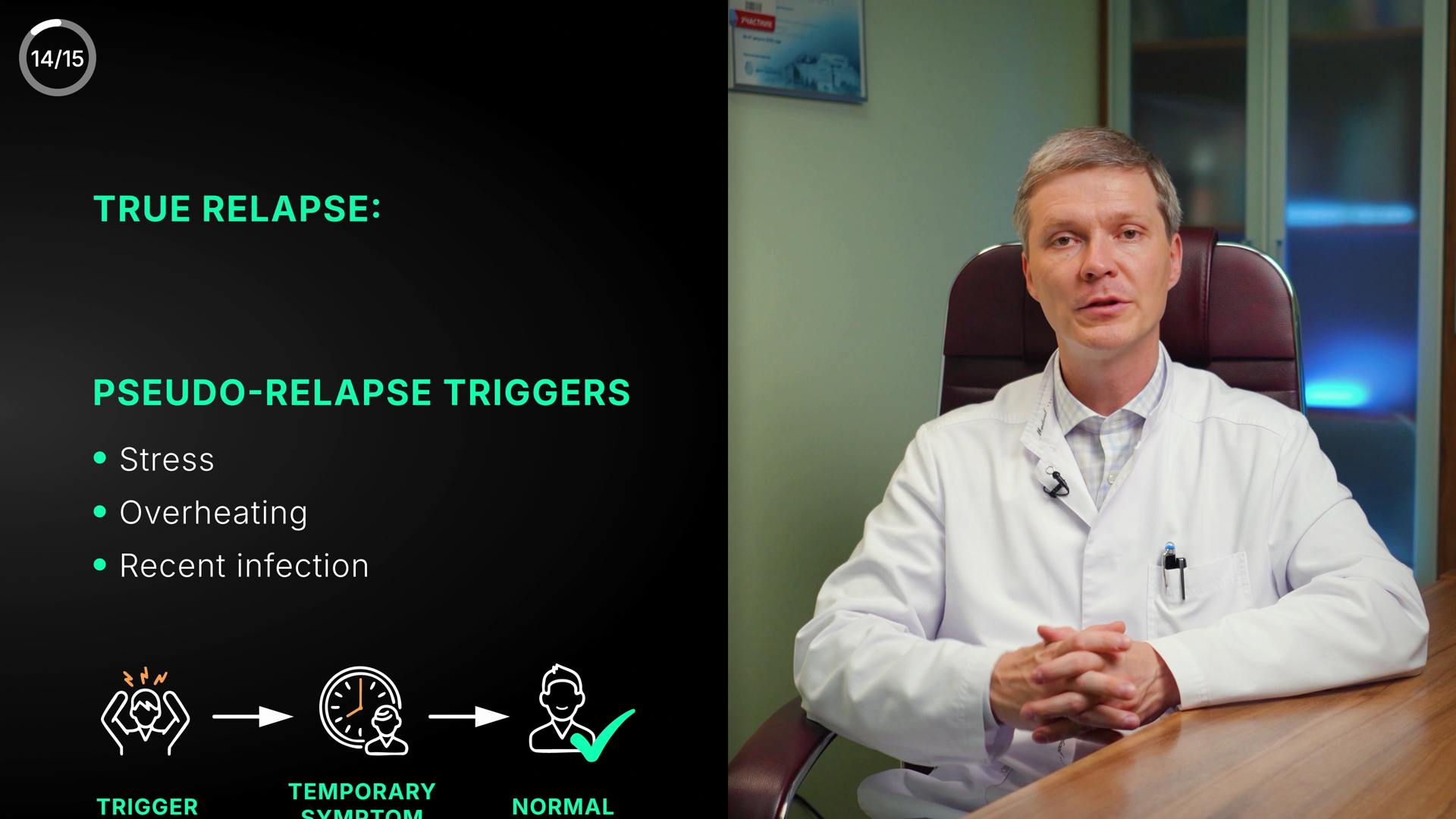
как естьFrame 9:32 — "TRUE RELAPSE:" fades in at the top while the whole previous block is still on screen and slides down: "PSEUDO-RELAPSE TRIGGERS / • Stress / • Overheating / • Recent infection / TRIGGER — TEMPORARY SYMPT…" (the caption is cut in half by the bottom edge of frame).
как надоHard-separate the two screens: fade the whole PSEUDO-RELAPSE block out (0.3 s) and only THEN fade "TRUE RELAPSE" in (0.3 s), with 2–3 frames of empty panel between them. The two headings must never be on screen at the same time, and no element may be pushed past the bottom edge of frame — nothing gets clipped at any point of the transition.
Hard-separate the two screens: fade the whole PSEUDO-RELAPSE block out (0.3 s) and only THEN fade "TRUE RELAPSE" in (0.3 s), with 2–3 frames of empty panel between them. The two headings must never be on screen at the same time, and no element may be pushed past the bottom edge of frame — nothing gets clipped at any point of the transition.
Развести экраны: полностью убрать блок PSEUDO-RELAPSE и только потом вводить «TRUE RELAPSE», ничего не выпускать за нижнюю кромку.
подробнее: речь + разбор по пунктам
💬 Что говорит врач в этот момент“typically psycho -emotional stress, overheating, or recent infections. At that moment, a slight MS activation can occur. The person starts feeling some disturbances, then the triggering factor resolves, the emotional stress passes, and everything returns to normal. That's what causes a pseudo -relapse. A true relapse involves formation of a new lesion, contrast enhancement,”
📺 Весь текст экранаPSEUDO-RELAPSE TRIGGERS | • Stress | • Overheating | • Recent infection | TRIGGER | TEMPORARY SYMPTOM | NORMAL
- СмыслРазвести экраны: полностью убрать блок PSEUDO-RELAPSE и только потом вводить «TRUE RELAPSE», ничего не выпускать за нижнюю кромку.
🖼🟢 ОкИстинное обострение: три критерия14/15
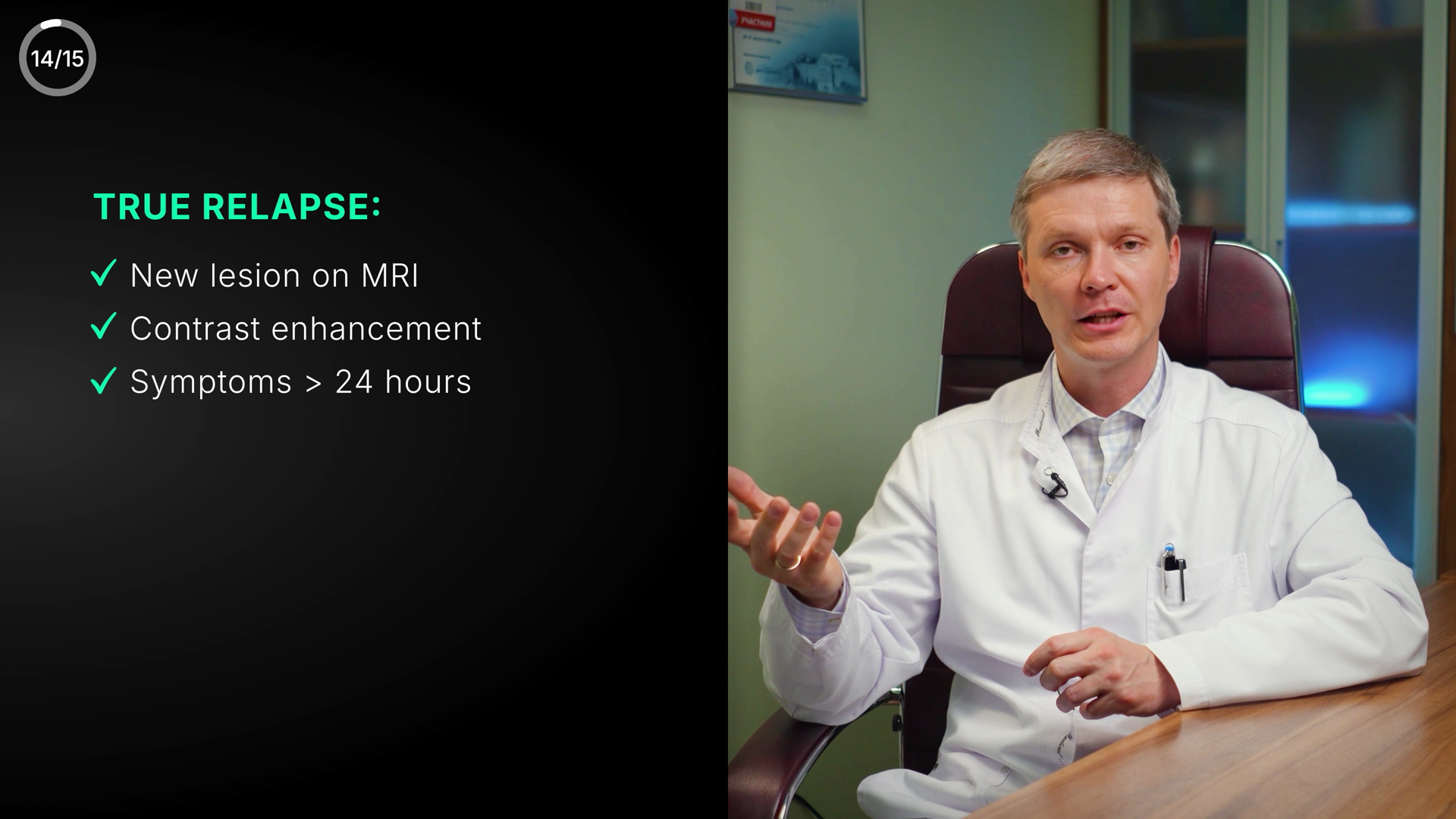
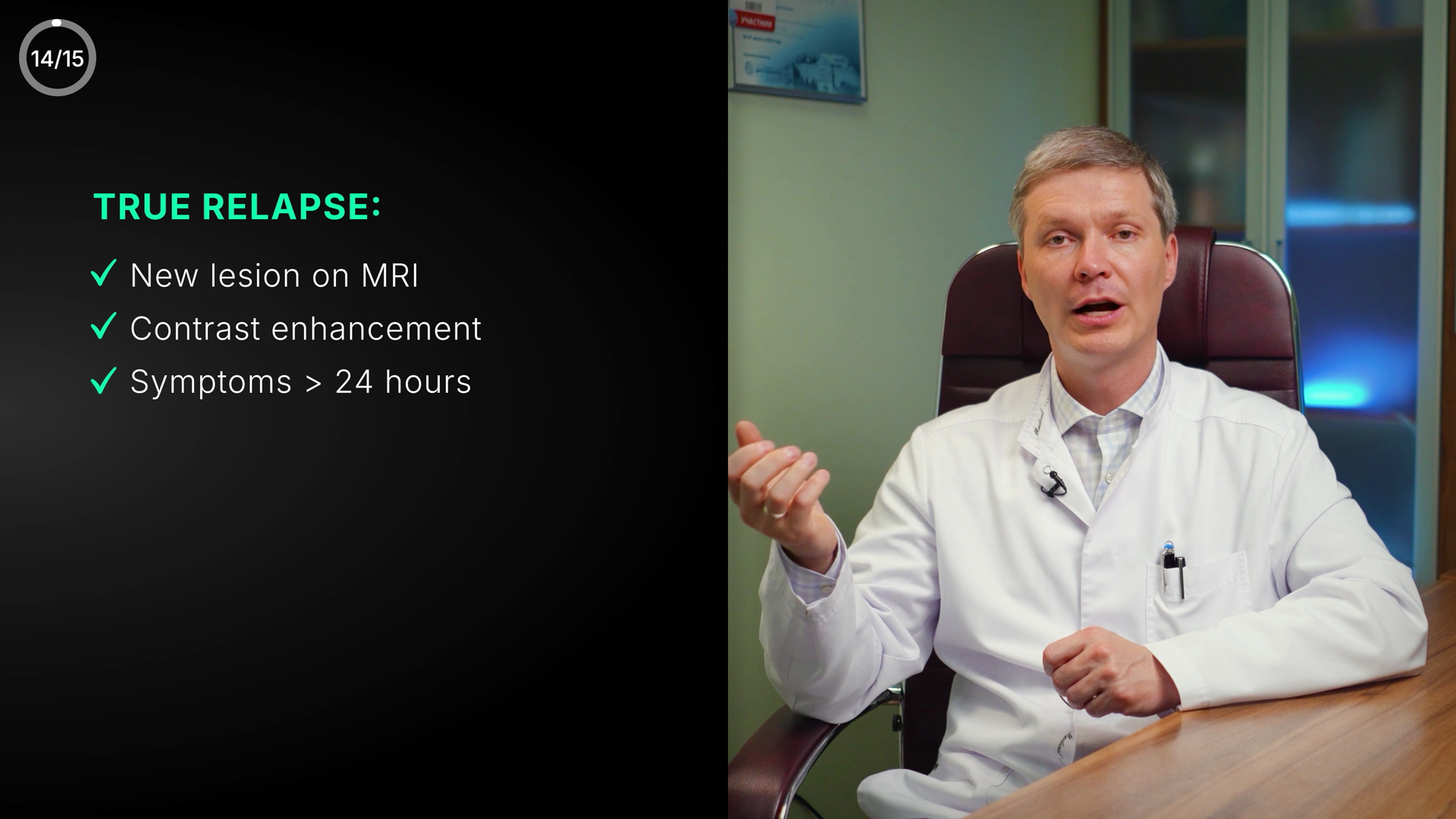
📺 На экране
TRUE RELAPSE: | ✓ New lesion on MRI | ✓ Contrast enhancement | ✓ Symptoms > 24 hours
🟢 Правок нет — экран чистый.
подробнее: речь + разбор по пунктам
💬 Что говорит врач в этот момент“A true relapse involves formation of a new lesion, contrast enhancement, and symptoms lasting more than 24 hours. So as soon as you develop a first symptom or any new symptoms and they last more”
📺 Весь текст экранаTRUE RELAPSE: | ✓ New lesion on MRI | ✓ Contrast enhancement | ✓ Symptoms > 24 hours
#18✏️🔴 ИсправитьФинальный призыв: «Не откладывайте — к специалисту»15/15
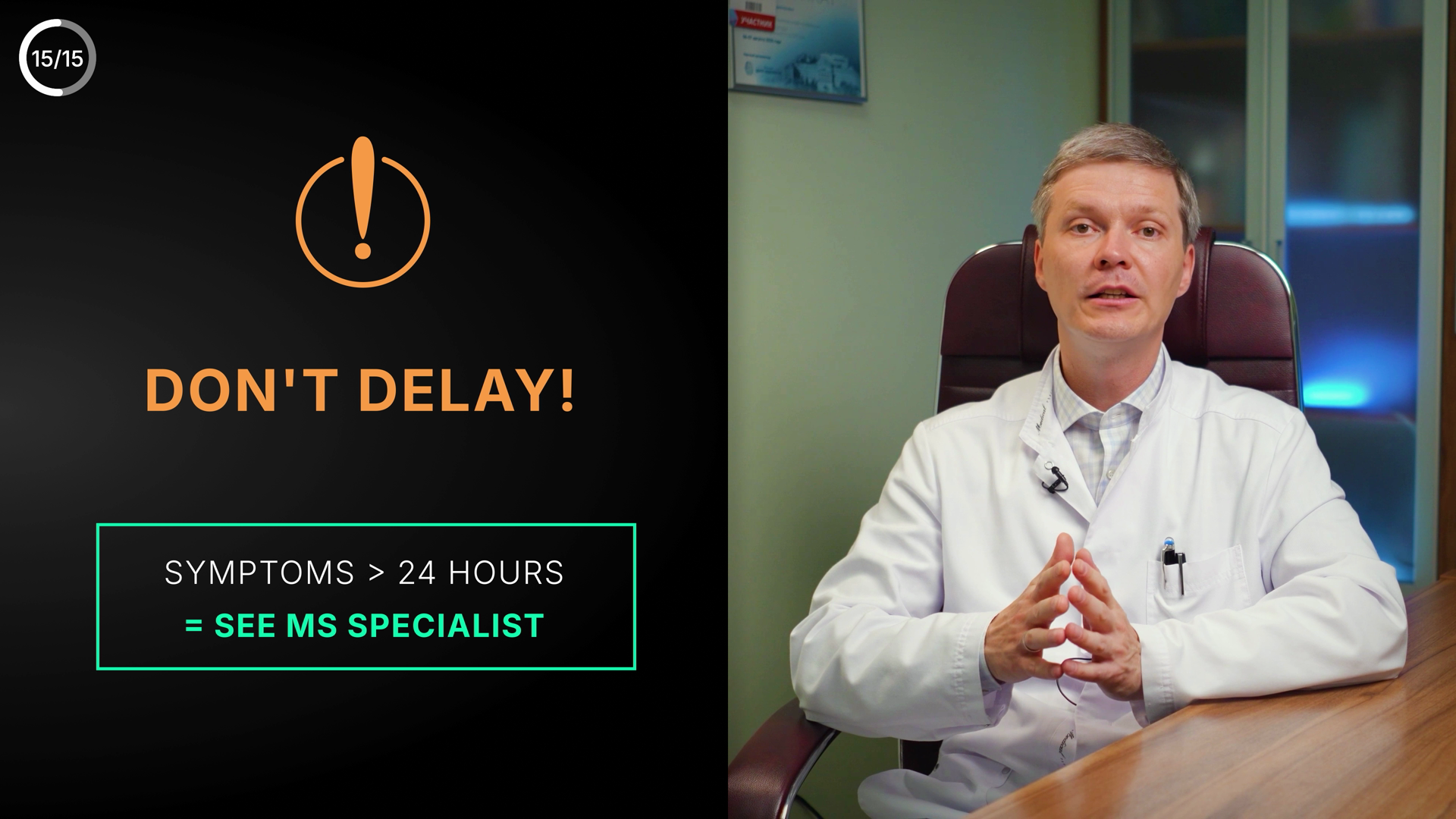

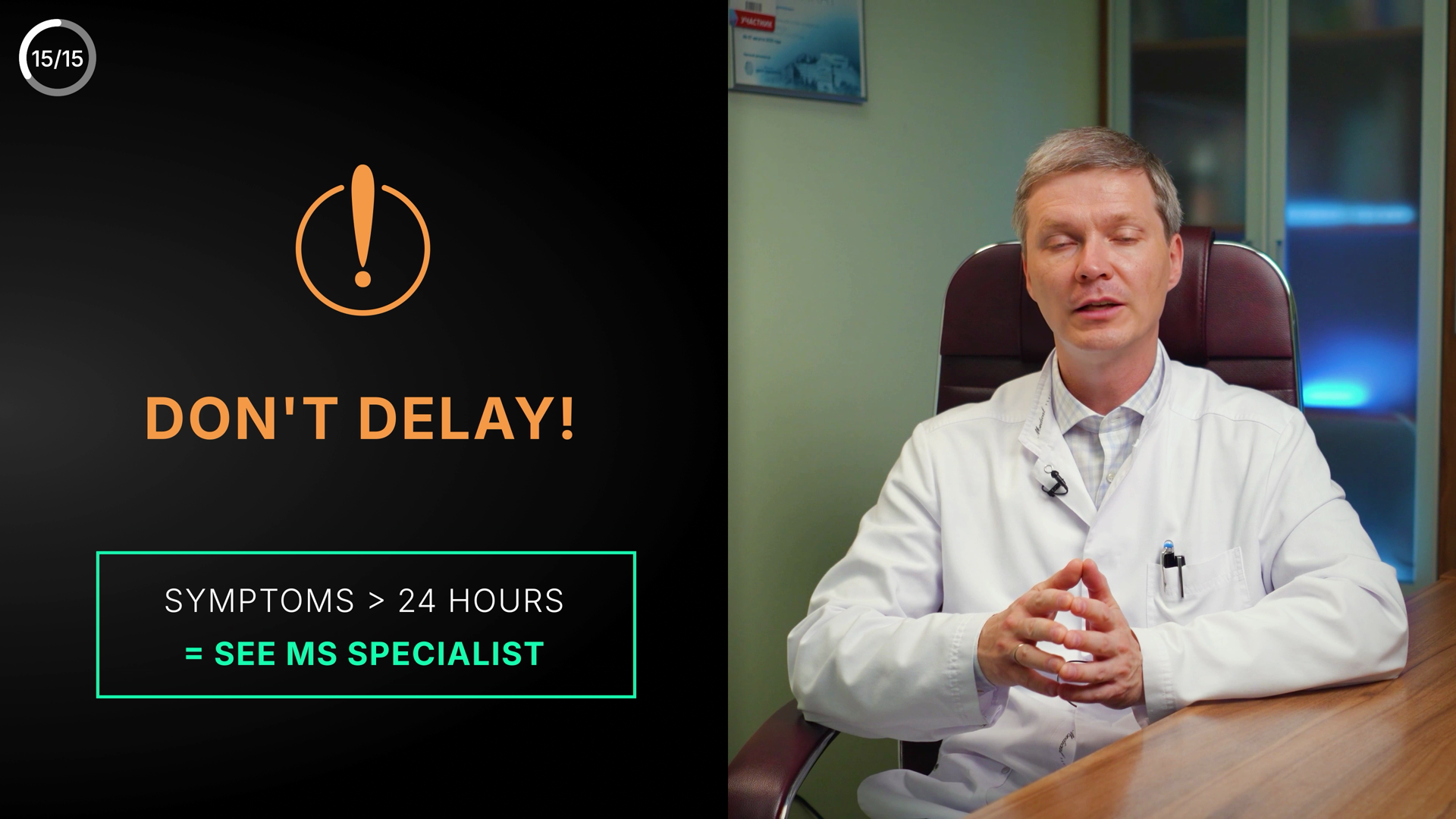
как есть= SEE MS SPECIALIST
как надо= SEE AN MS SPECIALIST
= SEE AN MS SPECIALIST
Добавить артикль в финальный призыв.
подробнее: речь + разбор по пунктам
💬 Что говорит врач в этот момент“See an MS specialist right away to confirm or rule out a relapse. And if a relapse is confirmed,”
📺 Весь текст экранаDON'T DELAY! | SYMPTOMS > 24 HOURS | = SEE MS SPECIALIST
- ГрамматикаДобавить артикль в финальный призыв.
🖼🟢 ОкПереход к финальной карточке «Early treatment»15/15
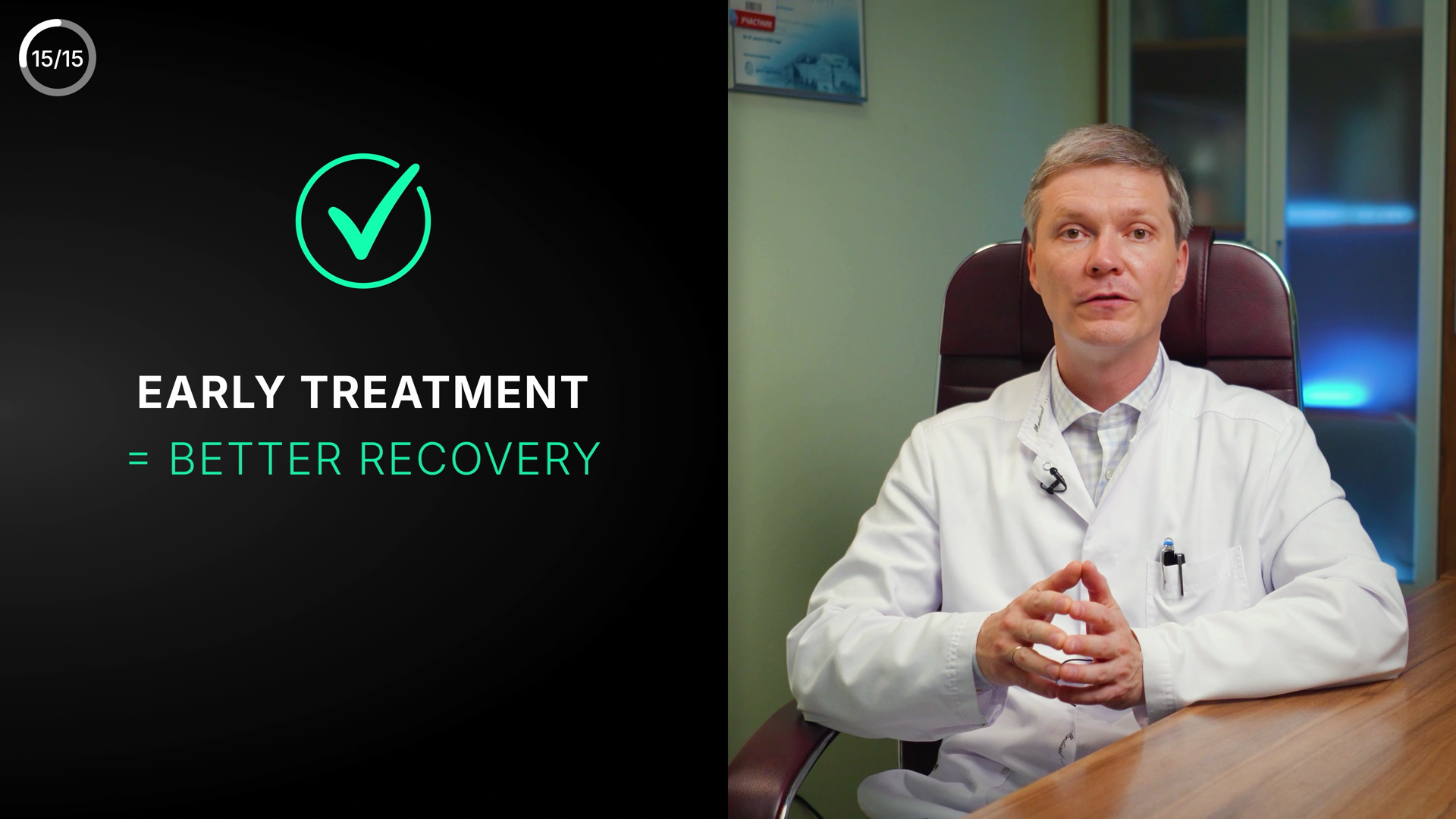
📺 На экране
EARLY TREATMENT | = BETTER RECOVERY
🟢 Правок нет — экран чистый.
подробнее: речь + разбор по пунктам
💬 Что говорит врач в этот момент“And if a relapse is confirmed, immediate therapy initiation to best restore the impaired function.”
📺 Весь текст экранаEARLY TREATMENT | = BETTER RECOVERY
🖼🟢 ОкФинальная карточка «Early treatment = better recovery»15/15
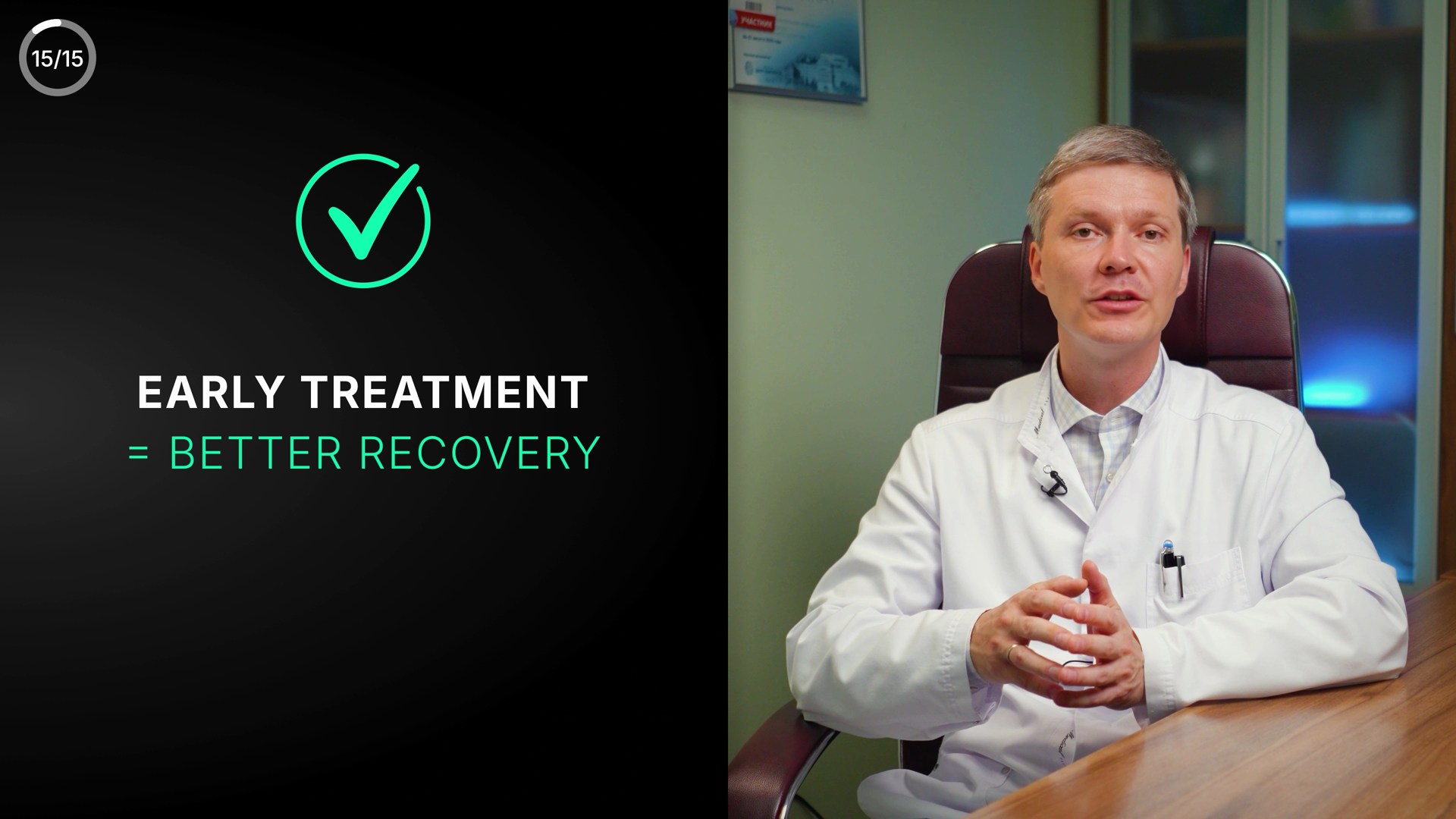
📺 На экране
EARLY TREATMENT | = BETTER RECOVERY
🟢 Правок нет — экран чистый.
подробнее: речь + разбор по пунктам
💬 Что говорит врач в этот момент“immediate therapy initiation to best restore the impaired function.”
📺 Весь текст экранаEARLY TREATMENT | = BETTER RECOVERY
📄 Транскрибация — весь текст озвучки с таймкодами; клик по таймкоду перематывает плеер
Красным зачёркнуто то, что уходит из начала по правке №1 (0:00 – 0:03). Зелёная черта — где ролик начнётся.
In this video, we'll answer some questions.
▼ новое начало ролика
What are the most characteristic manifestations of multiple sclerosis?
How does a relapse present? I have this symptom.
Is it related to multiple sclerosis or not?
In Greek, manifestation means symptom. That's why we always say a symptom of
multiple sclerosis. We have symptoms that are characteristic of MS,
and there are symptoms that aren't typical initially.
When a characteristic symptom appears, we immediately think,
could this person have MS? So what's typical for MS?
First is decreased vision in one eye.
This vision loss can present in completely different ways.
For example, a dark spot may appear in your visual field,
in the center or off to the side.
The eye might feel like it's covered by a curtain or gray film,
and one eye will have decreased perception.
And the image you perceive when looking at your environment may show altered color
perception flashes of light or overlapping glare these are the kinds of symptoms
we see but most often it's decreased vision like a curtain or dark spot in the
visual field and importantly in just one eye this is a characteristic symptom that
may indicate the onset of multiple sclerosis most often this is a manifestation
of what we call optic neuritis The next characteristic symptom is double vision.
For instance, out of nowhere you start seeing horizontal image separation,
or as patients describe it, focusing problems.
You look at an object and it keeps doubling.
When you turn your head right or left, the doubling goes away,
but when you turn the other way, it gets worse.
This type of double vision can quite often be be the first sign of multiple
sclerosis. Numbness in an arm or leg, fingers or the entire limb,
clumsiness when performing movements.
You used to perform fine motor movements quite well, but now there's some
awkwardness. And of course, limb weakness.
Often it's leg weakness or numbness that comes on suddenly.
You might notice you're limping on one leg,
or a feeling of heaviness in the legs when walking.
These are the main manifestations, symptoms that are quite characteristic of
multiple sclerosis there are rarer symptoms not as typical for ms these symptoms
can also appear at disease onset or later these include dizziness and coordination
problems there's imprecision when performing fine movements or walking balance
becomes impaired a person walks and starts veering to one side right then left
another less common initial manifestation of ms is urinary dysfunction.
Most often,
urinary problems are a symptom that appears later in more advanced stages of MS.
But it's important to keep in mind, especially with MS -related dysfunction.
These can vary, but with MS, so -called urgency is more characteristic.
Meaning the person doesn't feel the need to go at that moment.
Then suddenly there's an urgent, commanding need to go,
and they literally have to run. That's how strong this urge is.
This is called urinary urgency or imperative voiding.
This is quite characteristic of people with multiple sclerosis.
Another fairly characteristic sign,
but one that often escapes the attention of both doctors and patients,
is what we call fatigue, persistent fatigue.
It can hit you during the day and not be related to any physical exertion.
Sometimes this fatigue appears in the morning, after sleep.
You should wake up rested, but instead you wake up exhausted, exhausted,
as if you'd just done heavy physical labor.
This is fatigue. It prevents you from adequately completing your tasks at work.
This fatigue, this chronic long term fatigue, is a fairly characteristic sign.
Often people say, yes, I remember I didn't have any other symptoms before,
but I remember I started getting tired at work.
I even had to quit my job.
I switched to something easier because the fatigue was always with me.
This is also a characteristic sign. If it occurs in a young person,
it needs to be investigated. Although there are also atypical presentations.
For example,
MS can even debut with an epileptic seizure or with rarer neurological symptoms.
In any case, I'll put it this way. If a young person between 20 and 30 starts
experiencing dysfunction in any part of their body when performing certain tasks,
sensory disturbances or movement problems, we immediately start thinking,
could this be MS? mess?
You need to see at least a neurologist and not wait for it to go away.
And I have a strong request. If a neurologist examined you and said it's
degenerative disc disease, please get a second opinion to make sure this arm
numbness is actually related to a spinal problem and not a manifestation of
something more serious.
Feel free to share in the comments the symptoms that are characteristic for you.
Multiple sclerosis doesn't typically progress in a constant, steady manner.
It's characterized by a relapsing, remitting course.
There are episodes called relapses, when the person feels unwell,
when a symptom appears, vision decreased in one eye, an arm went numb,
or a leg became weak. If such a symptom appears and lasts more than 24 hours,
that's important. You still have it? It appeared today,
tomorrow you wake up and the symptom is still there.
there, this could be an MS relapse, either the disease onset,
or if you already have MS, the beginning of a relapse.
In this situation, you need to see a doctor immediately, preferably an MS
specialist, so they can determine whether this is a relapse or not.
And if it is a relapse,
they'll provide treatment to restore the impaired function as quickly as possible,
the function that brought you to the doctor.
The second part of this relapsing -remitting course is remission,
when the person feels well or has some lingering issues that bothered them before.
No new symptoms appear during this time,
and this state of remission is what we need to extend as much as possible using
disease modifying therapies for MS, maximizing the remission interval.
The longer we maintain it, the lower the chance of developing a disabling
complication in the future. In a person with MS, MS.
Relapses occur because the immune system at some point becomes activated.
You need to understand that in MS, we're dealing with autoimmunity.
The disease doesn't mean the immune system is constantly destroying myelin.
No, it destroys myelin during relatively brief time intervals.
A sudden immune activation begins. Immune cells enter the brain,
start damaging it, forming new lesions, and then everything subsides.
This entry of immune immune cells and appearance of new lesions.
That's what a relapse is. So a relapse is essentially inflammation within the
central nervous system, inflammation within the system.
In MS, it doesn't involve the entire brain at once.
Rather, it comes in measured doses, in the form of new lesions.
New lesions appear, and importantly, during a relapse, these lesions begin to
accumulate contrast agent. That's why we do MRI with contrast,
to see if there's active inflammation in the brain.
But why do these lesions accumulate contrast?
We administer contrast agent intravenously, so it's in the bloodstream.
The brain is separated from our blood system by what's called the blood -brain
barrier. This barrier is completely impermeable to most molecules.
But if an area of inflammation develops, then in that area,
this section of the barrier becomes becomes permeable and various substances rush
in, including the contrast agent.
It penetrates into this limited area of the new lesion.
And we see this and say,
you've developed acute inflammation in the brain in the form of a lesion and it
requires treatment.
A new lesion forming in the brain or spinal cord carries certain manifestations.
These are disruptions along the path of nerve impulses that manifest as movement
problems, typically or sensory disturbances.
So, if we start treating the relapse quickly enough, extinguishing this
inflammation, the lesion becomes non -inflammatory, movement is restored,
and you feel that your function has recovered.
This is typically achieved with certain medications.
First and foremost, we administer methylprednisolone, suppress the inflammation,
and the lesion becomes inactive. Function is restored.
In addition to actual relapses, there are also so -called pseudo -relapses.
How are they different?
The key difference is that pseudo -relapses last several hours,
never more than 24 hours. So if you develop a symptom,
say some visual flickering or hand numbness, and it lasted one or two hours,
three at most, then it passed, came back, passed again,
and the next day it doesn't appear anymore,
this belongs to the pseudo -relapse category.
category. What causes them? In people with MS, this can occur due to stress,
typically psycho -emotional stress, overheating, or recent infections.
At that moment, a slight MS activation can occur.
The person starts feeling some disturbances, then the triggering factor resolves,
the emotional stress passes, and everything returns to normal.
That's what causes a pseudo -relapse.
A true relapse involves formation of a new lesion, contrast enhancement,
and symptoms lasting more than 24 hours.
So as soon as you develop a first symptom or any new symptoms and they last more
than 24 hours, don't delay.
See an MS specialist right away to confirm or rule out a relapse.
And if a relapse is confirmed,
immediate therapy initiation to best restore the impaired function.
🔁 Находки прошлого QC (v1) — что исправлено, что нет
❌
1:43 · Двоение — чужой B-roll с налезающими подписями (было в QC v1)
Не исправлено. На вставке по-прежнему выжжены подписи источника, и они наезжают друг на друга: читается «Corrected Visiouble Vision». Плюс это по-прежнему сторонний референсный клип — вопрос прав. Как надо: взять свой кадр (или лицензированный) и подписать двумя своими титрами
Не исправлено. На вставке по-прежнему выжжены подписи источника, и они наезжают друг на друга: читается «Corrected Visiouble Vision». Плюс это по-прежнему сторонний референсный клип — вопрос прав. Как надо: взять свой кадр (или лицензированный) и подписать двумя своими титрами
Normal vision / Double vision в разнесённых углах кадра, а исходные выжженные подписи закрыть.❌
6:19 · «(DMTS)» вместо «DMTs» (было в QC v1)
Не исправлено. Теперь капс стоит в обоих местах — и в заголовке над стрелкой, и в легенде:
Не исправлено. Теперь капс стоит в обоих местах — и в заголовке над стрелкой, и в легенде:
DISEASE-MODIFYING THERAPIES (DMTS) и DISEASE-MODIFYING THERAPIES (DMTS). Стандартное написание аббревиатуры — DMTs со строчной «s» (это множественное число, а не буква аббревиатуры). Как надо: DISEASE-MODIFYING THERAPIES (DMTs) в обоих местах.❌
8:51 · Перевёрнутые цвета в таблице сравнения (было в QC v1)
Не исправлено. TRUE RELAPSE (то, из-за чего надо срочно к врачу) по-прежнему в зелёной шапке, PSEUDO-RELAPSE (безобидное) — в красной. Зелёный читается как «всё хорошо», красный как «опасность» — смысл ровно обратный. Как надо: поменять цвета местами (TRUE RELAPSE — красный/янтарный, PSEUDO-RELAPSE — нейтральный серый или зелёный), либо сделать обе шапки нейтральными.
Не исправлено. TRUE RELAPSE (то, из-за чего надо срочно к врачу) по-прежнему в зелёной шапке, PSEUDO-RELAPSE (безобидное) — в красной. Зелёный читается как «всё хорошо», красный как «опасность» — смысл ровно обратный. Как надо: поменять цвета местами (TRUE RELAPSE — красный/янтарный, PSEUDO-RELAPSE — нейтральный серый или зелёный), либо сделать обе шапки нейтральными.
✅
4:10 · Возрастная ось 20–40 против озвучки «20 to 30» (было в QC v1)
Снято перемонтажом. В v2 фраза «a young person between 20 and 30» переехала на 4:22, и под неё сделан отдельный экран
Снято перемонтажом. В v2 фраза «a young person between 20 and 30» переехала на 4:22, и под неё сделан отдельный экран
Age 20-30 = RISK GROUP — прямого противоречия больше нет. Но появилось новое: в пределах 30 секунд зритель видит две разные вилки — ось с подсветкой 20–40 на 4:12 и «Age 20-30» на 4:39. См. пункт по экрану 4:12.📋 Что именно мы проверяем — методика разбора
Грамматика
опечатки, согласование, артикли, пунктуация
Типографика
двойные пробелы, тире vs дефис, кавычки, пробел в «> 24 hours», регистр
Списки
единый маркер, параллельные формулировки, точки в конце, выравнивание
Вёрстка
наезд на лицо/край, обрезка, safe-zone, читаемость, налезающие подписи
Цвет-смысл
🟢 хорошо/да · 🔴 плохо/опасность — цвет обязан совпадать со смыслом
Имена
написание и единообразие во всех упоминаниях
Должности
актуальны, без ошибок, единый регистр
Бренды
свой бренд верно; никаких чужих логотипов и выжженных подписей источника
Факты
числа, диапазоны, сроки, медицинские утверждения — против канона
Смысл
экран соответствует речи, не вводит в заблуждение
Единообразие
единый формат чисел/аббревиатур (DMTs!), экран ↔ озвучка
Контекст
иллюстрация не противоречит тому, что говорит врач
Количество
на экране не больше пунктов, чем врач реально называет
Тайминг
визуал приходит вовремя и держится, пока идёт тема
Темп
успевает ли зритель прочитать ≈2.5 слова в секунду
YTMSEN · Multiple Sclerosis (EN re-version) · продюсер Роман Сергеев · RYA.AE · 2026-08-07