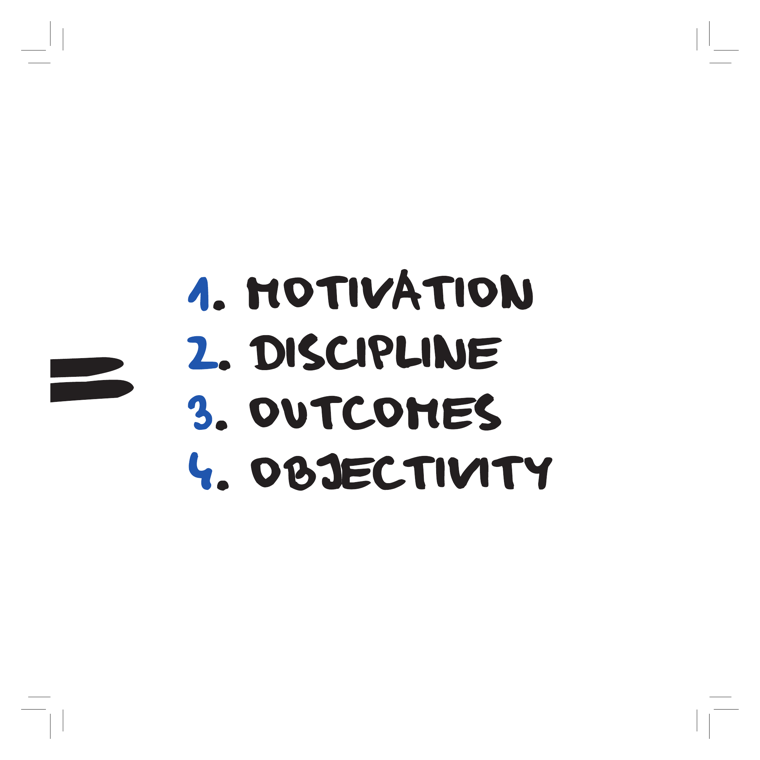
07 Personal-Development Equation (= Motivation + Discipline + Outcomes + Objectivity)
must
A bold hand-drawn equals sign on the left points to a four-item numbered list set in marker-style caps: 1. MOTIVATION, 2. DISCIPLINE, 3. OUTCOMES, 4. OBJECTIVITY. The numbers are blue, the words black, on plain white. No icons, arrows, or metaphor imagery — it is the bare statement of the book's core four-component equation, the spine the whole system hangs on.
Use: Full-cover explainer / system map: Roman introduces the book's four-pillar architecture, then animates each pillar lighting up in sequence as he previews the chapters. Reusable as a recurring framing card whenever he returns to 'where are we in the system.' Because the book itself repeats this graphic on pages 33/34/45, it is a natural backbone motif for the video.
Critical: The equation is presented as if these four are an exhaustive, scientifically derived formula for 'personal development,' but it's an authorial framing device, not a validated model — there's no equation, no weights, no evidence the four are necessary-and-sufficient. The reliance on 'discipline/willpower' as a separable pillar also leans on the willpower-as-finite-resource (ego-depletion) view that failed major replication. Roman can flag that it's a useful mnemonic, not a measured law.
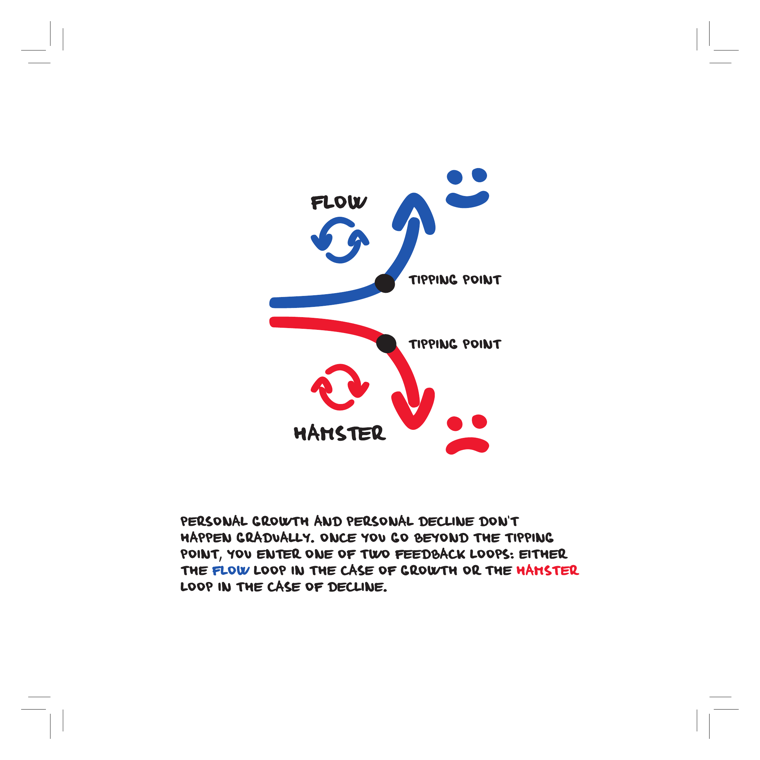
39 Flow vs Hamster Spirals (Tipping Point)
must
Two hand-drawn curved paths diverge from a horizontal baseline. The upper blue path rises after a black dot labeled "TIPPING POINT," arcing into an upward arrow toward a smiley face, with a circular two-arrow loop icon labeled "FLOW." The lower red path drops after its own black dot labeled "TIPPING POINT," curving into a downward arrow toward a frowning face, with a circular loop icon labeled "HAMSTER." Caption: growth and decline are non-gradual; past the tipping point you enter either the FLOW (growth) or HAMSTER (decline) feedback loop.
Use: Full-cover explainer and recurring motif: this is the book's central thesis diagram (repeated on 8 pages), so use it as an animated anchor that returns each time Roman transitions between the growth-loop and decline-loop halves of the review. Good as a chaptering device.
Critical: The "tipping point + self-reinforcing feedback loop" framing dramatizes behavior change as a binary, near-irreversible bifurcation. In reality habit/behavior change is more continuous and reversible; lapses don't lock you into a downward spiral. The two-attractor model is a motivational metaphor, not an established dynamical-systems finding for personal productivity — worth flagging as rhetorically tidy but empirically loose. Since the book reprints it 8 times, note the repetition as persuasion-by-repetition rather than added evidence.
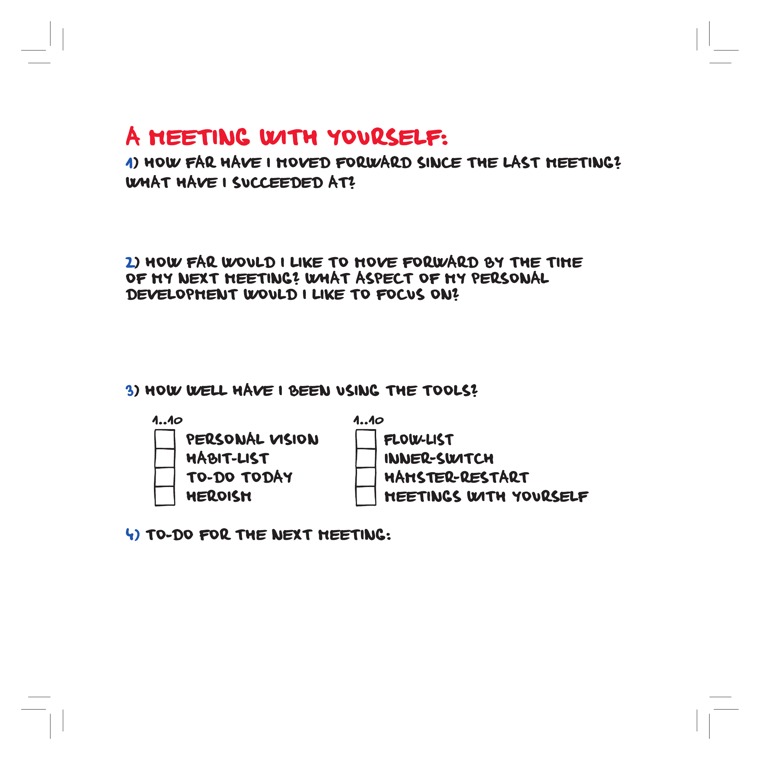
48 A Meeting With Yourself (Worksheet)
must
A blank "A Meeting With Yourself" worksheet with a red hand-drawn header. Four numbered prompts: (1) How far have I moved forward since the last meeting? What have I succeeded at? (2) How far would I like to move forward by the time of my next meeting? What aspect of personal development to focus on? (3) How well have I been using the tools? — followed by a 1..10 self-rating column listing all eight tools (Personal Vision, Habit-list, To-Do Today, Heroism, Flow-list, Inner-switch, Hamster-restart, Meetings With Yourself) each with a small empty score box. (4) To-do for the next meeting. Mostly white space left for handwritten answers.
Use: Full-cover explainer to close the video: present it as the book's "control panel" — a recurring retrospective where you review progress and self-score every other tool 1..10. Animate the eight tool names dropping into the rating column to visually tie the whole 8-tool system together. Works as a downloadable lead-magnet / call-to-action template.
Critical: Self-report 1..10 ratings on your own discipline are exactly where bias lives — people overestimate adherence, and the lowest performers self-score highest (Dunning-Kruger territory), so the worksheet's feedback loop can quietly reinforce delusion rather than correct it. There's also no evidence a periodic self-meeting beats simpler external accountability; it risks becoming productivity theatre. The honest framing: useful as a structured reflection ritual, not a validated measurement instrument.
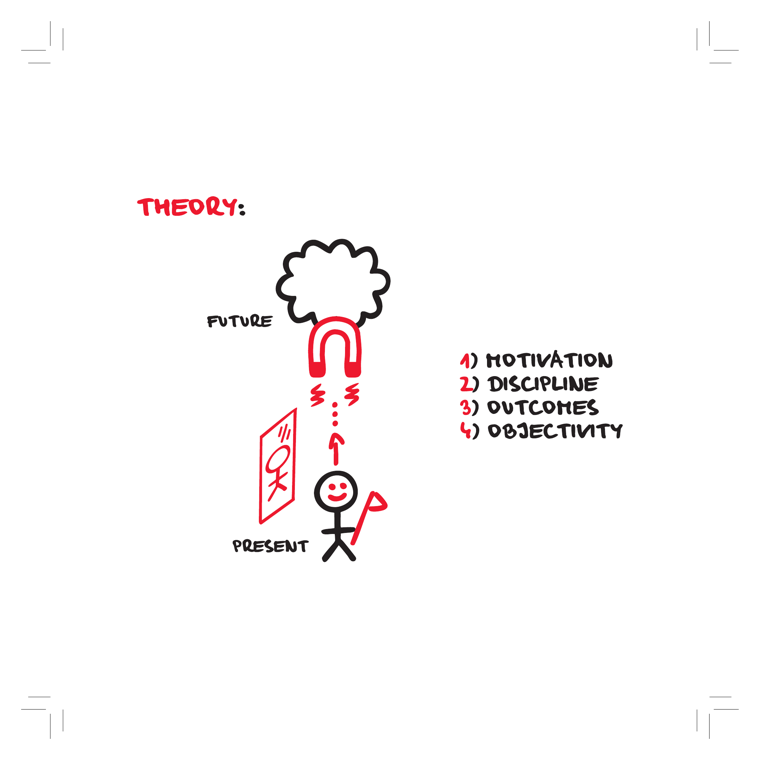
50 Theory Recap: Future Magnet & Present Self
must
A hand-drawn recap titled "THEORY:". At top, a thought-cloud labeled "FUTURE" with a red horseshoe magnet hanging below it, emitting red spark/wave symbols and a dotted line with an upward arrow. At bottom, a smiling stick figure labeled "PRESENT" holds a flag, standing beside a red-framed mirror/poster showing a small figure. To the right is a numbered red/black list of the four areas: 1) Motivation, 2) Discipline, 3) Outcomes, 4) Objectivity.
Use: Full-cover recap explainer / chapter summary slide: use as the "here's the whole system in one picture" beat, animating the four-area list in while the present-self is magnetically pulled toward the future vision. Good transition card between the book's parts.
Critical: The metaphor frames a vivid future vision as a literal "magnet" that pulls behavior — but future-self pull is a motivational aid, not a mechanism; intention-behavior gap research shows vision alone rarely closes the gap without implementation intentions/environment design. The tidy 4-area sequence also implies a clean causal pipeline that the underlying willpower/ego-depletion claims (contested post-2016 replication failures) don't fully support.
03 Things I Should / Would Like / Procrastinate-Do (Three Circles)
must
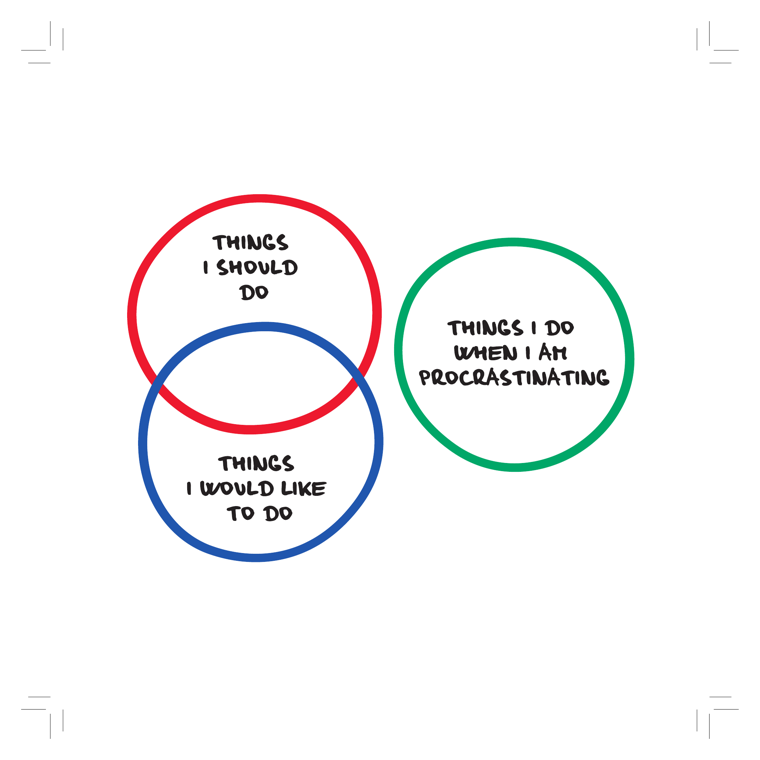
Three hand-drawn marker circles. A red circle labeled "THINGS I SHOULD DO" overlaps a blue circle labeled "THINGS I WOULD LIKE TO DO" — their intersection is the unlabeled sweet spot where obligation meets desire. A separate green circle, set apart on the right, is labeled "THINGS I DO WHEN I AM PROCRASTINATING," visually isolated from the other two to show procrastination falls outside both the should and the want-to.
Use: Strong full-cover explainer to open the procrastination problem: animate the green circle drifting away from the overlap to show how procrastination escapes the "should + want" zone. Good recurring b-roll motif when narrating the gap between intention and action.
Critical: The diagram implies procrastination is a clean separate category of "fun escape" activities, but research (Sirois, Pychyl) frames procrastination as mood-repair / emotion regulation, not simply doing pleasurable alternatives — people often procrastinate into low-value, non-enjoyable activities too. The neat non-overlap oversimplifies.
14 Goal-Junkie Cycle (Hedonic Adaptation Loop)
must
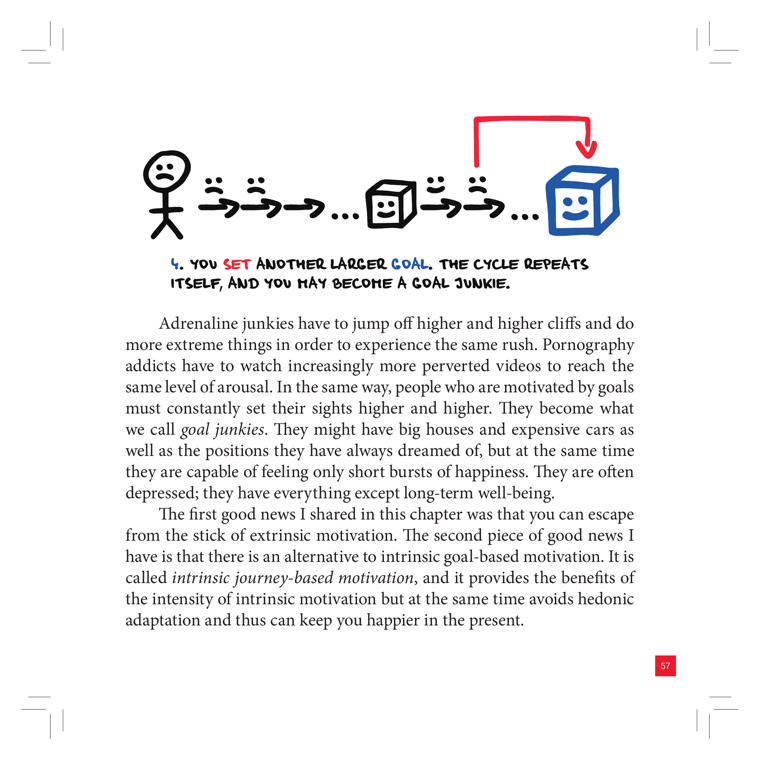
A hand-drawn cartoon strip: a frowning stick figure, then a row of small smiling cubes shrinking with arrows and "..." between them, ending in a large blue smiling cube. A red looping arrow runs from the big cube back to the start, signalling repetition. Caption (step 4): "You set another larger goal, the cycle repeats itself, and you may become a goal junkie."
Use: Full-cover explainer / looping animation b-roll: the red return-arrow makes it a natural endless-loop GIF showing how each achieved goal fades and a bigger one is set — illustrates hedonic adaptation and the "always chasing, never satisfied" trap of extrinsic goal-based motivation.
Critical: Hedonic adaptation is well-supported, but the "goal junkie" framing is moralized pop-psychology, not a measured construct; equating goal-pursuit with addiction (adrenaline/porn analogies in the text) is rhetorical, not clinical. The book also REPEATS this same graphic across pages [52,58], so on-screen Roman should note the duplication rather than treat it as two distinct diagrams.
15 Personal Vision as a Magnet (Journey-Based Motivation)
must
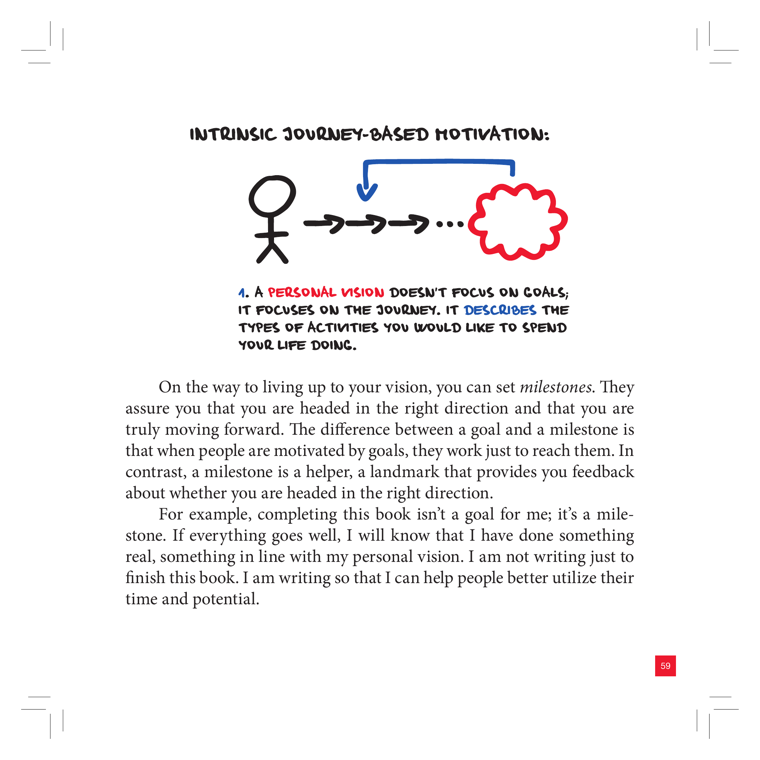
A hand-drawn stick figure on the left under the heading "INTRINSIC JOURNEY-BASED MOTIVATION:". A series of black arrows (→ → → …) leads rightward from the figure toward a red scribbled cloud — the "personal vision." A blue curved arrow loops back from the cloud down toward the path, implying the vision pulls/guides the person forward like a magnet. Caption: "A PERSONAL VISION doesn't focus on goals, it focuses on the journey. It describes the types of activities you would like to spend your life doing."
Use: Full-cover explainer to open the Motivation section: animate the stick figure walking arrow-by-arrow toward the cloud while the blue "pull" arc draws the figure forward. Good anchor visual that recurs (book repeats it on pp. 30/60/66/166), so reuse as a recurring motif/b-roll callback throughout the video whenever "vision vs goals" comes up.
Critical: The graphic sells "journey over goals" as obviously superior, but the science is mixed: process/approach goals and specific outcome goals both reliably boost performance (Locke & Latham), and a vague "vision cloud" with no measurable target is exactly the kind of fuzzy intention that fails to change behavior. Roman can flag that the book repeats this image 4 times — repetition as persuasion, not new evidence — and that "vision pulls you like a magnet" is motivational metaphor, not a mechanism.
16 Joy vs Flow: One Spike vs Sustained Spikes
must
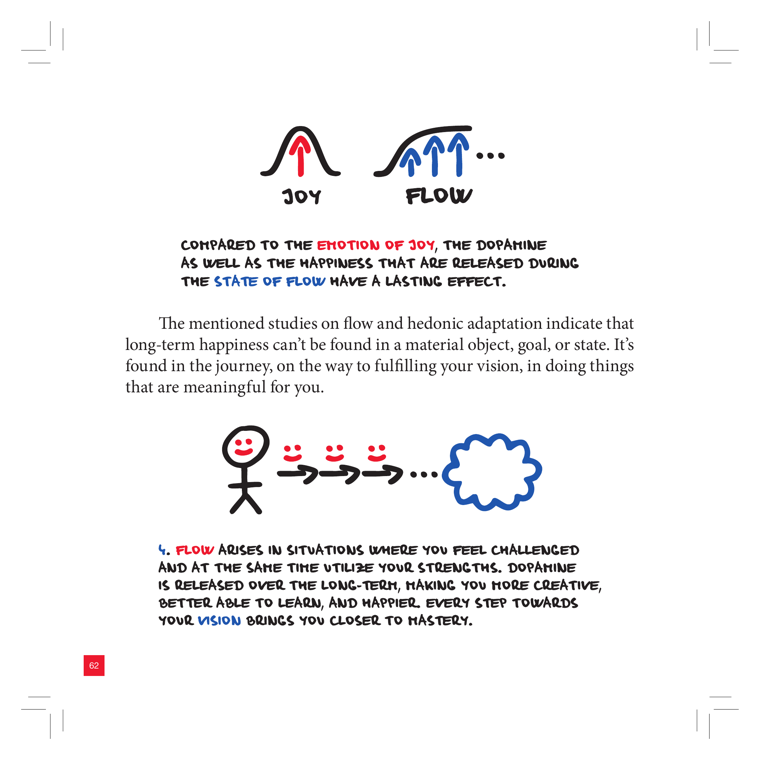
Two hand-drawn bell-curve mounds side by side. Left, labeled "JOY", has a single red up-arrow at its peak — one isolated dopamine spike. Right, labeled "FLOW", has a cluster of red up-arrows trailing off with an ellipsis — many sustained spikes over time. Below, a stick figure with red arrows (→ → →) progressing toward a blue cloud (vision/mastery), captioned that flow arises when challenged while using your strengths, releasing dopamine long-term.
Use: Full-cover explainer or side-by-side comparison b-roll: animate JOY's single spike fading vs FLOW's repeated, sustained spikes, then the stick-figure journey arrows building toward the vision cloud. Strong visual to contrast one-off pleasure (hedonic) with durable engagement.
Critical: The clean "one dopamine spike = fleeting joy vs many spikes = lasting flow" story is a pop-neuroscience simplification. Dopamine is more about reward-prediction and motivation than a literal "happiness chemical," and flow research (Csikszentmihalyi) is largely self-report, not neat dopamine-curve evidence. Hedonic adaptation is real, but the tidy curve metaphor overstates how well the brain mechanism is understood.
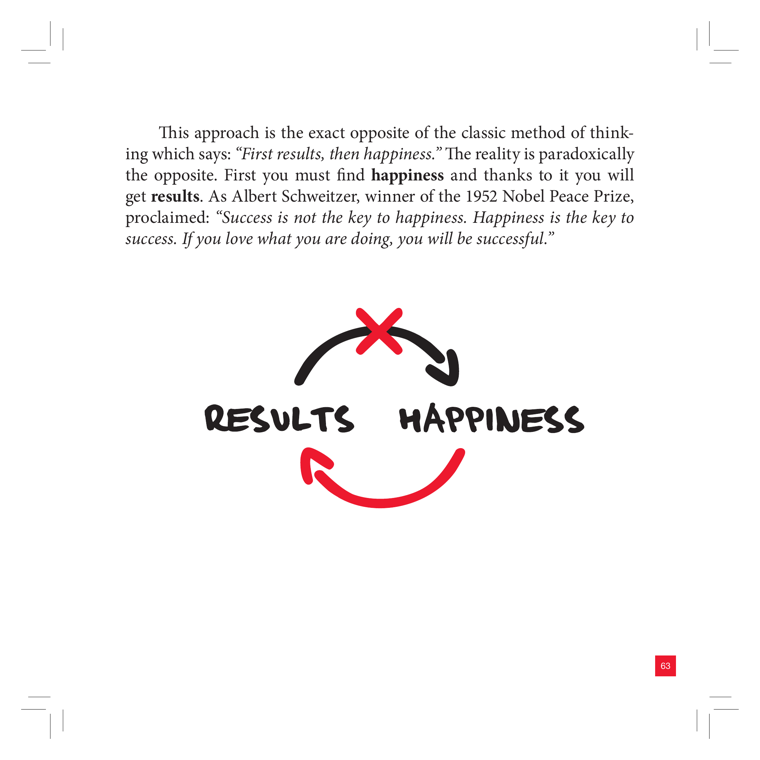
17 Results ↔ Happiness Reversed Loop
must
Two hand-lettered words, "RESULTS" (left) and "HAPPINESS" (right), connected in a circular loop by two curved arrows. The top black arrow points from RESULTS toward HAPPINESS but is crossed out with a red X, marking the conventional "first results, then happiness" direction as wrong. The bottom red arrow points from HAPPINESS back to RESULTS, asserting the correct causal order: happiness drives results. Accompanying text quotes Albert Schweitzer ("Success is not the key to happiness. Happiness is the key to success").
Use: Full-cover explainer: animate the crossed-out top arrow first (the myth "results → happiness"), then reveal the red bottom arrow flipping the causality (happiness → results). Strong as a comparison cold-open or thesis card framing the book's core motivation claim.
Critical: The clean one-way "happiness → results" arrow oversells the science. The positive-affect/success literature (Lyubomirsky, King & Diener 2005) shows a real but modest correlation and is largely correlational; causality runs both ways, and several positive-psychology effect sizes shrank after the replication crisis. Schweitzer-quote authority ≠ evidence. Honest redraw should keep BOTH arrows (a feedback loop), not crossing one out as simply "false."
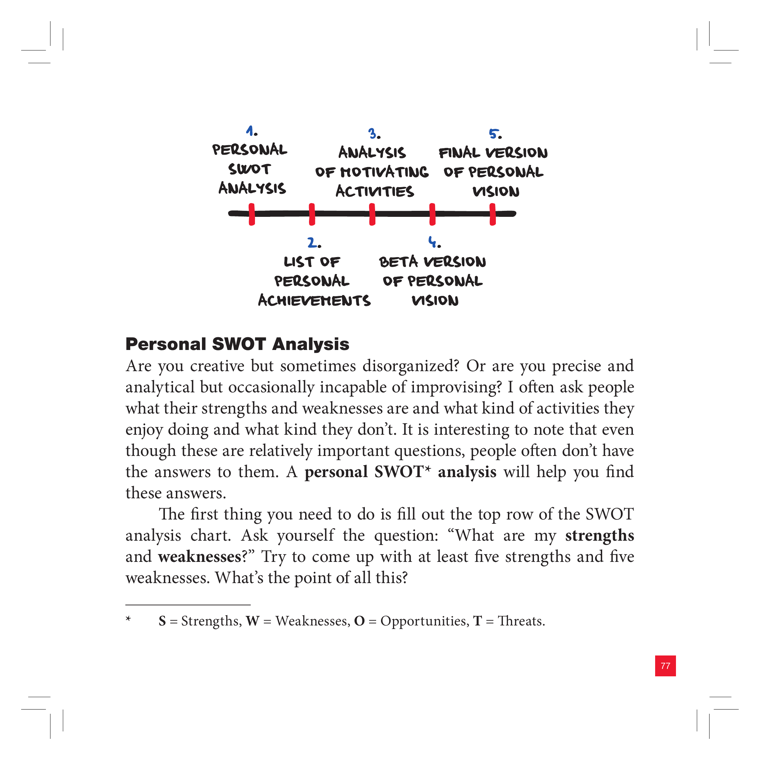
19 Personal Vision: 5-Step Roadmap
must
A hand-drawn horizontal timeline (a thick black arrow) with five red tick-marks, each numbered and labeled, alternating above/below the line. The five steps read: 1. Personal SWOT Analysis, 2. List of Personal Achievements, 3. Analysis of Motivating Activities, 4. Beta Version of Personal Vision, 5. Final Version of Personal Vision. Below sits the section heading "Personal SWOT Analysis" and body text, with a footnote defining SWOT (S=Strengths, W=Weaknesses, O=Opportunities, T=Threats). The pre-classified hint ("four-quadrant SWOT grid") is WRONG for this page — no grid is drawn here; it is a linear process roadmap. The graphic is repeated across pages 78-79.
Use: Full-cover explainer / animated build: reveal the five timeline nodes one by one to walk the viewer through the book's method for constructing a Personal Vision (SWOT to achievements to motivating activities to beta vision to final vision). Good chapter-opener b-roll for the Motivation area.
Critical: The roadmap implies a clean linear pipeline where a self-assessment SWOT mechanically yields a stable "Personal Vision." Self-report SWOT is prone to self-serving bias and poor self-insight (people are weak at naming their own strengths/weaknesses), and "vision-setting" as a motivation driver has thin causal evidence. The neat 5-step arrow oversells determinism in what is really an iterative, fuzzy process — worth flagging the false precision.
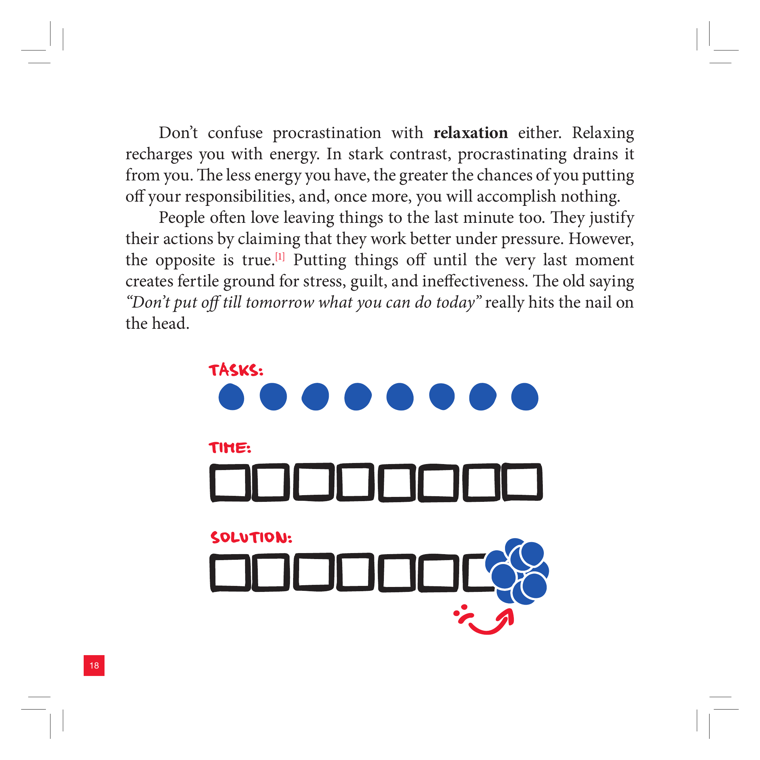
04 Tasks vs Time vs Solution Strip
must
Three hand-drawn rows under red labels. "TASKS:" = a row of 8 solid blue dots (the things you must do). "TIME:" = a row of 8 empty black-outlined squares (your available time slots/days). "SOLUTION:" = the same row of squares, but the first six are empty and the last two slots are crammed with a dense cluster of blue dots, with a red curved arrow pointing back to the start — the procrastinator's tasks all piled up at the deadline instead of spread across time.
Use: Full-cover explainer / animated build: drop the 8 task-dots one per time-slot (the ideal), then re-run it as the procrastinator's reality — dots stay empty until they avalanche into the final two slots. Strong comparison visual for the "last-minute" myth.
Critical: The book asserts "people work better under pressure... the opposite is true." That's directionally supported (last-minute work raises error rate and stress for most tasks), but it's overstated as universal — moderate deadline pressure (Yerkes-Dodson) genuinely lifts performance for some people/tasks, so the flat "the opposite is true" claim doesn't fully survive a nuance-check.
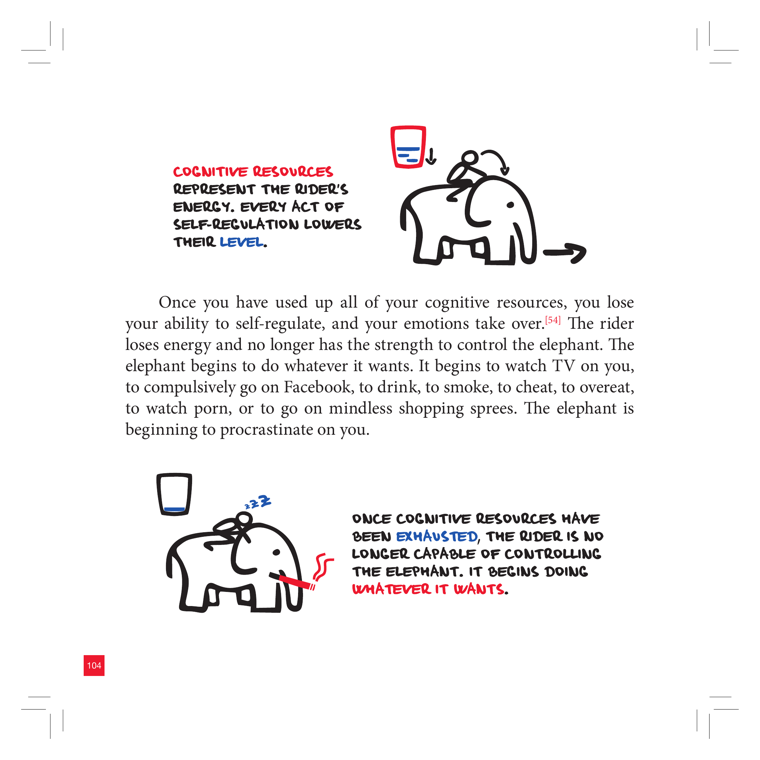
23 Elephant & Rider: Cognitive Resources Depleting
must
Two hand-drawn states of the same rider-on-elephant scene, each with a red handwritten callout. Top: a small rider sits on an elephant beside a battery/glass icon shown full; callout reads "Cognitive resources represent the rider's energy. Every act of self-regulation lowers their LEVEL." Bottom: the rider is slumped/asleep (Zzz) on the elephant beside an empty battery icon, with a red squiggle showing the elephant breaking loose; callout reads "Once cognitive resources have been EXHAUSTED, the rider is no longer capable of controlling the elephant. It begins doing WHATEVER IT WANTS."
Use: Full-cover explainer / two-state before-after build: drop the full-battery rider-in-control state, then dissolve to the empty-battery slumped-rider state to dramatize willpower depletion. Strong b-roll for any segment on self-control running out by evening.
Critical: This is the book's clearest commitment to the willpower-as-a-finite-fuel-tank (ego-depletion) model: the rider runs on a draining battery/glass of cognitive resources. That exact claim is the one that failed to replicate — the 2016 Hagger multi-lab registered replication found near-zero ego-depletion, and Job/Dweck showed the effect depends on whether you BELIEVE willpower is limited. So the depleting-battery icon is the contested visual; Roman can flag that the metaphor is intuitive but the literal "energy meter empties" mechanism is among the most disputed in the book.
24 Habit Disruption Recovery Chart
must
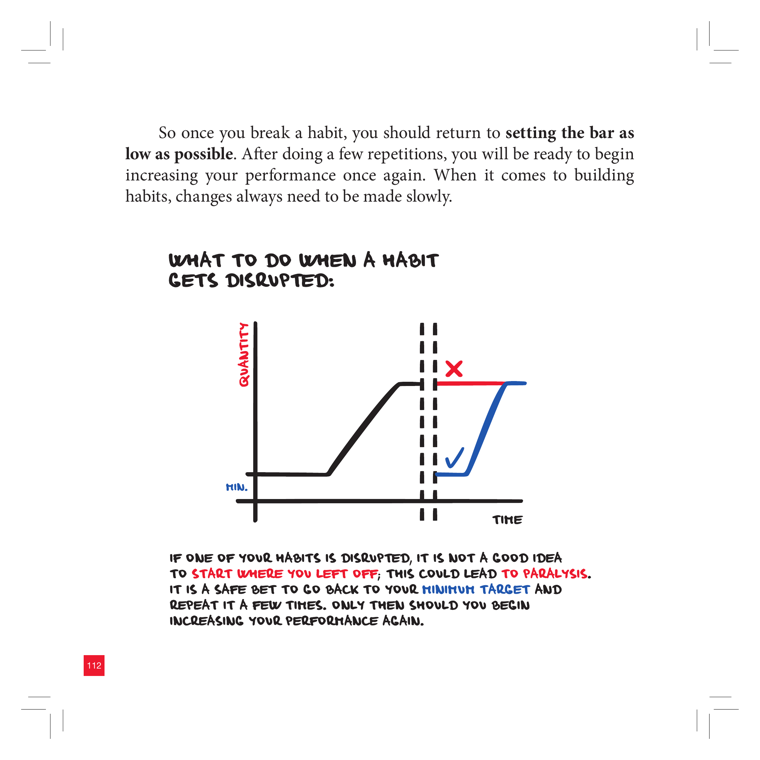
A hand-drawn line chart titled "What to do when a habit gets disrupted." Y-axis = QUANTITY (with a "MIN." baseline marked in blue), X-axis = TIME. A black curve rises from the minimum, climbs to a plateau, then hits a vertical dashed-line break (the disruption point). From there two paths diverge: a red line jumps straight back to the previous high level marked with a red ✗, and a blue line drops back down to the MIN. baseline and re-climbs gradually, marked with a blue ✓. Caption: don't restart where you left off (paralysis) — go back to your minimum target, repeat a few times, then increase.
Use: Full-cover explainer: animate the black curve building up, then the disruption break, then race the red (wrong/✗) vs blue (right/✓) recovery paths side by side. Strong comparison visual for the "after a break, restart small" lesson.
Critical: The "set the bar as low as possible" / minimum-target restart advice is consistent with behavior-design research (BJ Fogg's Tiny Habits, implementation-intention literature) and survives a 2026 check — it's a reasonable claim. The contestable part is the implicit framing that returning at full intensity causes "paralysis"; that's a plausible heuristic but presented as a sharp binary (✗ vs ✓) without data — real recovery is a gradient, not two clean curves.
25 Breaking Bad Habits Decline Chart
must
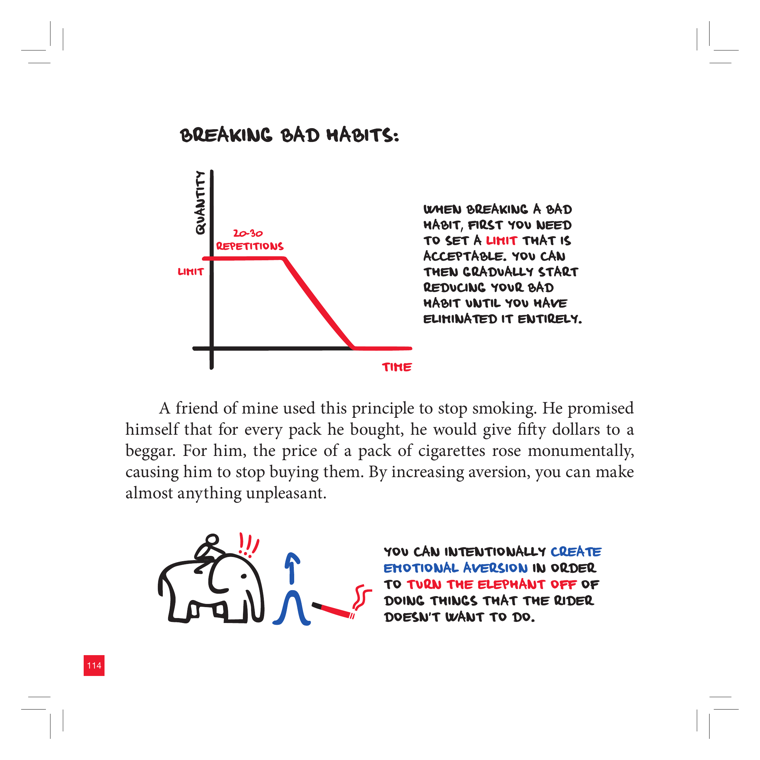
A hand-drawn line chart titled "Breaking Bad Habits." Y-axis = Quantity, X-axis = Time. A red line starts flat at a high horizontal level labeled "Limit" (annotated "20-30 repetitions"), holds briefly, then declines steeply to zero — the staged reduction of a bad habit until eliminated. Below, an inset shows the elephant metaphor: an elephant tugged on a string with an upward arrow and a red squiggle/spark, captioned that you can intentionally create emotional aversion to "turn the elephant off" from doing things the rider doesn't want.
Use: Full-cover explainer: animate the red line setting a "limit" cap then ramping down to zero to illustrate the taper-don't-quit-cold method (smoking example). Elephant inset works as a separate b-roll metaphor card on emotional aversion / making a habit unpleasant.
Critical: The "set a limit, then gradually reduce" tapering curve is plausible behaviorally, but the smoking anecdote (pay a beggar $50 per pack) is a single n=1 aversion story dressed as a method — aversion/punishment-based change has weaker, less durable evidence than reinforcement of replacement behaviors, and the clean monotonic decline hides real-world relapse. Worth flagging the gap between the tidy chart and messy quit data.
26 Habit-List Tracker Table
must
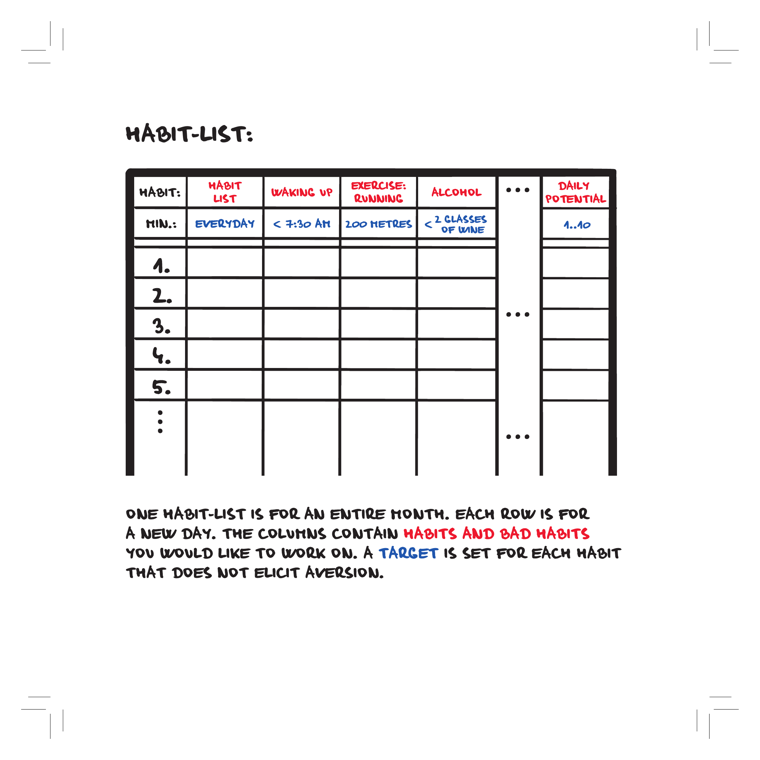
A hand-drawn blank worksheet titled "HABIT-LIST:" — a grid table for tracking habits over one month. The top-left cell reads "HABIT:" then "MIN.:" (minimum target). Column headers list example habits with their daily targets: Waking Up (< 7:30 AM), Exercise: Running (100 metres), Alcohol (< 2 classes of wine), then "..." for more columns, ending in a "Daily Potential" column (1..10). Rows are numbered 1, 2, 3, 4, 5... — each row = a new day. Caption: one habit-list covers an entire month, columns mix good habits and bad habits, and each habit gets a non-aversive target.
Use: Full-cover explainer when introducing the Habit-list tool — animate the blank grid then populate it row-by-row (days) to show how a month of habits is tracked and scored. Reusable as a recurring b-roll motif since the book itself repeats it on pages 118/120/122.
Critical: The template is a sound habit-tracking instrument, but the "Daily Potential 1..10" self-score column implies a tidy quantification of willpower/discipline that leans on the book's broader willpower-as-depletable-resource framing — contested post-2016 ego-depletion replication failures. Also worth noting the book reuses this same blank table 3x (pp.118/120/122), padding the page count rather than adding new information.
27 Decision Paralysis Fork (A ≠ B → Nothing / C)
must
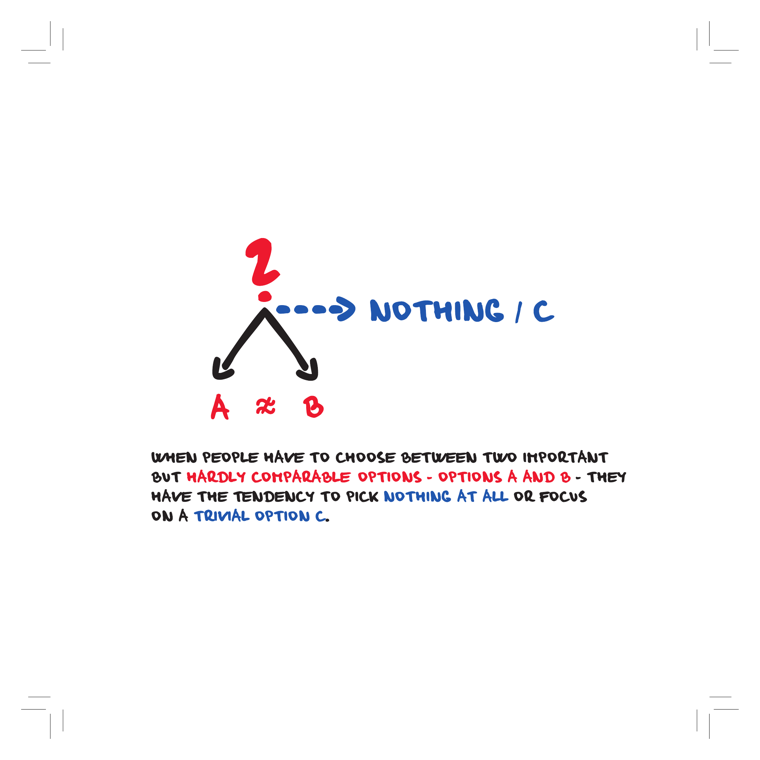
A hand-drawn branching diagram: a red question mark sits at the top of a fork. Two solid black arrows split down-left and down-right to "A ≠ B" (red), meaning two important but hardly-comparable options. A blue dashed arrow shoots sideways to "NOTHING / C" (blue). Caption: when people must choose between two important but hardly comparable options A and B, they tend to pick nothing at all or focus on a trivial option C.
Use: Full-cover explainer that animates the choice deadlock: A and B branches light up, the question mark pulses, then the dashed escape arrow slides out to "Nothing / C." Great cold-open metaphor for procrastination-as-avoidance and the paradox of choice; reusable as b-roll whenever Roman describes decision avoidance.
Critical: The cartoon implies decision paralysis is a universal trap, but the real research is more bounded: Iyengar & Lepper's "paradox of choice" / jam study has largely failed to replicate (Scheibehenne 2010 meta-analysis found near-zero average choice-overload effect). Avoidance under hard tradeoffs is real but far more context-dependent than the clean fork suggests — Roman can flag that the diagram overgeneralizes a contested effect.
30 Long To-Do List Breeds Aversion & Decision Paralysis
must
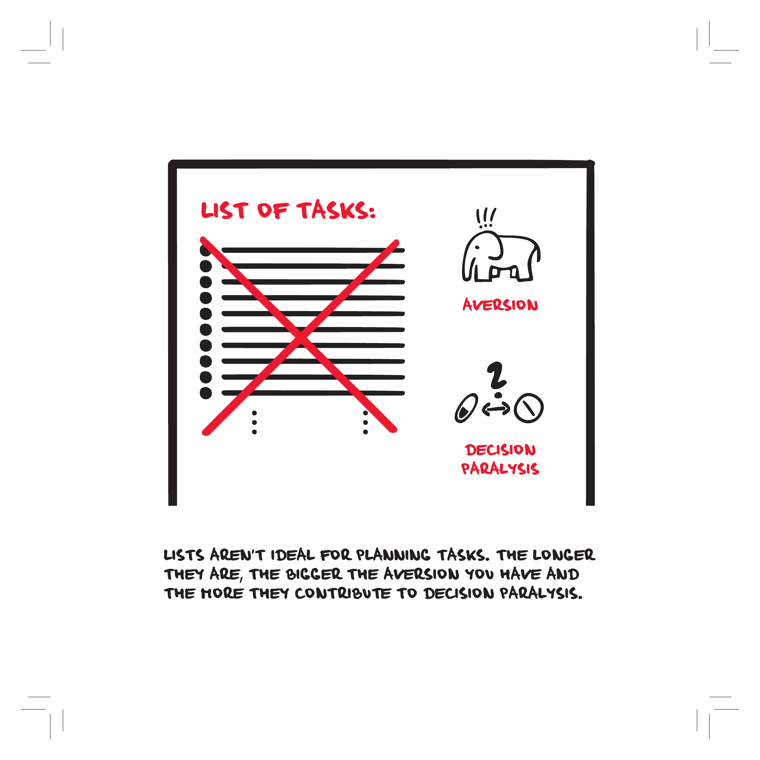
A hand-drawn frame titled "LIST OF TASKS:" containing a long bulleted list whose every line is struck out by a large red X, trailing into dots (implying it goes on endlessly). To the right, two captioned icons: an annoyed elephant with stress marks labeled "AVERSION", and below it two opposed choices (a checkmark-pill vs. a no-symbol) with a "?" and double-headed arrow between them labeled "DECISION PARALYSIS". Caption: lists aren't ideal for planning — the longer they are, the bigger the aversion and the more decision paralysis.
Use: Full-cover explainer: animate the red X slashing across an ever-growing list to dramatize why long to-do lists fail, then introduce the book's "To-Do Today" tool as the fix (short, fixed, today-only). Good as a problem-statement card before revealing the solution.
Critical: The "elephant" (Haidt's emotional system) framing of task-aversion is a useful metaphor, not a mechanism; the stronger, testable claim — that longer lists monotonically raise aversion and cause choice overload / decision paralysis — leans on choice-overload research (Iyengar & Lepper's jam study) that has largely failed to replicate in meta-analysis (Scheibehenne 2010). So "longer list = more paralysis" is plausible folk wisdom but not robustly evidenced; effect depends heavily on context.
31 One Large Task vs. Three Small Tasks (Elephant Split)
must
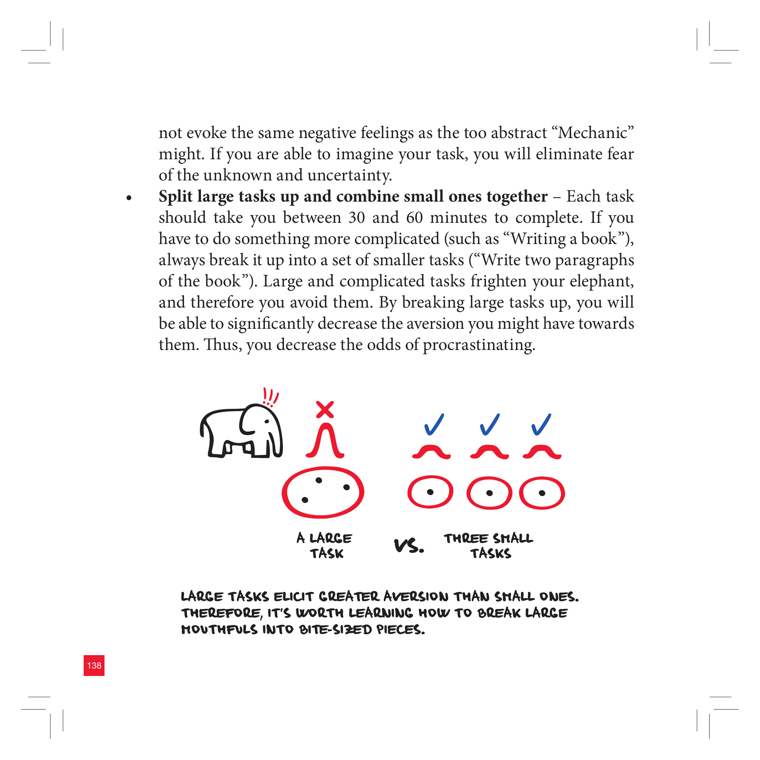
A hand-drawn comparison. On the left: a small elephant icon beside a single big worried/frowning face marked with a red X and a red exclamation "!!" above — labeled "A LARGE TASK." On the right: three small smiling faces, each topped with a blue check mark — labeled "THREE SMALL TASKS." A "vs." sits between them. Caption below: "Large tasks elicit greater aversion than small ones. Therefore, it's worth learning how to break large mouthfuls into bite-sized pieces."
Use: Full-cover explainer / side-by-side comparison: red-X frowning "big task" face morphs/splits into three green-check smiling small faces. Great as a visual punchline when Roman explains task-chunking, or as recurring b-roll whenever the "elephant" (emotional brain) appears.
Critical: The chunking advice itself is solid and survives a science-check (it maps onto goal-gradient and reducing task aversion / implementation-intentions research). The contestable part is the surrounding "elephant" framing — the book leans on the Haidt elephant-and-rider metaphor and on motivation/willpower models that are softer than presented; the claim "large tasks frighten your elephant" is a vivid story, not a measured mechanism. Roman can endorse the practical tip while flagging that the emotional-brain causality is metaphor, not evidence.
32 To-Do Today Board (Scattered Tasks)
must
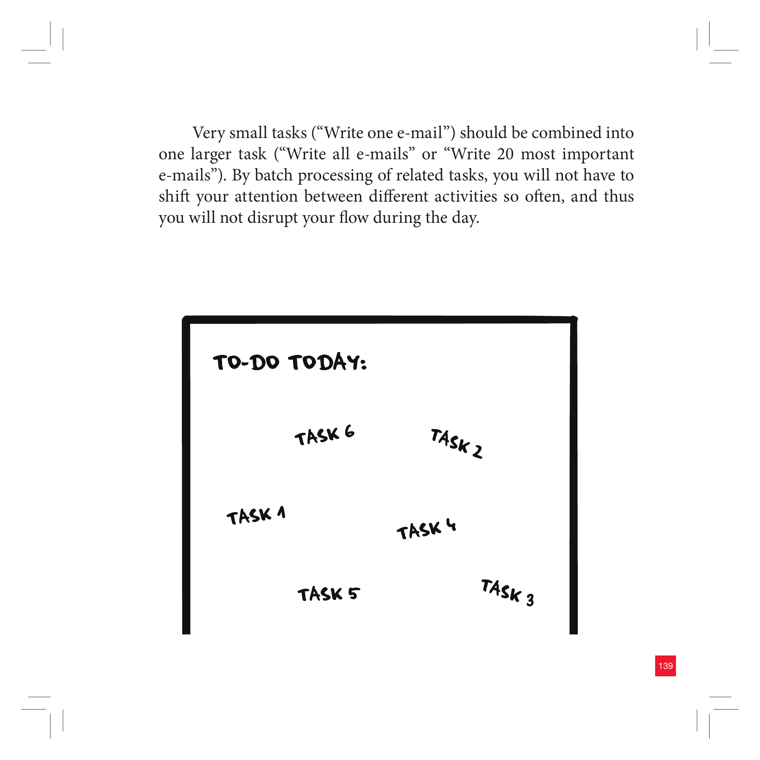
A hand-drawn whiteboard/sheet with a bold black border and the handwritten heading "TO-DO TODAY:". Inside, six items labeled TASK 1 through TASK 6 are scattered randomly across the board at varying positions and slight rotations, with no list order, columns, or priority structure. The placement is deliberately chaotic rather than a neat top-to-bottom list. Page number 139 in the red corner tab.
Use: Full-cover explainer of the "To-Do Today" tool: start with the scattered tasks (the messy default), then animate them snapping into a clean prioritized single-day list to show the method's value. Good recurring b-roll since the book reuses it across pages 140-143,169.
Critical: The image is a neutral worksheet metaphor, so no contested neuroscience claim to debunk; the critical angle is method-level — a flat 6-task daily list ignores prioritization weight (it's not Eisenhower/MITs) and the book repeating the same blank board across 5 pages pads the page count rather than adding new evidence. Roman can flag the "scatter then list" as cosmetic vs. genuine prioritization research.
37 Hamster Analysis Worksheet
must
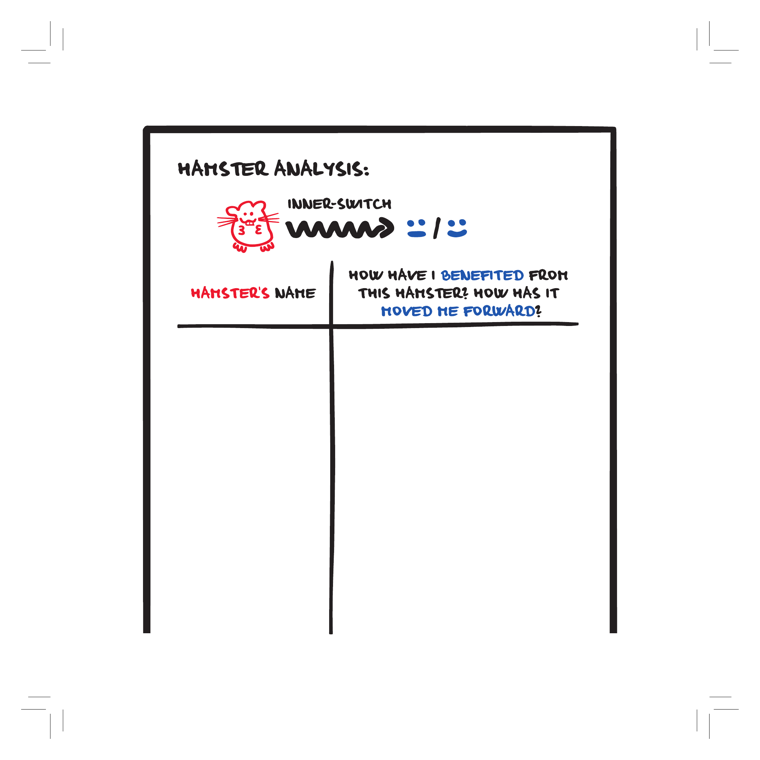
A hand-drawn worksheet titled "HAMSTER ANALYSIS:" with the Inner-switch icon (a red hamster, a black squiggle-arrow, and a frown/smile face pair). Below is a two-column table: left column header "HAMSTER'S NAME" (red), right column header "How have I BENEFITED from this hamster? How has it MOVED ME FORWARD?" Both columns are blank, ready to be filled in by the reader.
Use: Full-cover explainer: show the blank two-column worksheet, then fill rows live on screen (e.g. "The Comparison Hamster" / "It pushed me to raise my standards") to demonstrate the reframing exercise — turning a self-sabotaging inner voice into something that moved you forward.
Critical: The "hamster" is the book's metaphor for an automatic negative thought-loop; reframing it as beneficial is essentially classic CBT cognitive reappraisal — solid and evidence-based. But the worksheet's premise that every self-critical inner voice has genuinely "moved you forward" risks toxic-positivity bias: forcing a silver lining onto rumination or anxiety can invalidate when those loops are simply harmful and need stopping, not reframing.
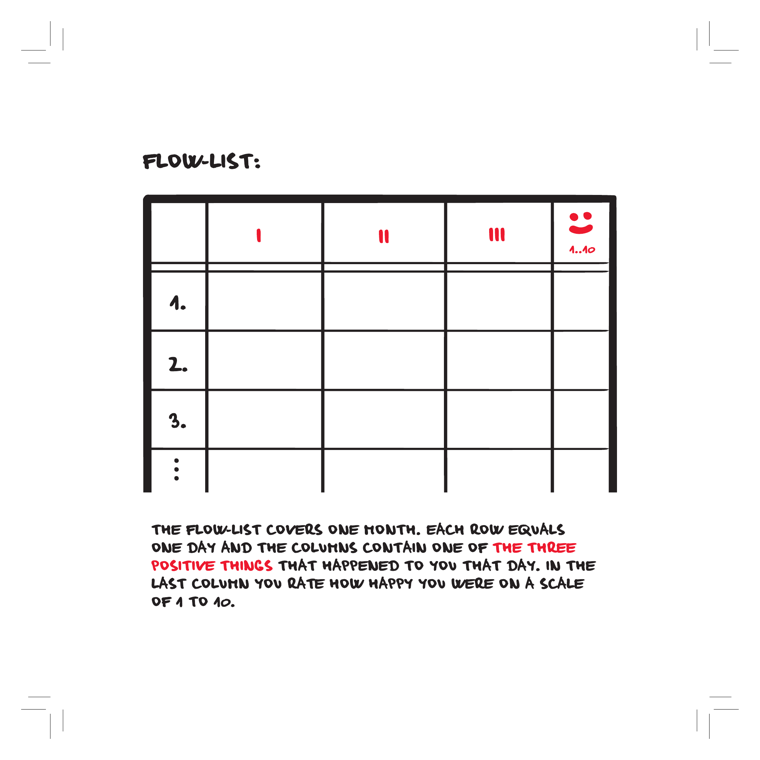
38 Flow-List Worksheet
must
A hand-drawn blank worksheet table titled "Flow-list:". Rows are numbered 1, 2, 3... (each row = one day of a month). Three columns headed with red tally marks I, II, III hold the three positive things that happened that day; a fourth column headed with a red smiley and "1..10" rates daily happiness. Caption explains it covers one month, one row per day, three positives plus a 1-10 happiness rating.
Use: Full-cover explainer: animate the blank grid filling in three positives + happiness scores across days, illustrating the gratitude-journaling tool. Good as the canonical reference when Roman demos how to actually keep a Flow-list.
Critical: It's a "three good things" gratitude journal rebranded as a Flow-list. The core gratitude-journaling effect is one of positive psychology's better-replicated interventions, but effect sizes are modest and shrink in higher-quality trials; "flow" (Csikszentmihalyi) is a separate construct and logging three positives doesn't actually train flow, so the naming oversells the mechanism.
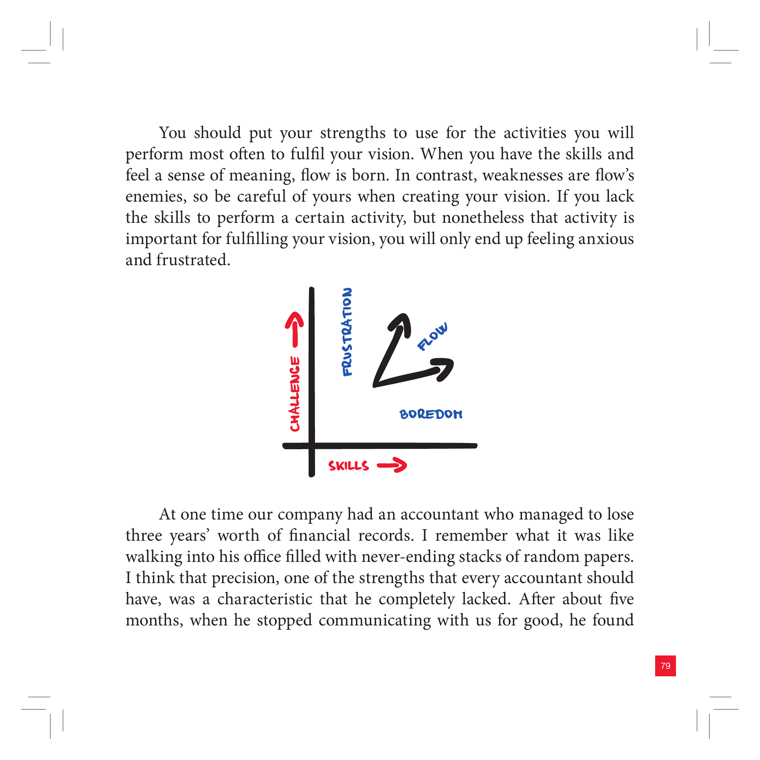
20 Flow Channel Quadrant (Challenge vs Skills)
must
A hand-drawn 2-axis chart: vertical axis labeled CHALLENGE (red up-arrow), horizontal axis labeled SKILLS (red right-arrow). The upper-left zone is labeled FRUSTRATION, the lower-right zone is labeled BOREDOM, and a black diagonal arrow rising through the middle is labeled FLOW. It maps the classic Csikszentmihalyi flow model where high challenge + low skill = frustration/anxiety, low challenge + high skill = boredom, and balance = flow.
Use: Full-cover explainer animatable as a build: draw axes, drop in the two failure-mode labels (Frustration / Boredom), then sweep the diagonal Flow arrow up the middle. Good b-roll under VO about matching task difficulty to skill level; supports the Flow-list tool segment.
Critical: Flow as a 2x2 of challenge vs skill is a popular simplification; Csikszentmihalyi's later 8-channel model and replication concerns mean "balance = flow" is more heuristic than measured. The diagram also implies flow is mainly a difficulty-tuning problem, ignoring autotelic personality, intrinsic motivation, and weak experimental control over the state.
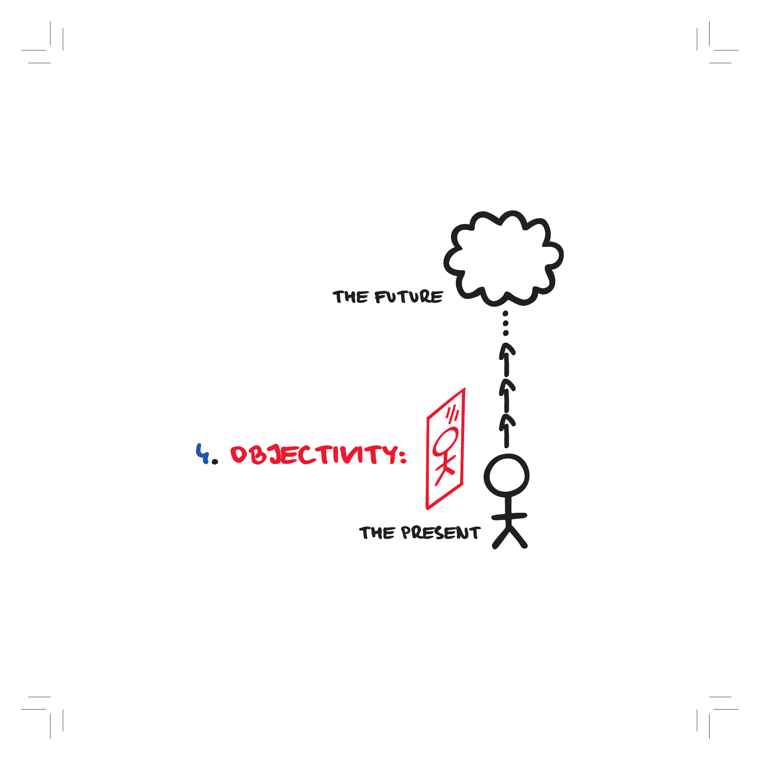
11 Objectivity: Present Self Aiming at the Future
must
A stick figure stands on the ground labeled "THE PRESENT," holding/standing beside a red sheet of paper (a list/scorecard with an "OK" mark and edits). A column of upward-pointing arrows rises from the figure toward a dotted line that leads into a thought-cloud labeled "THE FUTURE." The red "4. OBJECTIVITY:" heading sits to the left, marking this as the fourth system area.
Use: Full-cover explainer to open the fourth pillar: animate the present-self looking at a paper scorecard and projecting upward arrows toward an imagined future, framing objectivity as honest self-review (the "Meeting With Myself" tool) bridging present reality and future goals.
Critical: The graphic implies steady, rational arrows carry you from honest present self-assessment to a clear future — but self-review is biased: people systematically over-rate themselves (above-average effect) or fall into rumination, so "objectivity" via self-scoring is far less reliable than the clean upward arrows suggest. Worth flagging that true objectivity usually needs external feedback/data, not solitary self-meeting.
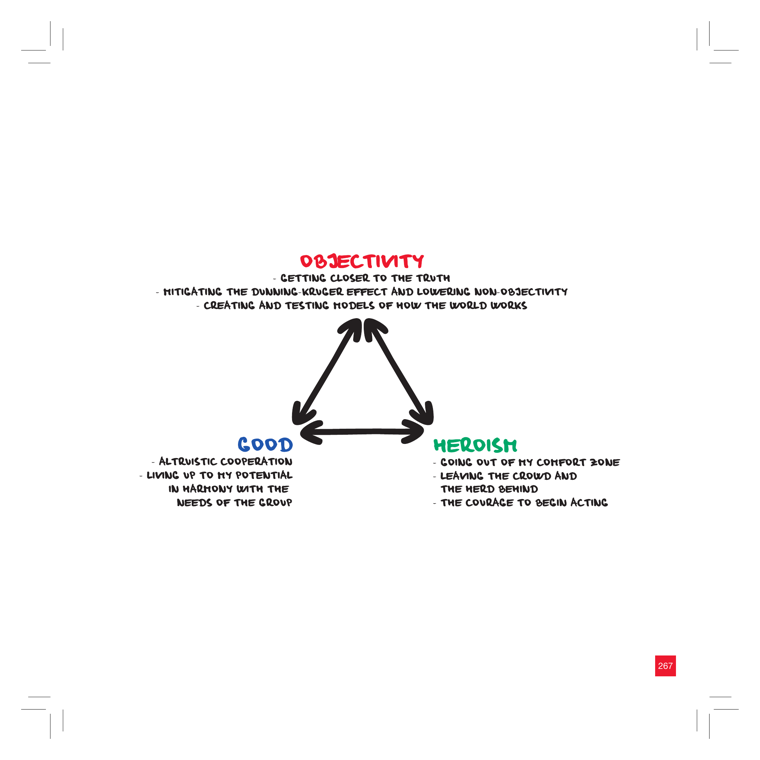
53 Objectivity–Good–Heroism Triangle
must
A hand-drawn triangle with double-headed arrows along each edge connecting three labeled vertices. Top (red) = OBJECTIVITY: getting closer to the truth, mitigating the Dunning-Kruger effect and lowering non-objectivity, creating and testing models of how the world works. Bottom-left (blue) = GOOD: altruistic cooperation, living up to my potential in harmony with the needs of the group. Bottom-right (green) = HEROISM: going out of my comfort zone, leaving the crowd and the herd behind, the courage to begin acting. The bidirectional arrows imply the three reinforce each other.
Use: Full-cover explainer: animate the triangle as the book's "meaningful life" north-star model, then drill into the Objectivity vertex (it's the cap of the whole system). Good as a recurring framing graphic to tie the three pillars together before contrasting them with the practical tools.
Critical: The Objectivity vertex explicitly invokes the Dunning-Kruger effect as a real thing to "mitigate" — but the canonical DK curve is heavily contested (much of the original effect is reproducible by regression-to-the-mean and noise; the dramatic "peak of Mount Stupid" graphic is a popularization, not the data). The book treats DK as settled fact. Also, the triangle presents Objectivity/Good/Heroism as a clean, mutually-reinforcing system, which is more an aspirational value-diagram than an empirical claim.
52 Action Plan: The Exact Steps I Will Take
nice
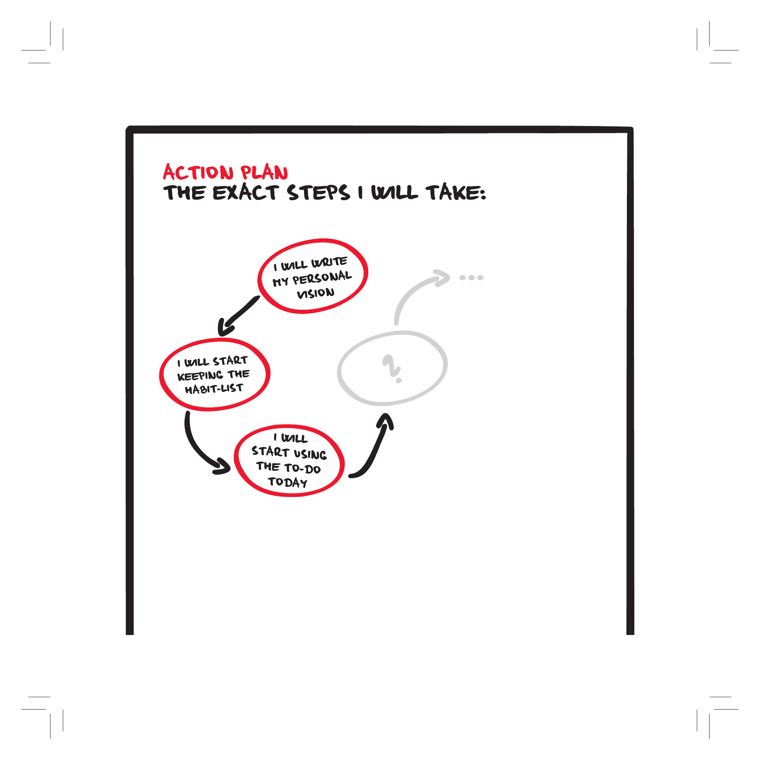
A bordered worksheet titled "ACTION PLAN — The exact steps I will take:". Three red hand-drawn ellipses are arranged in a clockwise loop, connected by black arrows: "I will write my personal vision" → "I will start keeping the habit-list" → "I will start using the To-Do Today". A fourth node in the cycle is left as a faint grey ellipse with a question mark, and a grey dashed arrow trails off into "…", signalling the reader fills in their own next step. It is a commitment/worksheet diagram, not a chart.
Use: Full-cover explainer to close the video: an animated "your turn" cycle that recaps the first three tools (Personal Vision → Habit-list → To-Do Today) as concrete first actions, with the empty grey node inviting the viewer to commit their own next step — a natural call-to-action / outro beat.
Critical: Implies that simply writing a vision and starting two paper tools reliably triggers a self-sustaining action loop. Intention-behavior-gap research shows written intentions alone produce only modest follow-through; the empty fourth node also quietly admits the system has no defined endpoint — momentum is asserted, not evidenced.
05 Crossing the Procrastination Chasm to a Fulfilled Life
nice
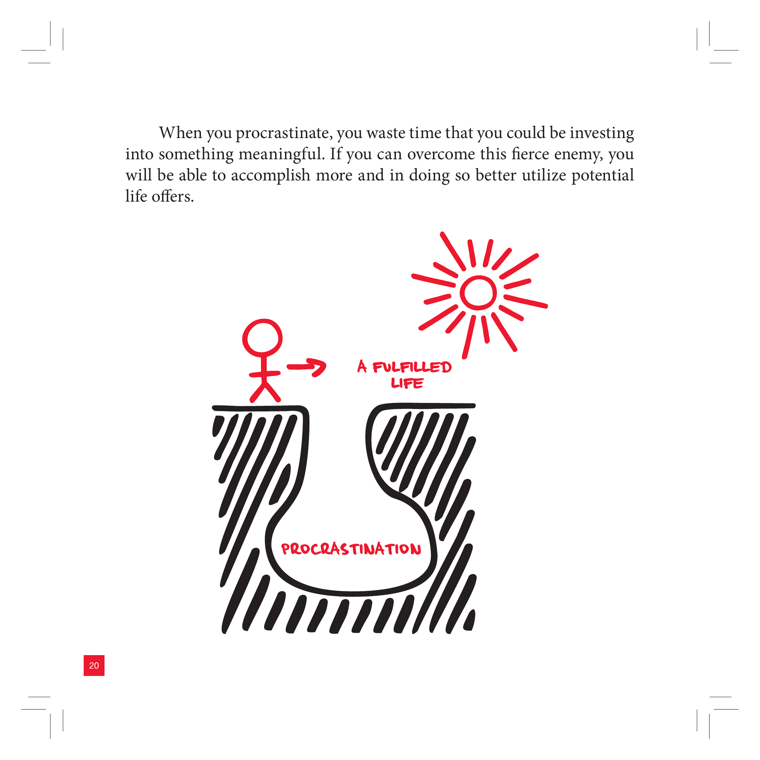
A red stick figure stands on the left edge of a deep, hatched chasm labeled "PROCRASTINATION" at its bottom, pointing with an arrow across the gap toward a hand-drawn red radiating sun labeled "A FULFILLED LIFE" on the far right. The body text above frames procrastination as a "fierce enemy" you must overcome to invest time in something meaningful. It is a single dominant metaphor illustration spanning the lower two-thirds of the page (despite the filename's "fire-and-rubbish-bin" hint, the art is a figure-at-a-chasm reaching toward a sun).
Use: Full-cover opening explainer / chapter intro b-roll: animate the figure deciding whether to cross the gap, with the sun as the payoff. Good emotional cold-open establishing the stakes of the whole book before introducing the 4-area system.
Critical: The visual frames procrastination as a single external "fierce enemy" you defeat in one heroic leap toward a sunny payoff. 2026 behavioral science treats procrastination less as an enemy to conquer and more as emotion-regulation / mood-repair (Sirois & Pychyl) — a recurring management problem, not a one-time chasm-crossing. The single-jump-to-bliss framing oversells a binary win.
08 Life: A Limited Amount of Time
nice
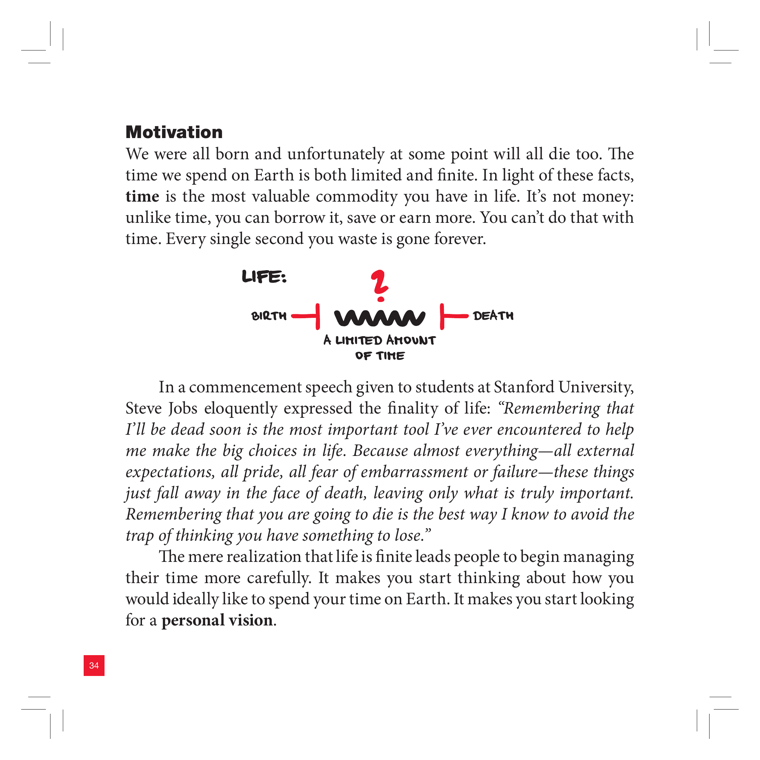
A hand-drawn doodle captioned "LIFE:" with a horizontal timeline running between two bracket end-caps labeled "BIRTH" (left) and "DEATH" (right). Between them is a jagged zig-zag line representing the lived span, with a red question mark hovering above its midpoint. Beneath, the caption reads "A LIMITED AMOUNT OF TIME." It illustrates the Motivation chapter's opening argument that time is finite and is the most valuable, non-renewable commodity.
Use: Full-cover explainer or b-roll under the cold-open about mortality/finite time; the red "?" can punch in as the unknown length of one's lifeline. Pairs naturally with the Steve Jobs Stanford "remember you'll die" quote on the same spread, and as a lead-in to the Personal Vision tool.
Critical: The visual claim (life is finite, so time is your scarcest asset) survives a science-check fine — it's a values/motivational framing, not an empirical model. Roman's critical angle is rhetorical, not factual: this is classic memento-mori / mortality-salience persuasion (à la Jobs' speech), which research shows can spur either constructive planning OR avoidance and anxiety; the book sells only the productive half. The "?" implying you should optimize every second can also tip into the hustle-culture / time-guilt the book elsewhere claims to cure.
18 Group Selection: Cooperators vs. Loners
nice
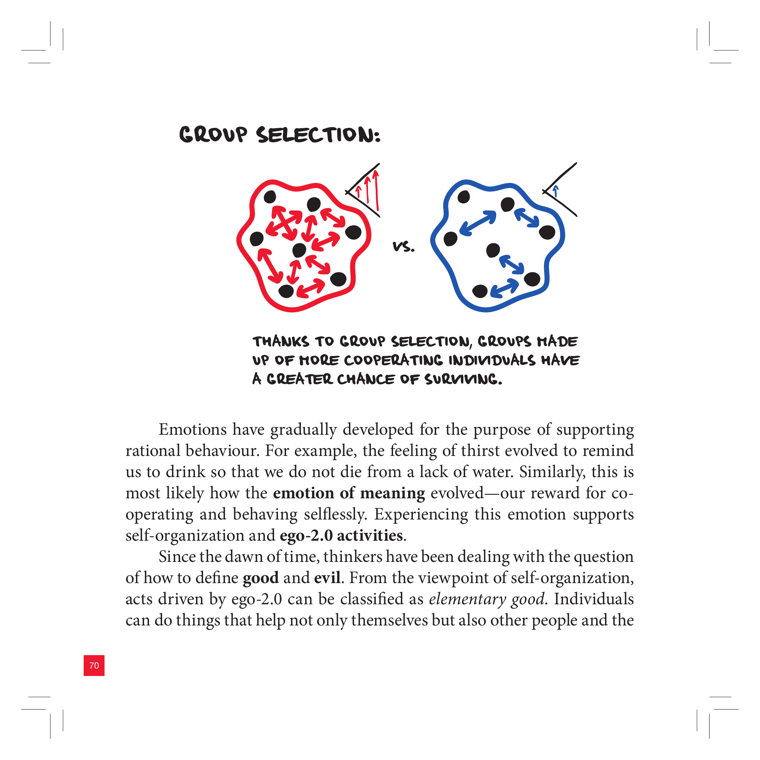
Two hand-drawn cell-like blobs side by side labeled "GROUP SELECTION:". The left blob is outlined in red, filled with black dots (individuals) connected by many red arrows pointing inward toward each other (cooperation), with a small flag/banner icon at its edge. The right blob is outlined in blue with scattered black dots and blue arrows pointing outward/apart (non-cooperation), also with a flag icon. A "vs." sits between them. Caption: "Thanks to group selection, groups made up of more cooperating individuals have a greater chance of surviving."
Use: Full-cover comparison explainer when Roman narrates the evolutionary-biology backstory for the "emotion of meaning" and ego-2.0 / cooperation argument: animate the red cooperative group thriving vs. the blue fragmented group; good A/B b-roll for the selfishness-vs-altruism beat.
Critical: Group selection is scientifically contested — most evolutionary biologists favor inclusive fitness / kin & multilevel selection over naive "groups of cooperators survive" group selection (the Wilson–Dawkins debate). The book leans on it as settled fact to justify an innate "emotion of meaning," which overstates the consensus.
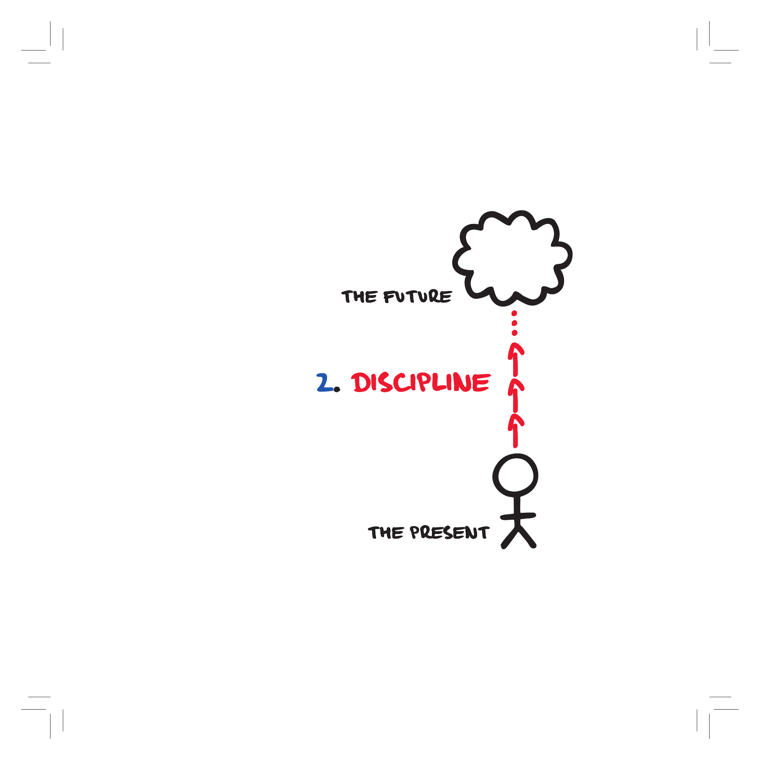
09 Discipline: The Present → The Future
nice
A stick figure labeled "THE PRESENT" stands at the bottom. Above it floats a thought bubble labeled "THE FUTURE." A vertical chain of red dashed/solid arrows points upward from the person toward the future bubble, labeled "2. DISCIPLINE" (the "2." in blue, "DISCIPLINE" in red). The arrows visualize discipline as the upward force that carries a person from their present self toward their imagined future.
Use: Full-cover explainer / chapter-opener animation establishing the second pillar of the system. Use as a clean transitional title card when Roman moves from Motivation into Discipline — the upward arrows are an obvious build/motion cue.
Critical: The metaphor frames discipline as a simple upward force bridging "present self" and "future self" — neat but it sidesteps the contested science the book leans on elsewhere (willpower-as-depletable-muscle / ego depletion, now widely failed to replicate). The visual implies discipline is a single effortful push rather than environment design, habits, and identity — a 2026 behavior-science view would push back on the "just strain upward" framing.
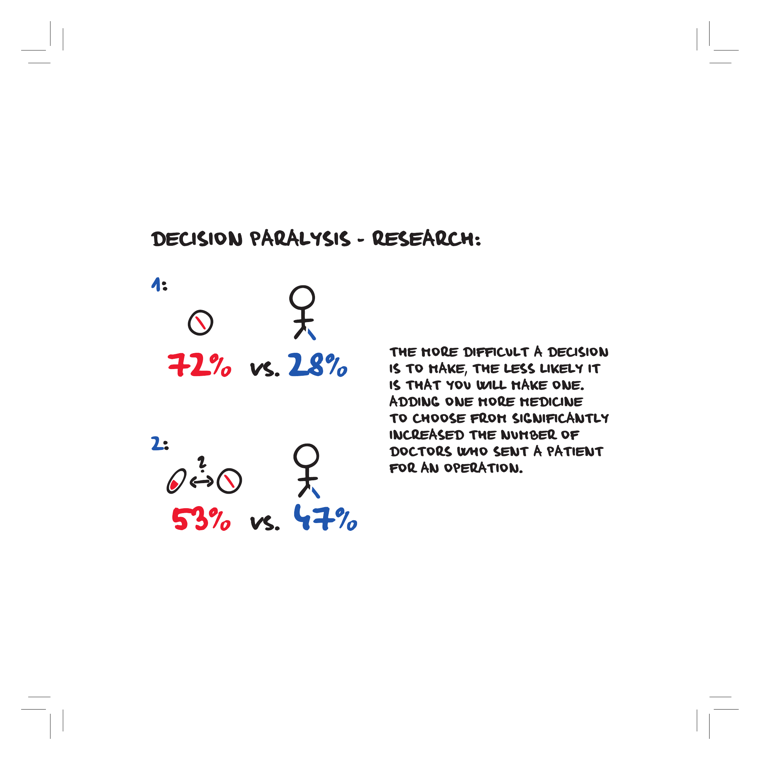
28 Decision Paralysis — The Research
nice
Two stacked hand-drawn stat panels under the title "Decision Paralysis - Research:". Panel 1: a single crossed-out pill (a "no" circle) beside a confident stick figure, with "72% vs. 28%" (72% in red, 28% in blue) — the easy single-option case. Panel 2: two pills connected by a double-headed arrow with a question mark above (a comparison/dilemma) beside a stick figure, with "53% vs. 47%" (53% red, 47% blue) — the harder two-option case. A side text block explains: the more difficult a decision is to make, the less likely you are to make one; adding one more medicine to choose from significantly increased the number of doctors who sent a patient for an operation instead.
Use: Full-cover explainer: animate the two panels as a before/after comparison to show how adding a second option flips doctor behavior. Works as a clean two-stat reveal (72/28 then 53/47) while Roman narrates the decision-paralysis study, or as b-roll cutaway when discussing choice overload.
Critical: This is the Redelmeier & Shafir (1995) hip-replacement/ibuprofen vignette study. The book presents it as a hard percentage fact, but it was a hypothetical-scenario survey of physicians, not real referral data, and the broader "choice overload" / jam-study literature failed to replicate robustly (Scheibehenne et al. 2010 meta-analysis found near-zero average effect). So the crisp 72/28 vs 53/47 numbers oversell a contested, context-dependent effect.
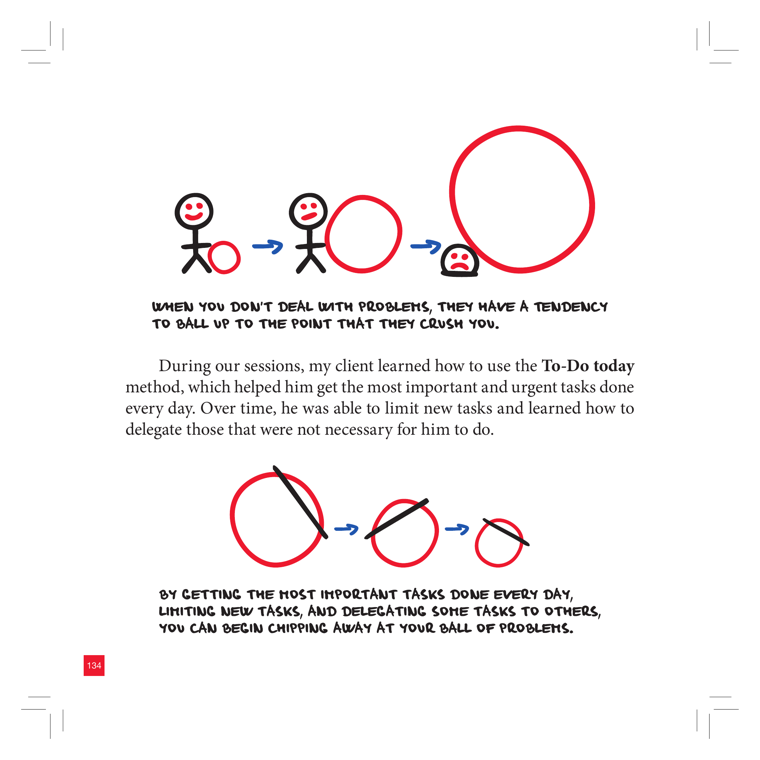
29 The Ball of Problems
nice
Two stacked stick-figure strips. Top strip: a smiling stick figure, then the same figure pushing a small red circle, then pushing a much larger red ball while frowning — labeled "When you don't deal with problems, they have a tendency to ball up to the point that they crush you." Bottom strip: a large red circle with a diagonal line through it, then a smaller one, then a tiny one — labeled "By getting the most important tasks done every day, limiting new tasks, and delegating some tasks to others, you can begin chipping away at your ball of problems." Bright red circles, blue arrows, hand-drawn caps captions.
Use: Full-cover explainer or b-roll for the To-Do Today section: animate the growing red ball crushing the figure (cost of procrastination), then the reverse shrink-down to show the method chipping problems away. A clean before/after comparison of the two strips.
Critical: The "snowball of problems" is an intuitive motivational metaphor, not a research claim, so it survives a science-check. Roman could note it oversimplifies: not every deferred task compounds (some problems decay or self-resolve), and the tidy "do top tasks + delegate = ball shrinks" arc ignores that real overload often isn't a prioritization failure but structural over-commitment — chipping away assumes the inflow is controllable, which the snowball framing itself contradicts.
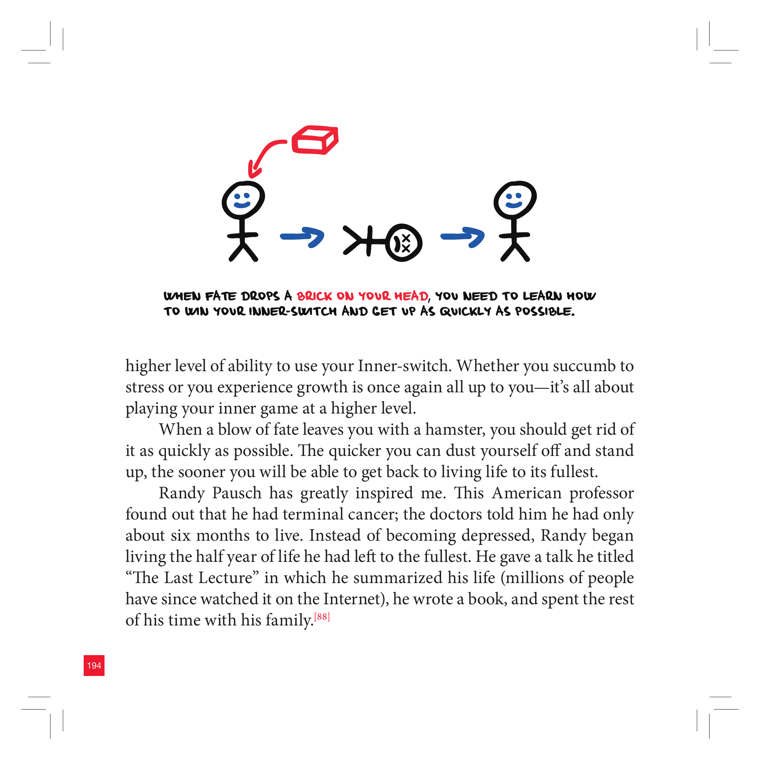
36 Brick of Fate & the Inner-Switch Reset
nice
A smiling stick figure on the left gets a red brick ("brick of fate") dropping onto its head via a curved arrow. A blue arrow leads to a small target/switch icon labeled with a flipped state, then another blue arrow leads to a recovered smiling stick figure on the right. Hand-lettered caption: "When fate drops a brick on your head, you need to learn how to turn your Inner-switch and get up as quickly as possible." Page number 194.
Use: Full-cover explainer / b-roll metaphor: animate the brick falling, the figure flipping its inner-switch, and bouncing back to smiling — illustrates resilience / cognitive reappraisal after a setback. Pairs with the Randy Pausch "Last Lecture" anecdote on the same page.
Critical: The "Inner-switch" frames recovery from adversity as a simple toggle you flip by choice — close to cognitive reappraisal, which has real support, but the book overstates it as instant and willpower-driven ("it's all up to you"). 2026 science on stress, trauma and post-traumatic growth shows recovery is uneven, not a binary switch, and "growth vs. succumb is entirely your choice" risks victim-blaming people facing severe loss. Optimistic but oversimplified.
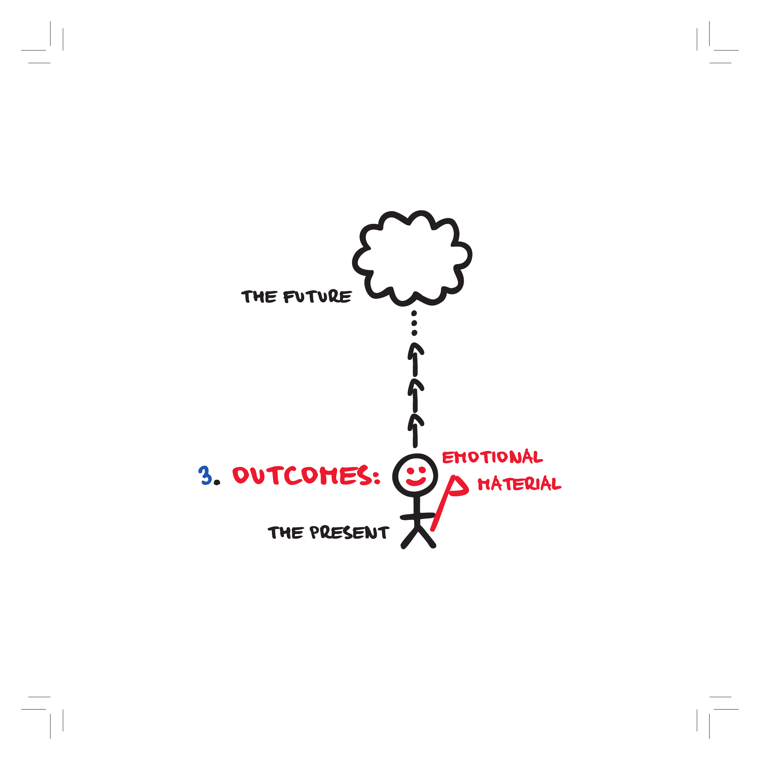
10 Outcomes: From Present to Future
nice
A smiling stick figure stands on the ground labeled "THE PRESENT," planting a red flag labeled "EMOTIONAL MATERIAL." A dotted line with three upward chevron arrows rises from the figure to a thought cloud at top labeled "THE FUTURE." The header reads "3. OUTCOMES:" (3 in blue, OUTCOMES in red). It frames Outcomes as the bridge that turns present action into a desired future.
Use: Full-cover explainer to open the third pillar (Outcomes); the rising arrows can animate present→future, and the "emotional material" flag can be a callout for why outcomes matter beyond logic.
Critical: The figure literally is the "3. Outcomes" section opener, so it states the model rather than an empirical claim — low science-check risk. The contestable subtext is the implied promise that vividly imagining a desired future ("emotional material") reliably drives present action; positive future-fantasy / mental-contrasting research (Oettingen) actually shows pure positive visualization can sap motivation unless paired with obstacle planning.
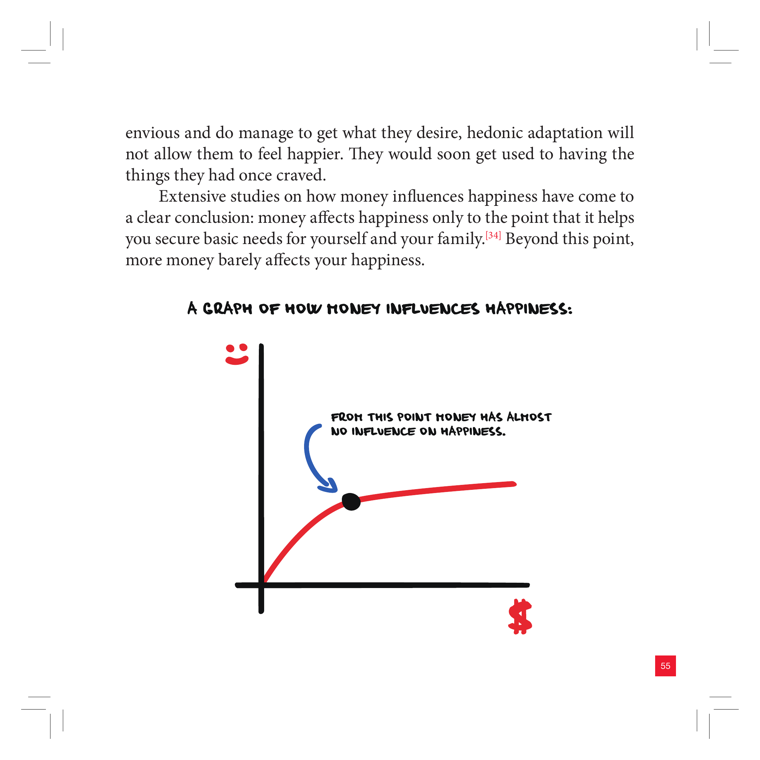
13 Money vs. Happiness Curve
nice
A hand-drawn line graph titled "A graph of how money influences happiness." The Y-axis is marked by a red smiley face (happiness), the X-axis by a red dollar sign (money). A red curve rises steeply at first, then flattens into a near-horizontal plateau. A black dot sits at the inflection point where the curve bends, with a blue arrow and caption: "From this point money has almost no influence on happiness."
Use: Full-cover explainer: animate the curve drawing in as Roman narrates the "money buys happiness only up to basic needs" claim, with the dot/threshold as the punchline. Reusable as b-roll for any segment on hedonic adaptation or diminishing returns.
Critical: The book draws a hard plateau ("almost no influence beyond this point"), echoing the 2010 Kahneman-Deaton ~$75k satiation finding. But 2021 Killingsworth and the 2023 Killingsworth-Kahneman-Mellers adversarial collaboration showed experienced well-being keeps rising with log income for most people (with only a flattening for an unhappy minority) — so the strict flattening curve is contested. Honest redraw: log-shaped diminishing returns, not a true plateau.
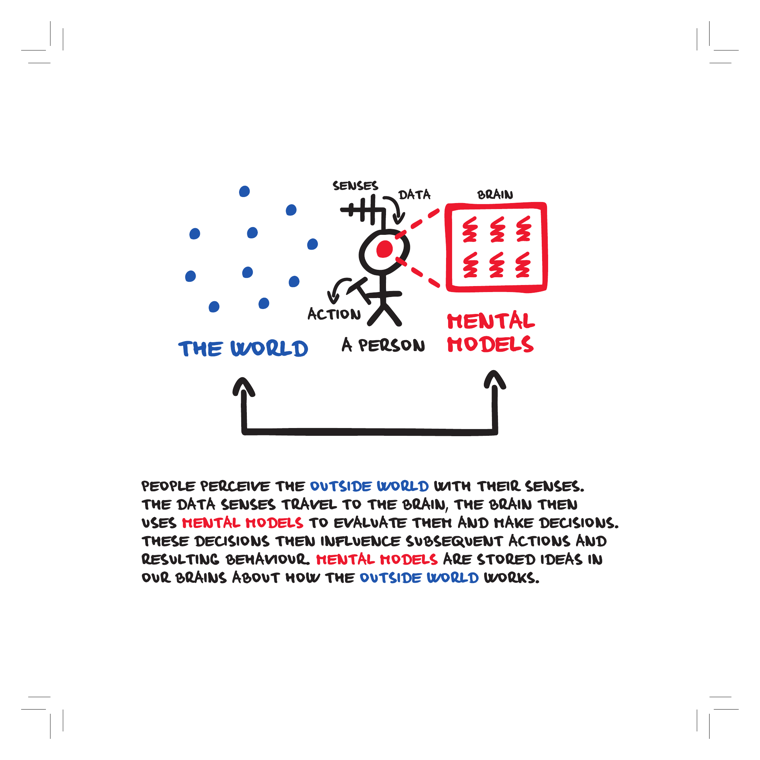
42 The World, the Senses & Mental Models
nice
A stick figure (the red dot on the forehead marks the "person/brain") stands between two domains. On the left, scattered blue dots labeled "THE WORLD" feed into the figure via "SENSES" → "DATA". Inside/beside the head a red gridded box of squiggles is labeled "BRAIN" / "MENTAL MODELS". An "ACTION" arrow loops back out from the figure toward the world, and a big bracket-arrow underneath ties world and mental models together. Caption: senses carry data to the brain, the brain uses mental models to evaluate and decide, decisions drive actions, and mental models are stored ideas about how the outside world works.
Use: Full-cover explainer: animate the perception loop (World → Senses → Data → Brain/Mental Models → Action → World) to set up why our internal map can be wrong before the Objectivity tools section. Good recurring b-roll motif for any "we don't see reality directly" point.
Critical: The "mental models" / perception-as-construction framing is broadly defensible (predictive processing, schema theory), so it survives a science-check better than the book's contested icons (willpower-muscle, ego-depletion glass, Dunning-Kruger curve). Roman's divergence: the diagram is a tidy linear pipeline (data in → model → action out), whereas modern cognitive science is more loop/prediction-driven — the brain isn't a passive receiver but actively predicts and filters input. Also worth flagging that "mental models" here is a loose self-help label, not a precise mechanism.
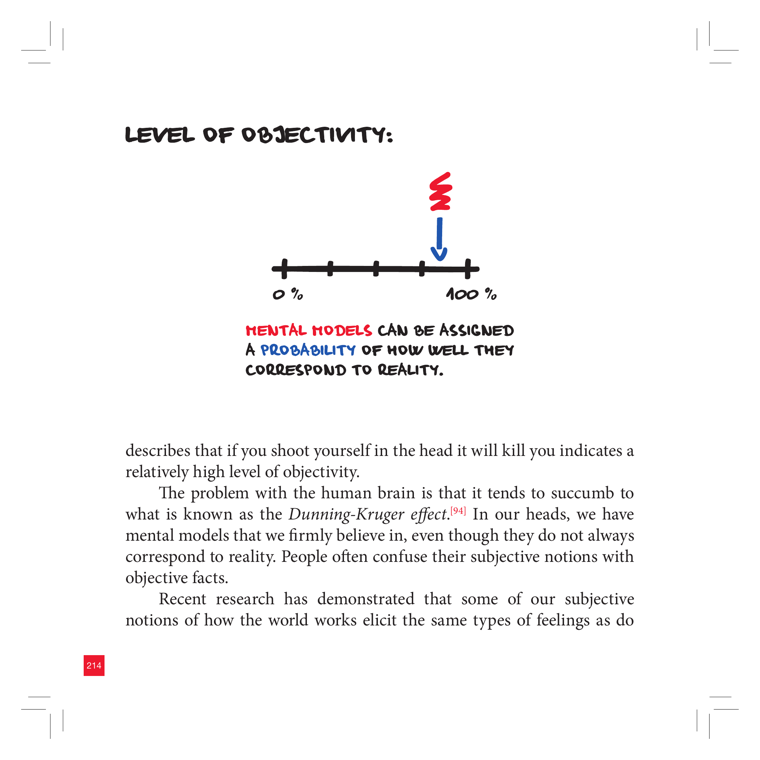
43 Level of Objectivity Scale
nice
A hand-drawn horizontal scale/gauge with five tick marks, labeled "0 %" on the left and "100 %" on the right. A red squiggly marker with a blue arrow points down onto the high end near 100%. A handwritten caption below reads "MENTAL MODELS can be assigned a PROBABILITY of how well they correspond to reality," with "MENTAL MODELS" in red and "PROBABILITY" in blue.
Use: Full-cover explainer: animate the arrow sliding along a 0–100% objectivity gauge to show how a belief ("a bullet to the head is lethal") sits near 100% while subjective mental models sit lower. Good for narrating the probability-of-correctness concept.
Critical: The book frames objectivity as a single 0–100% probability you can assign to any belief, and the surrounding text invokes the Dunning-Kruger effect — which is heavily contested in 2026 (much of the classic curve is a statistical artifact of autocorrelation/regression to the mean). Roman can note that "rate your belief on an objectivity scale" sounds rigorous but is itself a subjective self-estimate, the very bias it claims to fix.
44 Non-Objectivity: Subjective vs Objective Probability Scale
nice
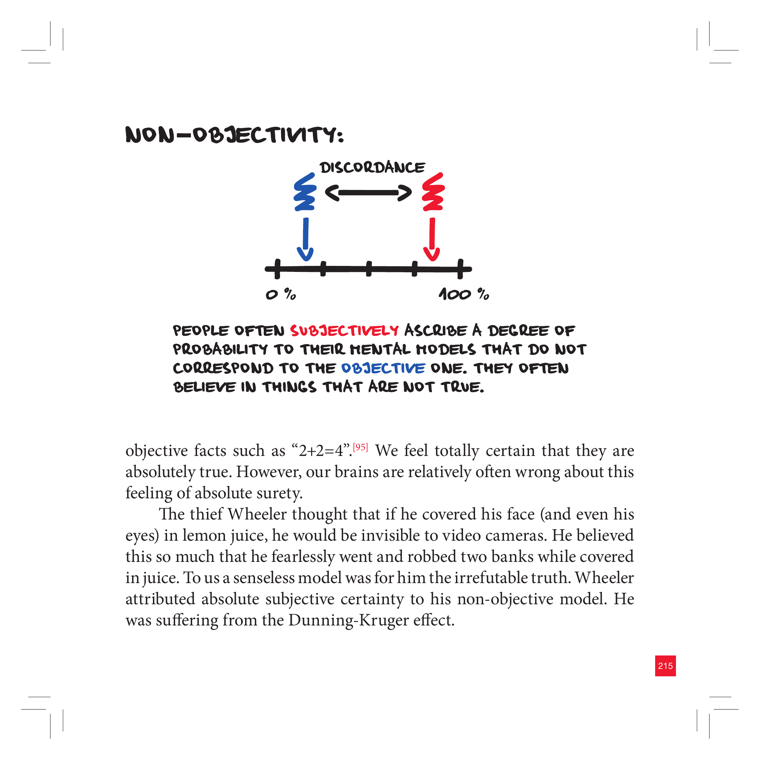
A 0%–100% horizontal probability scale (number line) with two zig-zag spring/lightning-bolt markers above it: a blue one on the left and a red one on the right, joined by a double-headed arrow labeled "DISCORDANCE". Each marker drops a colored arrow down to a point on the scale, showing a gap between where someone subjectively places their certainty (red, near 100%) and where the objective probability actually sits (blue, lower). Caption below: "People often SUBJECTIVELY ascribe a degree of probability to their mental models that do not correspond to the OBJECTIVE one. They often believe in things that are not true." The page text ties it to the thief Wheeler (lemon-juice invisibility) and the Dunning-Kruger effect.
Use: Full-cover explainer: animate the two markers on a 0–100% confidence scale and grow the "discordance" gap between felt certainty and real probability — a clean visual for the calibration / overconfidence point before Roman pivots to the Dunning-Kruger critique.
Critical: The diagram itself (subjective confidence can diverge from objective probability = miscalibration/overconfidence) is well-supported. But the page anchors it to the Dunning-Kruger effect, which is heavily contested in 2026: much of the classic DK "curve" is reproduced by regression to the mean and the better-than-average artifact (Nuhfer, Gignac & Zajenkowski), so Roman should keep the calibration point but flag the DK framing as the weak link.
46 The Dunning-Kruger Effect
nice
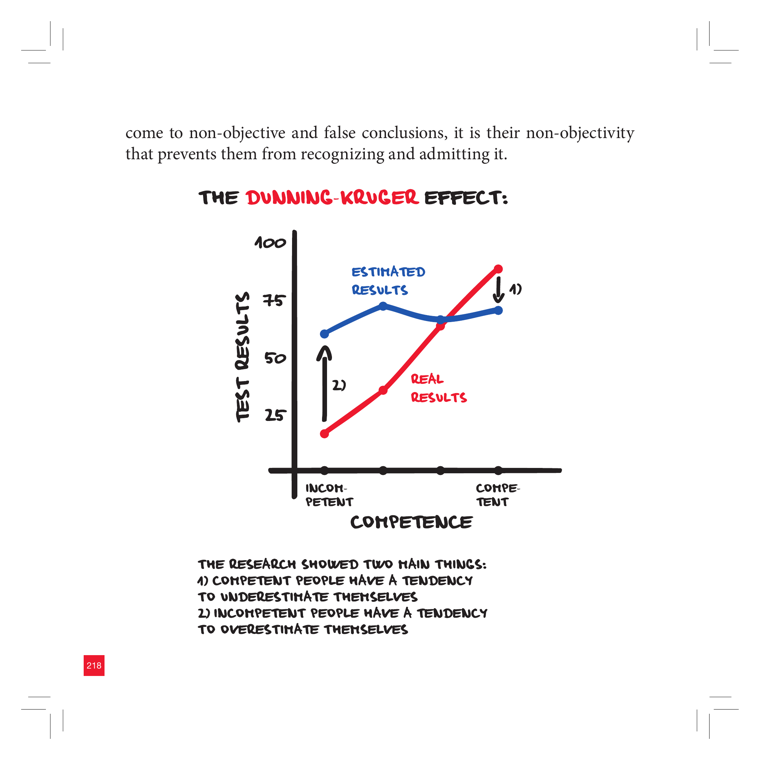
A hand-drawn line chart titled "THE DUNNING-KRUGER EFFECT". Y-axis = "TEST RESULTS" (25, 50, 75, 100); X-axis = "COMPETENCE" running from "INCOMPETENT" to "COMPETENT". A blue line labeled "ESTIMATED RESULTS" stays high and roughly flat across the range; a red line labeled "REAL RESULTS" rises steeply from low to high. Arrow 2) points up at the gap where incompetent people overestimate; arrow 4) points down where competent people underestimate. Caption: competent people tend to underestimate themselves, incompetent people tend to overestimate themselves.
Use: Full-cover explainer: animate the blue "estimated" vs red "real" lines diverging, then highlight the two gaps (over- and under-estimation). Strong b-roll for the segment on objectivity / why people can't see their own non-objectivity.
Critical: The classic "confidence-high-at-the-incompetent-end" curve is heavily contested. Critics (Nuhfer 2016/2017, Gignac & Zajenkowski 2020) argue the Dunning-Kruger pattern is largely a statistical artifact — regression to the mean plus the better-than-average effect — and that random/noise data reproduce the same shape. The book presents it as a settled, clean behavioral law, which a 2026 science-check does not support.
06 A System of Personal Development (section opener)
skip
A text-only page with a red bold heading "A System of Personal Development" over four justified body paragraphs. Each paragraph introduces one of the book's four sections, with the key word bolded: motivation, discipline, outcomes, objectivity. No illustration, chart, icon, or worksheet is drawn — purely prose laying out the structure of the book.
Use: Source text only — Roman can read off the four-area sequence (Motivation → Discipline → Outcomes → Objectivity) as a voiceover spine, but the page itself is not redrawable b-roll; the system would be visualized in a separate built diagram, not this page.
Critical: The page asserts a clean linear "system" of four independent areas hung with 8 paper tools — a tidy framework claim. A 2026 review can note this is the author's organizing scheme, not an empirically validated model of personal development; the neat 4-stage funnel implies a causal pipeline that the underlying psychology research doesn't support.
33 Petr Ludwig and Philip Zimbardo (Author Photo)
skip
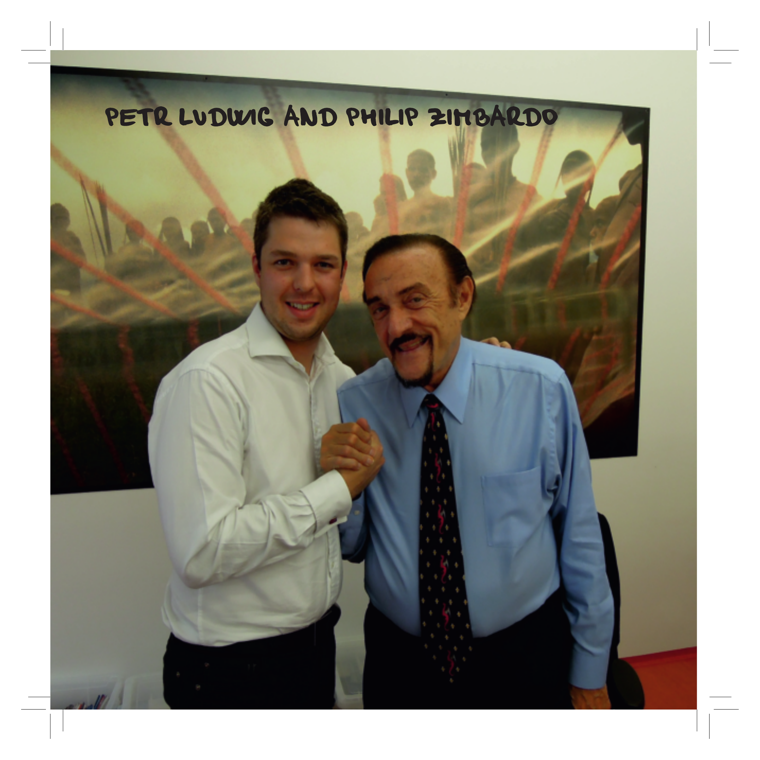
A framed photograph of two men shaking hands and posing together in front of a poster, with the hand-lettered caption "PETR LUDWIG AND PHILIP ZIMBARDO" across the top. It is a personal credibility/endorsement snapshot of the book's author with psychologist Philip Zimbardo, not an infographic. No chart, labels, or data — just the photo and a name caption.
Use: Could appear briefly as b-roll if Roman discusses the book's authority/endorsements (e.g. Zimbardo association), but not something to redraw as a graphic.
Critical: An endorsement photo is a credibility-by-association cue, not evidence; Roman might note that posing with a famous psychologist doesn't validate the book's contested claims (willpower-as-muscle, ego-depletion). Also Zimbardo's own Stanford Prison Experiment has been heavily critiqued since.
49 The Most Important Idea in This Book (Blank Box)
skip
A large empty black-outlined rectangle taking the top half of the page, with a hand-drawn red-and-black title inside its top edge: "THE MOST IMPORTANT IDEA IN THIS BOOK:". The box body is intentionally left blank for the reader to write their own one-line takeaway. Below the box is closing body copy asking the reader to imagine forgetting everything but one thing and to email it to [email protected], plus a William James quote.
Use: Optional outro beat only — Roman could mirror the "if you remember one thing" framing as a closing call-to-action card, but there is nothing to redraw.
51 Tools & Methods Summary List
skip
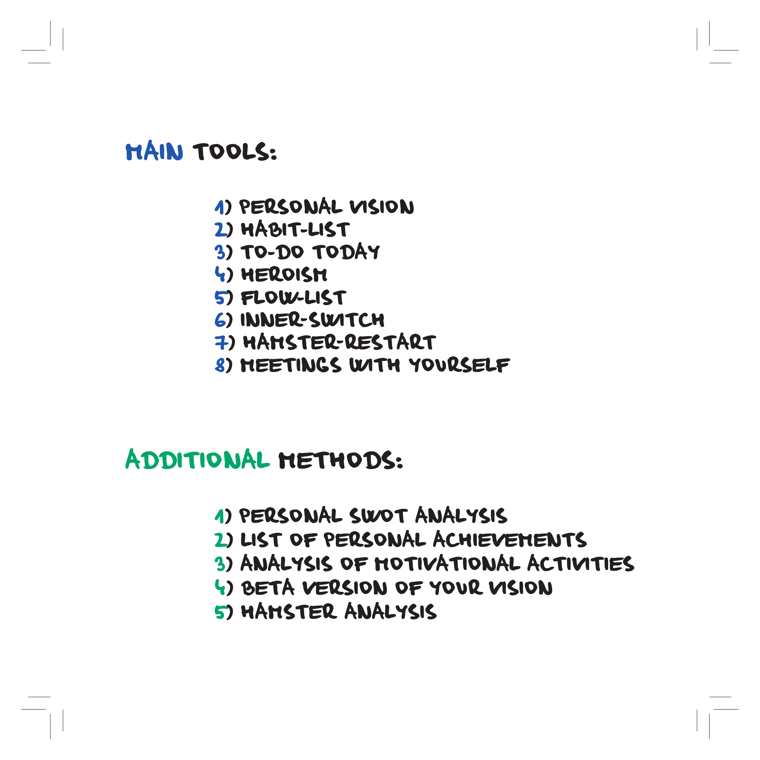
A plain two-section text recap on a white page in the book's hand-lettered marker font. Heading "MAIN TOOLS:" (blue) over a numbered list of 8: 1) Personal Vision, 2) Habit-list, 3) To-Do Today, 4) Heroism, 5) Flow-list, 6) Inner-switch, 7) Hamster-restart, 8) Meetings with Yourself. Below, heading "ADDITIONAL METHODS:" (green) over 5: 1) Personal SWOT Analysis, 2) List of Personal Achievements, 3) Analysis of Motivational Activities, 4) Beta Version of Your Vision, 5) Hamster Analysis. No icons, no chart, no layout structure beyond the two indented lists.
Use: Use as a lower-third or end-of-section text recap if you want to list all 8 tools by name on screen, but it is not worth redrawing as a graphic — better served by your own animated checklist of the 8 tools mapped to the 4 areas.
Critical: The list bundles 13 separate "tools/methods" as if each is independently evidence-based; a 2026 review would note most are repackaged generic productivity habits (SWOT, achievement journaling, habit tracking) with little tool-specific validation, and that more tools does not mean a more effective system.
54 Bertrand Russell Pull-Quote (Red Divider)
skip
A full-bleed solid red page with a single centered white serif pull-quote: "The good life is one inspired by love and guided by knowledge." Attributed below, right-aligned, to "– Bertrand Russell". No illustration, chart, or worksheet — purely typographic on a red field, with printer crop/registration marks at the corners.
Use: At most a brief title-card / transition beat if Roman wants to drop the quote on screen between sections; otherwise nothing to redraw. Not usable as an explainer graphic.
01 Carrot & Stick — The Frustrated Figure (Part Opener)
skip
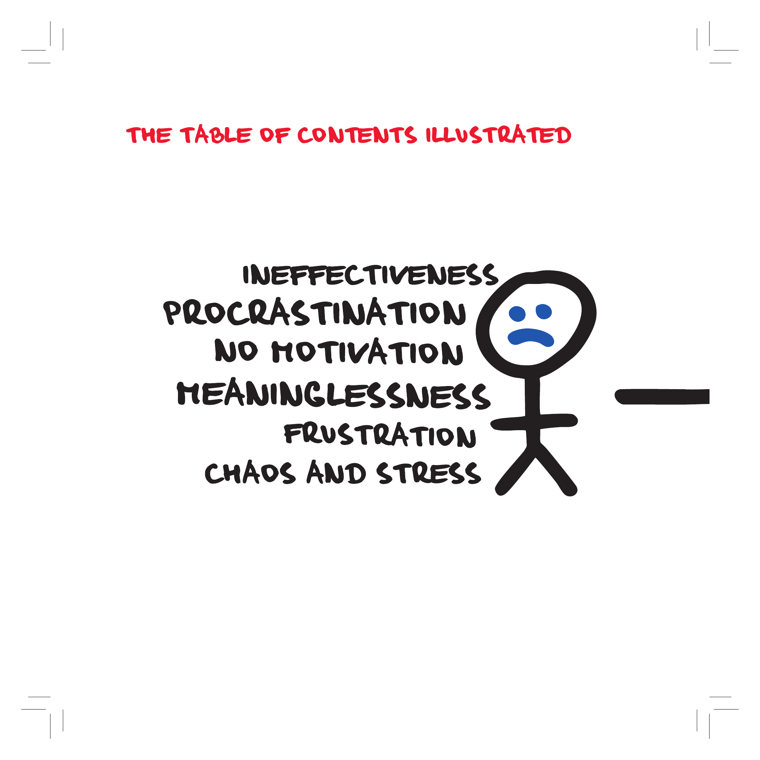
A hand-drawn black stick figure with a frowning blue face stands beside a large minus sign, signaling a negative state. A stacked column of hand-lettered words to its left reads: INEFFECTIVENESS, PROCRASTINATION, NO MOTIVATION, MEANINGLESSNESS, FRUSTRATION, CHAOS AND STRESS. Header in red caps: "THE TABLE OF CONTENTS ILLUSTRATED." Decorative crop marks sit in the corners. No data, axes, or worksheet structure — purely a mood/metaphor opener for the book's "before" (unmotivated) state.
Use: Light b-roll / cold-open mood graphic when Roman lists the symptoms of procrastination (the "before" state). Could animate the word-stack as a falling list behind the sad figure, but it's decorative, not an explainer.
Critical: The "carrot and stick" / sad-minus framing implies these six states are one undifferentiated negative cluster cured by the book's system. A 2026 review would note procrastination is multi-causal (emotion regulation, executive function, ADHD, depression) — not simply "no motivation" fixable by paper tools — so the lumped-symptom visual oversells a single root cause.
12 Section Divider: Motivation
skip
A solid red full-bleed page with no illustration or chart. White uppercase label "MOTIVATION" sits upper-right, with a black subtitle below it: "HOW TO GET MOTIVATED AND STAY THAT WAY". Printer crop marks frame the corners. It is a part-opener divider for the book's first system area.
Use: Not a redraw candidate. At most a quick full-screen chapter-title card / transition beat when Roman moves into the Motivation section of the video.
21 Motivation Tool Callout: Personal Vision
skip
A hand-drawn marker-style callout embedded in body text. A small icon of two stacked boxes (a folded-paper / document glyph representing the Personal Vision worksheet) sits beside a red handwritten "1..10" rating scale. To the right, brush-lettered text reads "MOTIVATION TOOL: PERSONAL VISION" (MOTIVATION in black, TOOL in blue). Surrounding paragraphs instruct the reader to rate their current motivation and use of the Personal Vision tool on a 1-10 scale.
Use: Minor lower-third / tag overlay when Roman names the "Personal Vision" tool in the Motivation area — a label chip, not a full-cover explainer. The 1-10 self-rating idea can be voiced over but doesn't need its own redraw.
Critical: The 1-10 self-rating of "motivation" and "tool usage" is pure subjective self-report with no validation — a vibe check, not measurement. Roman could note that self-rated motivation is notoriously unreliable and doesn't predict behavior change, so the scale is motivational theater rather than a real progress metric.
22 Part Opener: Discipline
skip
A full-bleed solid-red page with no illustration. Right-aligned white bold title "DISCIPLINE" sits at upper-center, and below it a black bold subtitle reads "HOW TO GIVE YOURSELF ORDERS AND FOLLOW THEM". Printer crop marks sit in the corners. No chart, metaphor, or data — purely a section-divider title page.
Use: Use only as a chapter-transition card or lower-third title when Roman moves into the Discipline section of the review; not redrawn as an explainer. Could supply the section name/color cue for an animated part-divider.
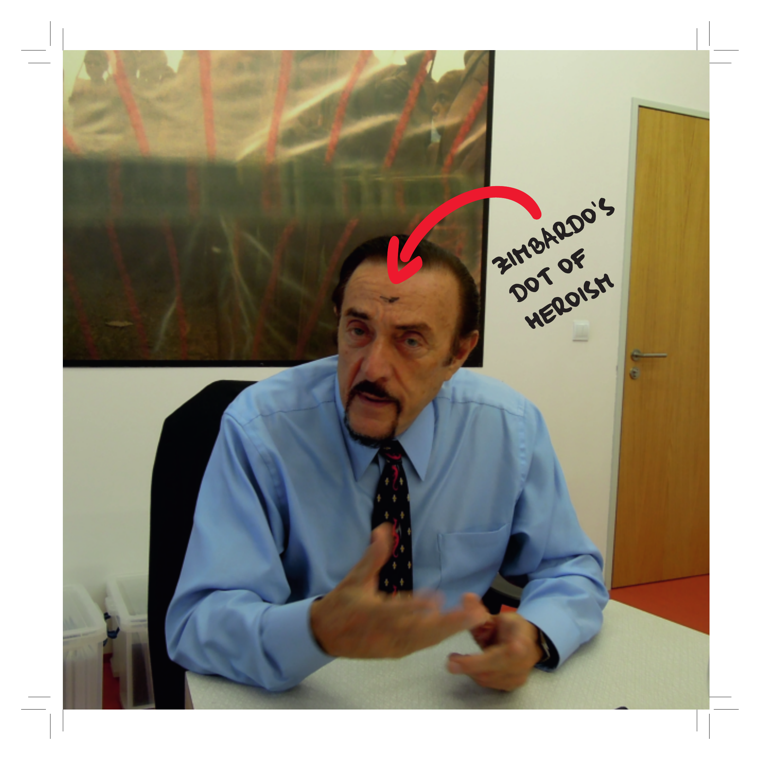
34 Zimbardo's Dot of Heroism (Photo)
skip
A full-bleed lifestyle photograph of an older man (Philip Zimbardo) in a blue shirt and tie, seated and gesturing during an interview in an office, with a framed image and door behind him. A hand-drawn red curved arrow points to his forehead with handwritten caption "ZIMBARDO'S DOT OF HEROISM". No chart, axes, or data.
Use: B-roll / portrait insert when narrating the Zimbardo "everyday heroism" anecdote behind the Heroism tool; not something to redraw as a graphic.
Critical: The "dot of heroism" framing leans on Zimbardo's heroic-imagination idea, which is more motivational rhetoric than validated intervention; but this is a photo, not a claim-bearing diagram.
35 Outcomes — Part Opener
skip
A solid red full-bleed page with no imagery. Top-right white label reads "OUTCOMES"; below it, large black headline reads "HOW TO FIND HAPPINESS AND ALSO KEEP IT". Printer crop/registration marks at the corners. Pure typographic section divider, no chart, icon, or worksheet.
Use: Could serve only as a quick full-screen chapter/section transition card ("Part 3: Outcomes") if Roman wants to mark the book's structure on screen; otherwise skip.
40 Objectivity — Part Opener
skip
A full-bleed solid red page with no illustration. Right-aligned text reads "OBJECTIVITY" in white, with the subtitle "LEARNING HOW TO SEE OUR FLAWS" in black below it. Printer crop/registration marks sit in the corners. It is a pure section-divider title page.
Use: Could be used only as a chapter-transition title card to signal the start of the "Objectivity" section of the video; carries no data or metaphor to explain.
41 The Herd / Social Proof (text page — no diagram)
skip
The rendered page (book p.212/PDF 213) is pure running text with no illustration. It opens the objectivity chapter with the McArthur Wheeler "lemon-juice bank robber" anecdote, then explains senses → data stream → brain decisions, and introduces "mental models" assessed for "objectivity." No drawn figure, chart, labels, or worksheet appears on this page despite the "herd/social proof" hint.
Use: No redraw. The Wheeler lemon-juice story is strong narrative b-roll / cold-open for an objectivity or Dunning-Kruger segment, but as text, not as a graphic.
Critical: The Wheeler anecdote is the founding story of the Dunning-Kruger effect, which is heavily contested in 2026 (much of the "curve" is explained by statistical artifacts — regression to the mean / autocorrelation — per Nuhfer and Gignac & Zajenkowski). If a herd/social-proof graphic does exist on the companion page, its claim would also warrant scrutiny.
45 Dunning-Kruger Study (text page)
skip
A full page of body text describing the Dunning-Kruger experiment: incompetent people overestimate their abilities and "don't know that they don't know," competent people slightly underestimate, with a Forrest Gump quote ("Stupid is, as stupid does") and the coined shorthand "DK." No chart, curve, or illustration is present — only paragraphs of prose and the red page-number badge (217).
Use: Not usable as a redrawn graphic — it is a text recap page. The underlying DK concept could be voiced over with a separately built DK curve, but this page itself offers nothing to put on screen.
Critical: The classic Dunning-Kruger curve is heavily contested in 2026 — critics (e.g. autocorrelation/regression-to-the-mean reanalyses by Nuhfer and Gignac & Zajenkowski) argue the iconic effect is largely a statistical artifact, not a real metacognitive pattern. Any DK visual the book leans on should be flagged as scientifically shaky.
02 Procrastination Defined (Section Opener)
skip
A chapter-opener page. Two stylized hand-lettered headings: "PRO-CRASTINUS = (lat.) belonging to tomorrow" in blue, and "PROCRASTINATION = putting things off intentionally or habitually" in red, each with a small caps subtitle line. Below is three paragraphs of body prose defining procrastination and distinguishing it from laziness (bold words "laziness"). No chart, diagram, icon, or metaphor illustration — purely typographic.
Use: Source the etymology/definition as on-screen lower-third text only ("procrastinus = belonging to tomorrow"); not redrawn as a graphic. Could underlay a talking-head intro defining the term.
Critical: The book's clean "procrastination is not laziness — it's wanting to act but being unable to start" framing is a tidy rhetorical split; modern research sees procrastination as emotion/mood regulation (avoiding negative affect), so the laziness-vs-willpower binary oversimplifies.
47 Conclusion: The Key to Longevity (divider)
skip
A solid red full-bleed page with two lines of text: "CONCLUSION" in white and "THE KEY TO LONGEVITY" in black, right-aligned. No illustration, chart, or worksheet — purely a section-opener divider with crop marks.
Use: None as a redrawn graphic. At most a one-frame title card if Roman wants to mark the transition into the book's closing chapter.